


1972


Afte playing their first eleven season as the Senators in Washington D.C., the franchise relocated to Arlington, Texas and became the Rangers for the 1972 season. The Rangers were managed by Hall of Famer Ted Williams and finished in last place in the American League West with a 54-100 record. The Rangers played their first game at Arlington Stadium on April 21st and defeated the California Angels 7-6. The Rangers hit rock bottom in September when they posted a 3-23 record.
Much of the blame for the Rangers lack of success fell on the offense which had a league low .217 batting average. Shortstop Toby Harrah (.259/1/31) led the team in average and garnered the Rangers only spot at the All-Star game in Atlanta.

Right fielder Ted Ford (.235/14/50) blasted fourteen home runs to lead the ballclub. First baseman Frank Howard (.244/9/31) provided some additional pop in his age thirty-five season. Third baseman Dave Nelson (.226/2/28) swiped fifty-one bags but was caught stealing a league high seventeen times.
The Rangers pitchers performed admirably despite their lack of run support. The staff managed a combined 3.54 ERA over the course of the year. The starting rotation of Pete Broberg (5/4.29/133), Dick Bosman (8/3.63/105), Rich Hand (10/3.32/109), Bill Gogolewski (4/4.24/95) and Don Stanhouse (2/3.78/78) won only twenty-nine of eight-five decisions. Broberg topped the league in hits batters with thirteen. The bullpen featured a three-pronged attack of Horacio Pina (2/3.20/60), Mike Paul (8/2.17/108) and Paul Lindblad (5/2.62/51). Paul led the league in home runs allowed per nine innings (0.2) and Lindblad topped the league in games played with sixty-six.
1973


The Rangers remained in last place in the American League West in 1973 winning three more games in the now 162-game season. Texas finished thirty-seven games behind the eventual world champion Oakland A’s. The Rangers would not post a winning record in any month or against any other American League club and had a miserable August finishing 6-24. Texas would cycle through three managers with Whitey Herzog starting the season, Del Wilber replacing Herzog on an interim basis and finally Billy Martin taking over as skipper.
Alex Johnson (.287/8/68) led the team in batting average at the newly created designated hitter position. Right fielder Jeff Burroughs (.279/30/85), acquired from the California Angels, topped the club in home runs and RBIs with thirty and 85 respectively. Left fielder Rico Carty (.232/3/33), acquired in an offseason trade with the Braves, provided leadership to a young Ranger’s squad. Second baseman Dave Nelson (.286/7/48) and first baseman Jim Spencer (.267/4/43) each earned All-Star invites to the game in Kansas City.


The 1973 Rangers pitching staff struggled to a team ERA of 4.64 for the year. Veterans Jim Bibby (9/3.24/155), Jim Merritt (5/4.05/65) and Sonny Siebert (7/3.99/76) anchored the Texas starting rotation. Youngsters Pete Broberg (5/5.61/57) and Steve Dunning (2/5.34/38) combined to make 32 starts for the Rangers. The Rangers made high school pitching phenom David Clyde (4/5.01/74) the number one pick in the 1973 draft, and he skipped the minor leagues pitching for Texas twenty-two days later. Clyde won his major league debut 4-3 over the Twins in front of a sellout Arlington Stadium crowd on June 27th.
1974


The 1974 edition of the Texas Rangers showed marked improvement in Billy Martin’s first full season as Manager. The Rangers won eighty-four games and ended the year in second place behind the Oakland A’s. Texas got out of the gate strong bu winning 13 of 21 games in April. Texas fell off in May posting an 11-16 record but played eight games over .500 for the rest of the year.
The Texas offense surged to a team batting average of .272 for the season led by right fielder Jeff Burroughs (.301/25/118). Burroughs led the league in RBIs (118) and was voted the Most Valuable Player in the American League.

A. L. Most Valuable Player
Jeff Burroughs (TEX)

A. L. RBI Leader (118)
Jeff Burroughs (TEX)
Rookie first baseman Mike “The Human Rain Delay” Hargrove hit .323 with four home runs and sixty-six RBIs on his way to winning Rookie of the Year in the Amercian League.

A.L. Rookie of the Year
Mike Hargrove (TEX)
Catcher Jim Sundberg hit .247 with three home runs and 36 RBIs earning him fourth place in the Rookie of the Year voting. Sundberg along with Burroughs would be named to the All-Star game in Pittsburgh.


Third baseman Lenny Randle (.302/1/49) had a solid season and garnered some MVP votes. Second baseman Dave Nelson’s (.236/3/42) numbers fell off in ’74, but he made history on August 30th when he stole second, third and home in the first inning against the Cleveland Indians.

Dave Nelson
Steals 2nd, 3rd & Home
1st Inning
vs. Cleveland Indians
The Rangers acquired Ferguson Jenkins from the Chicago Cubs after the 1973 season for Bill Madlock and Vic Harris. Jenkins (25/2.82/225) would pay immediate dividends for the Rangers leading the A.L. in wins (25), complete games (29), walks per 9 innings (1.2) and strikeout-to-walk ratio (5.00). Jenkins came in second in Cy Young voting and fifth in the A.L. MVP conversation.

A. L. Co-Wins Leader (25)
Ferguson Jenkins (TEX)
Accompanying Jenkins in the starting rotation were Jim Bibby (19/4.74/149), Jackie Brown (13/3.57/134), Steve Hargan (12/3.95/98) and David Clyde (3/4.38/52). Steve Foucault (8/2.24/106) saved twelve games for the Rangers out of the bullpen.
1975


The Texas Rangers regressed to a 79-83 record in 1975 and finished in third place, nineteen games behind the Oakland Athletics. The Rangers played .500 ball through the end of May but ended July nine games under. Billy Martin was fired as Manager on July 20th due to off-field issues and was replaced by Frank Lucchesi. The Rangers played their best baseball in August posting a 19-12 record.
The Rangers offense fell off in 1975 with the team batting average dropping sixteen points. Right fielder Jeff Burroughs (.226/29/94) batting average plummeted, and he led the league in strikeouts with 155. First baseman Jim Spencer (.266/11/47) provided some power with eleven long balls on the year. Third baseman Toby Harrah (.293/20/93) and left fielder Mike Hargrove (.303/11/62) turned in all-star worthy performances with Harrah swiping a team high twenty-three bags.


On June 13th, the Rangers traded Jim Bibby, Jackie Brown and Rick Waits to the Cleveland Indians for pitcher Gaylord Perry. Perry (12/3.03/148) and Fergie Jenkins (17/3.93/157) would head the Cleveland rotation. Jenkins performance fell off from the prior season as he allowed a league high thirty-seven home runs but topped the league in walks allowed per nine innings (1.9). Perry and Jenkins were surrounded by an aging starting rotation of Steve Hargan (9/3.80/93), Bill Hands (6/4.02/67) and Clyde Wright (4/4.44/32). Steve Foucault remained the team’s closer and posted an 8-4 mark with 56 punchouts.
1976


The Texas Rangers dropped to fifth place in the American League West in Frank Lucchesi’s first full season as Manager. The Rangers won three less games than in 1975 and finished the year fourteen back of the Kansas City Royals. The Rangers found themselves ten games above .500 at the end of June but a disastrous July (8-22) put an end to the Texas playoff hopes.
The Texas offense received solid contributions from a number of players. Designated hitter Tom Grieve (.255/20/81) topped the team in home runs with twenty. Right fielder Jeff Burroughs (.237/18/86) paced the Rangers in RBIs with eighty-six. First baseman Mike Hargrove (.287/7/58) led the league in walks with ninety-seven. Catcher Jim Sundberg (.228/3/34) earned a Gold Glove for his prowess behind the dish. Shortstop Toby Harrah (.260/15/67) earned the team’s only All-Star invitation to the game in Philadelphia.
The Ranger twirlers had an exceptional season posting a combined 3.47 ERA. Two key acquisitions boosted the staff’s success. Nelson Briles (11/3.26/98) was acquired in an offseason trade with Kansas City for Dave Nelson. On June 1st, the Rangers sent Bill Singer, Roy Smalley, Mike Cubbage and Jim Gideon to the Twins for Bert Blyleven (9/2.76/144) and Danny Thompson. Briles and Blyleven would combine with staff ace Gaylord Perry (15/3.24/143) to anchor the Rangers starting rotation which also included Jim Umbarger (10/3.15/105) and Tommy Boggs (1/3.49/36).
1977


Th Texas Rangers rebounded in 1977 posting a 94-68 record good enough for second place in the American League West. The Rangers finished eight games behind the Kansas City Royals. Frank Lucchesi was replaced as Manager on June 21st after a 31-31 start. Eddie Stanky took over the helm for one game before retiring from the managerial ranks. Connie Ryan stepped in as interim manager and the club went 2-4. The real turnaround started when Billy Hunter became skipper, and the Rangers posted a 60-33 record to close the season.
During the offseason, the Rangers traded former MVP Jeff Burroughs to the Atlanta Braves for Carl Morton, Adrian Devine, Ken Henderson, Dave May and Roger Moret. Despite the loss of a premier offensive threat such as Burroughs, the Rangers hit a collective .270 for the season. Catcher Jim Sundberg hit .291 while collecting another Gold Glove and earning MVP votes at the end of the year. Second baseman Bump Wills (.287/9/62) made an immediate impact and finished third in the rookie of the year voting. Juan Beniquez hit .269 with ten home runs and sixty-eight RBIs while earning a gold glove in center field. Shortstop Toby Harrah hit .263 with 27 long balls, 87 RBIs and led the league in walks with 109. Free agent signee Bert Campaneris hit .254 and swiped 27 bags. Campaneris led th league in caught stealing with 20 offenses but was named the lone Ranger representative for the All-Star game at Yankee Stadium.

The Rangers had a formidable pitching staff in 1977 that combined for a 3.56 ERA. The starting five: Gaylord Perry (15/3.37/177), Doyle Alexander (17/3.65/82), Bert Blyleven (14/2.72/182), Dock Ellis (10/2.90/90) and Nelson Briles (6/4.24/57) won 62 games combined. Alexander was signed as a free agent in the offseason and Ellis was purchased from the A’s in June. Blyleven led the league in WHIP allowing just 1.065 walks and hits per inning pitched. Adrian Devine who was acquired in the Burroughs trade won eleven games and saved fifteen more in relief.
After the 1977 season, the Rangers added on a second deck to Arlington Stadium increasing capacity and attendance.

Prior to
No Upper Deck
1978


The Texas Rangers completed the 1978 season in a second-place tie with the California Angels. The Rangers posted an 87-75 record and finished five games behind the A.L. West champion Kansas City Royals. At the end of June, Texas was four games over .500 but a 10-20 June dropped the Rangers in the standings. Despite winning thiry-eight of their last fifty-eight games, the Rangers could not catch the Royals.
Al Oliver was acquired by the Rangers as part of a four-team trade in the offseason. Oliver would hit .324 for the year with fourteen home runs, 89 RBIs and finished fourteenth in MVP voting. Bobby Bonds (.265/29/82) was acquired in a midseason trade with the White Sox and led the team in home runs (29). Cather Jim Sundberg (.278/6/58) collected a gold glove and some MVP votes. Free agent signee Richie Zisk (.262/22/85) manned the DH position and was named to the All-Star game in San Diego.

The Ranger pitching staff saw some turnover with Gaylord Perry and Bert Blyleven being traded out of town. The Rangers acquired Ferguson Jenkins (18/3.04/157) via trade with Boston and Jon Matlack (15/2.27/157) via a trade with the Mets. Jenkins would finish sixth in the Cy Young voting. Doc Medich (9/3.47/71) was signed as a free agent. Doyle Alexander (9/3.86/81) and Dock Ellis (9/4.20/45) rounded out the starting five. Reggie Cleveland (8/3.09/46) and a twenty-two-year-old Len Barker (1/4.82/33) won six and saved sixteen more out of the pen.
1979


The 1979 edition of the Texas Rangers ended the season in third place in the American League West. Texas posted an 83-79 mark and finished five games behind the division-winning California Angels. The Rangers got off to a solid start and ended June eleven games above .500. The Rangers title hopes faded in July and August when they won only twenty of fifty-eight games. Despite a strong September (19-8), Texas could not catch the Angels.
The Rangers pitching staff some more turnover with Len Barker, Dave Righetti and Dock Ellis being shipped out of Arlington. Fergie Jenkins had a solid year as team ace posting a 16-14 mark with 164 strikeouts but allowed a league high forty home runs. Young righthander Steve Comer had a 17-12 record with a 3.68 ERA and 86 punchouts. Doc Medich (10/4.17/58), Doyle Alexander (5/4.45/50), Jon Matlack (5/4.13/35) and John Henry Johnson (2/4.92/46) rounded out the starting rotation. Reliever Sparky Lyle (5/3.13/48) was acquired from the Yankees and played the role of setup man. Closer Jim Kern (13/1.57/136) saved twenty-nine games, finished fourth in the Cy Young voting, eleventh in MVP voting and was the Rangers only invite to the All-Star game in Seattle. Kern was also selected as the Fireman of the Year.

A.L. Co-Fireman of the Year
Jim Kern (TEX)

Catcher Jim Sundberg (.275/5/64) secured another Gold Glove during a solid season. Rookie first baseman Pat Putnam (.277/18/64) tied for the team lead in home runs with eighteen and finished fourth in the Rookie of the Year voting. Centerfielder Al Oliver hit a blistering .323 for the year and clubbed twelve home runs and seventy-six RBIs. Third baseman Buddy Bell had a stellar season hitting .299 with eighteen homers and 101 RBIs. Bell led the league in games played (162) and at-bats (670). Bell finished tenth in MVP voting and won a Gold Glove for his play at the hot corner. Right fielder Richie Zisk (.262/18/64) tied for the team lead in homers with eighteen.
The Rangers mascot Rootin Tootin Ranger made his short-lived debut in 1979. The weight of the uniform combined with the Texas heat caused the wearer to faint on his first day ending the mascot’s career.

1980


The Texas Rangers lost seven more games than their prior campaign and dropped to fourth place in the American League West. After winning seventy-six games the Rangers found themselves 20.5 games behind the division winning Royals. The Rangers flirted with .500 through the end of August but a disastrous 9-17 mark in September dropped them from contention.
Centerfielder Mickey Rivers (.333/7/60) had a stellar season and garnered some Most Valuable Player votes. Catcher Jim Sundberg (.273/10/63) and third baseman Buddy Bell (.329/17/83) each won gold gloves for their defensive acumen. Bell along with left fielder Al Oliver (.319/19/117) each received MVP votes and were selected for the All-Star game in Los Angeles. Oliver would lead the league in games played with 163.


Turnover on the pitching staff was now the norm for Texas. Doyle Alexander was traded prior to the 1980 season to the Atlanta Braves. Gaylord Perry (6/3.43/107) was dealt in August to the Yankees and Sparky Lyle (3/4.69/43) was shipped to Philadelphia in September. Jon Matlack (10/3.68/142), Doc Medich (14/3.92/91), Fergie Jenkins (12/3.77/129) and Steve Comer (2/7.99/9) got the bulk of the Texas starts. Danny Darwin (13/2.63/104) took over the closer’s role for a struggling Jim Kern (3/4.83/40).
1981


The Texas Rangers finished the strike-shortened 1981 season in second place overall with a record of 57-48. The Rangers had a strong first half with a 33-22 record just 1.5 games behind the Oakland Athletics. After the strike the Rangers were 24-26 and ended the second half in third place. The Rangers did not qualify for the postseason as the leaders of each half were selected.
The Rangers offense was fueled by third baseman Buddy Bell (.294/10/64) and designated hitter Al Oliver (.309/4/55). Bell led the American League in sacrifice flies (10) and both players received MVP votes and selection to the All-Star game in Cleveland. Bell, along with catcher Jim Sundberg (.277/3/28) each received the Gold Glove Award for their defensive acumen.


The Ranger’s pitching staff was solid throughout the season sporting a combined 3.40 ERA. The starting rotation featured Danny Darwin (9/3.64/98), Doc Medich (10/3.08/65), Rick Honeycutt (11/3.31/40), Fergie Jenkins (5/4.50/63) and Jon Matlack (4/4.14/43). Medich topped the league in shutouts with four and Honeycutt led the league in walks per nine innings with 1.2. Steve Comer (8/2.56/22) and Jim Kern (1/2.70/20) each had six saves out of the bullpen.
On May 25th against the Minnesota Twins, third baseman Bill Stein recorded his seventh straight pinch hit setting a new American League record.

Bill Stein Sets AL Record
with 7th Straight Pinch Hit
1982


In 1982 the Texas Rangers dropped to sixth place in the American League West division winning 64 and losing 98. The Rangers would end the season twenty-nine games behind the champion California Angels. The Rangers got off to a dreadful start winning just fourteen games through the end of May. The Rangers posted their only winning record in June, but by the end of July their dismal play cost manager Don Zimmer his job. Darrell Johnson took over as skipper and the Rangers continued to play uninspired baseball finishing the year 26-40 under Johnson.
Rookie first baseman Dave Hostetler (.232/22/67) led the team in homers with twenty-two and finished sixth in the Rookie of the Year voting. Third sacker Buddy Bell (.296/13/67) won a gold glove for his play in the field and was elected to the All-Star game in Montreal.
Larry Parrish (.264/17/62), who was acquired in an offseason trade with the Expos for Al Oliver, hit his third grand slam in a week’s time on July 10th against the Detroit Tigers in the first game of a double header.

Larry Parrish Hits 3rd Grand Slam in One Week
The Ranger’s pitching staff posted a team ERA of 4.30 for the campaign. Knuckleballer Charlie Hough (16/3.95128) was the lone bright spot in the starting rotation posting the only winning record at 16-13. Lefty Frank Tanana (7/4.21/87) led the American League in losses with eighteen. Fellow southpaw Rick Honeycutt (5/5.27/64) won only five of twenty-two decisions. Doc Medich (7/5.06/37) and John Butcher (1/4.87/39) rounded out the starting five. Closer Danny Darwin (10/3.44/61) won ten games out of the pen and saved seven more.
1983


The Rangers improved by 13 wins in 1983 and jumped to third place in the American League West. Texas would finish a distant twenty-two games behind the division-winning Chicago White Sox but showed marked improvement over the 1982 squad. Doug Rader took over the managerial reins from Darrell Johnson in the offseason and had the Rangers headed in the right direction.
The pitching staff improved their team ERA by almost a full run over the previous version posting a 3.31 earned run average. Charlie Hough (15/3.18/152) continued to vex hitters with his knuckleball. Danny Darwin (8/3.49/62) moved into a starting role and led the league in home runs allowed per nine innings (0.4). Mike Smithson (10/3.91/135) and Frank Tanana (7/3.16/108) combined to post a 17-23 record in fifty-five starts. Southpaw Rick Honeycutt (14/2.42/56) stepped up as staff ace leading the league in ERA (2.42) and ERA+ (165). Honeycutt would be the lone Ranger’s All-Star representative on Chicago’s South side.

A. L. ERA Leader (2.42)
Rick Honeycutt (TEX)

Centerfielder George Wright (.276/18/80) had a breakout year playing in a league high 162 games and received some MVP votes. Right fielder Larry Parrish (.272/26/88) led the team in homers and RBIs with twenty-six and eighty-eight respectively. Left fielder Billy Sample (.274/12/57) manned the corner outfield position and stole forty-four bags. Veteran third baseman Buddy Bell hit a team high .277 with fourteen homers and sixty-six runs batted in while earning a gold glove for his play at the hot corner. Dave Hostetler was moved from first to DH and fell back to earth hitting .220 with eleven homers and forty-six RBIs.
1984

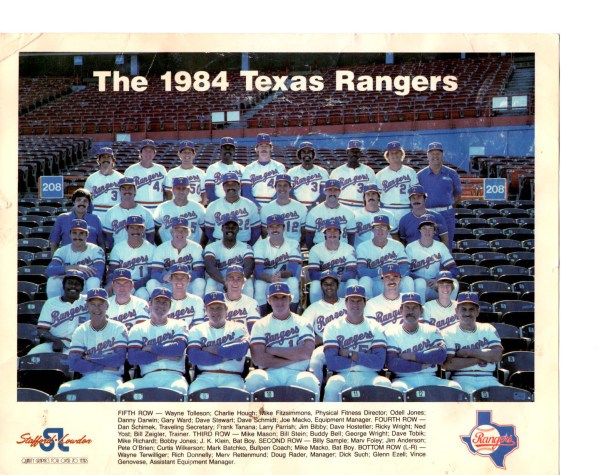
The 1984 edition of the Texas Rangers dropped to the basement of the American League West in Doug Rader’s second full season at the helm. The Rangers finished 69-92 but only 14.5 games behind the Kansas City Royals in a competitive division. The Rangers won only eight of their first twenty-two contests and only posted one winning month in August (15-13).
Mickey Rivers took over as designated hitter for the Rangers and hit .300 with four dingers and thirty-three RBIs. Right fielder Larry Parrish (.285/22/101) led the team in homers (22) and RBIs (101). First baseman Pete O’Brien hit .287 with eighteen long balls and eighty batters plated. Second baseman Wayne Tolleson (.213/0/9) topped the team in stolen bases with twenty-two. Perennial All-Star third baseman Buddy Bell (.315/11/83) topped the team in batting average earning a silver slugger award, gold glove and an invite to the All-Star game in San Francisco.

The Rangers pitching staff regressed a little in 1984 posting a combined 3.91 ERA. Charlie Hough (16/3.76/164) recorded a 16-14 mark while leading the league in games started (36), complete games (17), hits allowed (260) and batters faced (1133). Southpaw Frank Tanana (15, 3.25/141) notched a 15-15 record in thirty-five starts. Danny Darwin (8/3.94/123), Dave Stewart (7/4.73/119) and Mike Mason (9/3.61/113) rounded out the starting rotation. Closer Dave Schmidt (6/2.56/46) won six games and saved twelve out of the Texas bullpen.
The Arlington Stadium faithful witnessed history three times during the course of the year. Unfortunately, the Rangers were on the wrong side each time. On May 6th, Cal Ripken Jr. of the Orioles hit for the cycle against the Rangers in a 6-1 Baltimore triumph.

Cycle:
Cal Ripken Jr. (BAL)
vs. Texas Rangers
On the Fourth of July, Phil Niekro of the visiting Yankees, recorded his 3,000th career strikeout in a 6-2 New York victory.

3,000th Strikeout:
Phil Niekro (NY)
Lastly on September 30th, Mike Witt of the visiting Angels achieved perfection against the Rangers in a 1-0 California win.

Perfect Game:
Mike Witt (CA)
vs. Texas Rangers (1-0)
1985

The Rangers held on to their last place standing in the American League West in 1985 winning seven fewer games than the ’84 campaign. Texas finished the year 28.5 games behind the division-winning Kansas City Royals. The Rangers never contended after dropping their first five contests to start the season. The Rangers poor start cost Doug Rader his job after just thirty-two games and a 9-23 record. Bobby Valentine took over as skipper for the rest of the season.
First baseman Pete O’Brien (.267/22/92) led the team in homers (22) and RBIs (92) while playing in a team high 159 games. Second baseman Toby Harrah hit .270 with nine home runs and forty-four driven in. Left fielder Gary Ward (.287/15/70) stole a team best twenty-six bases and was elected to the All-Star game in Minneapolis.

Center fielder Oddibe McDowell (.239/18/42) placed fourth in the Rookie of the Year voting and made history on July 23rd when he hit for the cycle against the Cleveland Indians.

Cycle:
Oddibe McDowell (TEX)
vs. Cleveland Indians
Designated hitter Cliff Johnson (.257/12/56) had a solid season before being traded to the Blue Jays in late August.
The Texas pitching staff surrendered 785 runs to the tune of a 4.56 team ERA. Charlie Hough (14/3.31/141) was the only pitcher to achieve double-digit wins (14). Lefty Mike Mason (8/4.83/92) posted an 8-15 mark while veterans Burt Hooton (5/5.23/62) and Frank Tanana (2/5.91/52) combined for a 7-15 record. Jeff Russell (3/7.55/44) posted a lofty 7.55 ERA in thirteen starts. Closer Greg Harris, purchased from the San Diego Padres in the offseason, went 5-4 with a 2.47 ERA, 111 strikeouts and eleven saves.
1986

The Rangers leapt from last to second place in Bobby Valentine’s first full season as manager. Texas finished with an 87-75 record and ended the year just five games behind the first place California Angels. Despite a sluggish start in April (9-10) the Rangers entered the All-Star break six games above the .500 mark. A poor July saw them drop to four games above .500 but they finished the season with a 35-25 record.
The Rangers starting rotation featured Bobby Witt (11/5.48/174), Ed Correa (12/4.23/189), Jose Guzman (9/4.54/87), Mike Mason (7/4.33/85) and Charlie Hough (17/3.79/146). Witt led the league in walks (143) and wild pitches (22) and posted an 11-9 record. Hough pitched a team high 230.1 innings an earned an invite to the All-Star game in Houston.

Closer Greg Harris (10/2.83/95) won ten games and saved twenty out of the bullpen. Twenty-one-year-old Mitch Williams (8/3.58/90) appeared in a league high eighty games out of the pen.
The Rangers offense did not lack for power as they had wight players reach double digits in homers: Catcher Don Slaught (.264/13/46), first baseman Pete O’Brien (.290/23/90), third baseman Steve Buechele (.243/18/54), center fielder Oddibe McDowell (.266/18/49), right fielder Pete Incaviglia (.250/30/88), designated hitter Larry Parrish (.276/28/94), reserve outfielder Ruben Sierra (.264/16/55) and backup catcher Darrell Porter (.265/12/29) all achieved the feat. Incaviglia struck out a league high 185 times. O’Brien and shortstop Scott Fletcher (.300/3/50) each received MVP votes while Sierra finished sixth in the Rookie of the Year voting.
1987


The Rangers won twelve less games in 1987 and dropped from second place to seventh in the American League West. Despite their last place finish, only ten games separated Texas from the division winning Minnesota Twins. After a slow start that saw Texas eight games under .500 at the end of May, the Rangers played their best two months of baseball during June and July posting a 30-25 record. Bobby Valentine’s team floundered in august (12-17), went 14-14 in September and finished the year dropping four straight contests.
Right fielder Ruben Sierra (.263/30/109) led the Rangers with 109 runs batted in while leading the league in at-bats (643) and sacrifice flys (12). First baseman Pete O’Brien (.286/23/88) left fielder Pete Incaviglia (.271/27/80) and center fielder Oddibe McDowell (.241/14/52) provided the Rangers lineup with additional power. Designated Hitter Larry Parrish (.268/32/100) led the team with thirty-two dingers and was selected as the Ranger’s representative for the All-Star game in Oakland.

Texas featured a four-man rotation through much of the 1987 season featuring Charlie Hough (18/3.79/223), Jose Guzman (14/4.67/143), Bobby Witt (8/4.91/160) and Ed Correa (3/7.59/61). Hough led the league in games started (40), innings pitched (285.1), hit batters (19) and batters faced (1231). Witt led the league in walks allowed with 140. Greg Harris (5/4.86/106) split his time between starting and the bullpen, Closer Dale Mohorcic (7/2.99/48) saved sixteen games out of the pen.
1988


The 1988 edition of the Texas Rangers won five less games than in 1987 but managed to climb out of the cellar in the American League West. The Rangers finished the season at 70-91 a distant 33.5 games behind the American League Champion Oakland Athletics. Texas followed a slow start in April (8-13) with a promising May record of 17-11. A disastrous July (9-18) sandwiched around a .500 record in August and a terrible September (9-19) removed Texas from any postseason contention.
Texas used a half dozen starters throughout the regular season producing mixed results. Charlie Hough (15/3.32/174), Jose Guzman (11/3.70/157), Paul Kilgus (12/4.16/88) and Jeff Russell (10/3.82/88) each won double digit games for the Rangers. Hough led the leagues in walks allowed (126) and Russell was chosen to represent the Rangers at the All-Star game in Cincinnati.

Bobby Witt (8/3.92/148) and Ray Hayward (4/5.46/37) rounded out the starting rotation while Mitch Williams (2/4.63/61) saved eighteen games in sixty-seven appearances.
Right fielder Ruben Sierra (.254/23/91) led the team in homers with twenty-three and RBIs with ninety-one. Left fielder Pete Incaviglia (.249/22/54) led the league in strikeouts with 154. First baseman Pete O’Brien (.272/16/71) and third baseman Steve Buechele (.250/16/58) each had solid seasons on the corners. Reserve outfielder Cecil Espy (.248/2/39) stole thirty-three bases and finished eighth in the Rookie of the Year voting.
1989


1989 was a season of change for the Texas Rangers organization. Owner Eddie Chiles sold the team to a new ownership group including future U.S. President George W. Bush. On the field, the Rangers parted ways with Mitch Williams, Paul Kilgus, Pete O’Brien, Oddibe McDowell and Jerry Browne via trades. As part of those transactions, Texas welcomed newcomers Rafael Palmeiro, Jamie Moyer and Julio Franco. Also added via free agency were Nolan Ryan and Jim Sundberg. Texas finished the season with a respectable 83-79 record. The Rangers ended in fourth place, sixteen games behind the Oakland A’s. Texas got off to a sizzling start by posting a 17-5 record in April. A 10-17 May record brought Texas back to earth and they played .500 ball the rest of the year.
Newly acquired first baseman Rafael Palmeiro had a solid first season in Arlington hitting .275 with eight home runs and 64 RBIs. Left fielder Pete Incaviglia provided power if not average by slashing .236/21/81. Third baseman Steve Buechele contributed sixteen homers, fifty-nine RBIs and a .235 average. Designated hitter Harold Baines (.285/3/16) was acquired in July from the White Sox in exchange for Sammy Sosa and won a Silver Slugger Award. Newly acquired second baseman Julio Franco (.316/13/92) grounded into a league high twenty-seven double plays but earned a Silver Slugger Award and a trip to the All-Star game in Anaheim. Joining Franco for the All-Star festivities at Angel Stadium was right fielder Ruben Sierra (.306/29/119). Sierra led the league in games played (162), triples (14), RBIs (119), slugging percentage (.543) and total bases (344). Sierra would finish second in the N.L. MVP voting and earn a Silver Slugger Award.

A. L. RBI Leader (119)
Ruben Sierra (TEX)

A. L. Triples Leader (14)
Ruben Sierra (TEX)


The Rangers pitching staff employed a six-man rotation during 1989. Bobby Witt (12/5.14/166) led the league in earned runs allowed (111) and walks (114) but managed to post a 12-13 record. A twenty-four-year-old Kevin Brown (12/3.35/104) went 12-9 and finished sixth in the Rookie of the Year voting. Forty-one-year-old knuckler Charlie Hough (10/4.35/94) recorded a 10-13 record while allowing a league high twentu-eight long balls. Lefties Mike Jeffcoat (9/3.58/64) and Jamie Moyer (4/4.86/44) combined for a 13-15 record. Both Nolan Ryan (16/3.20/301) and Jeff Russell (6/1.98/77) joined Sierra and Franco in Anaheim for the All-Star game. Russell led the league in games finished (66) and saves (38) earning him the American League Fireman of the Year Award.

A.L. Fireman of the Year
Jeff Russell (TEX)
The Ryan Express topped the league in strikeouts (301), wild pitches (19), hits per nine innings (6.1) and strikeouts per nine innings (11.3). Ryan finished fifth in the Cy Young voting and twenty-third in the MVP race.

A. L. Strikeout Leader (301)
Nolan Ryan (TEX)
Nolan also made history on August 22nd when he recorded his 5,000th career strikeout against Rickey Henderson of the Oakland Athletics.

5,000th Strikeout:
Nolan Ryan
1990


The Texas Rangers once again finished with an 83-79 record in 1990 but moved from fourth to third place in the American League West division. The Rangers would end the season twenty games behind the division winning A’s and eleven games behind the second place White Sox. Texas started the season with an 11-9 mark in April but had a disastrous May posting an 8-19 record. Texas would win thirty-three of their next fifty-five but could not make up ground on the front-running Athletics.
The Rangers featured a four-man rotation which included Bobby Witt (17/3.36/221), Charlie Hough (12/4.07/114), Kevin Brown (12/3.60/88) and Nolan Ryan (13/3.44/232). Knuckleballer Hough led the league in hit batters with eleven. The Ryan Express led the league in strikeouts (232), WHIP (1.034) and strikeouts per nine innings (10.2). Ryan achieved two career marks on the road in 1990 featuring is sixth no-hitter at Oakland and his 300th career win at Milwaukee.

A. L. Strikeout Leader (232)
Nolan Ryan (TEX)
Kenny Rogers won ten games out of the bullpen and saved fifteen more.
Centerfielder Gary Pettis hit .239 with three home runs, thirty-one RBIs and a team high 38 stolen bases to go along with his Gold Glove Award for defensive excellence. First baseman Rafael Palmeiro (.319/14/89) led the league in hits (191) and finished fourteenth in the Most Valuable Player voting. Second baseman Julio Franco (.296/11/69) won a Silver Slugger award and was the only Rangers to be selected for the All-Star game at Wrigley Field.

1991


The 1991 edition of the Texas Rangers remained in third place in the American League West winning two more games than their prior campaign. Texas finished ten games behind the eventual World Series champion Minnesota Twins. At the end of April, the Rangers stood at 8-8, but a strong May record of 18-9 kept Texas in the race early in the season. The Rangers would play .500 ball for the rest of the season ending any hopes of making up ground on Minnesota.
The Ranger’s offense was led by a trio of All-Star invitees: Rafael Palmeiro (.322/26/88), Ruben Sierra (.307/25/116) and Julio Franco (.341/15/78) each earned a trip to the Sky Dome for the midsummer’s classic. Palmeiro led the league in doubles with forty-nine and garnered some MVP votes. Sierra finished eighth in the MVP voting on the strength of his .307/25/116 slash line. Franco was the American League batting champion posting a .341 average for the year.

A. L. Batting Champion (.341)
Julio Franco (TEX)


Nineteen-year-old catcher Ivan “Pudge” Rodriguez (.264/3/27) finished fourth overall in the Rookie of the Year voting. Designated hitter Brian Downing hit .278 with seventeen homers and forty-nine RBIs in his age 40 season.
The Texas pitching staff took a step back in 1991 to the tune of a 4.47 team ERA. The Ranger’s staff featured six starters who had 11 or more starts during the season: Kevin Brown (9/4.40/96), Nolan Ryan (12/2.91/203), Jose Guzman (13/3.08/125), Bobby Witt (3/6.09/82), Dennis “Oil Can” Boyd (2/6.68/33) and Brian Bohanon (4/4.84/34). Brown led the league in hit batters with thirteen and Ryan led the league in WHIP (1.006), hits per nine (5.3) and strikeouts per nine (10.6). Ryan made history on May 1st when he threw his seventh career no hitter against the Toronto Blue Jays in a 3-0 Rangers victory.

No Hitter:
Nolan Ryan
vs. Toronto Blue Jays (3-0)
Thirty-nine-year-old Rich “Goose” Gossage (4/3.57/28) joined the Rangers bullpen as an offseason free agent. Jeff Russell (6/3.29/52) took over the closer role and saved thirty games out of the bullpen.
1992
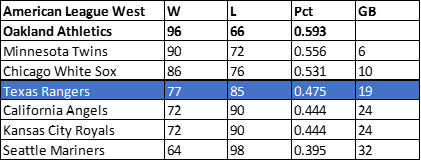
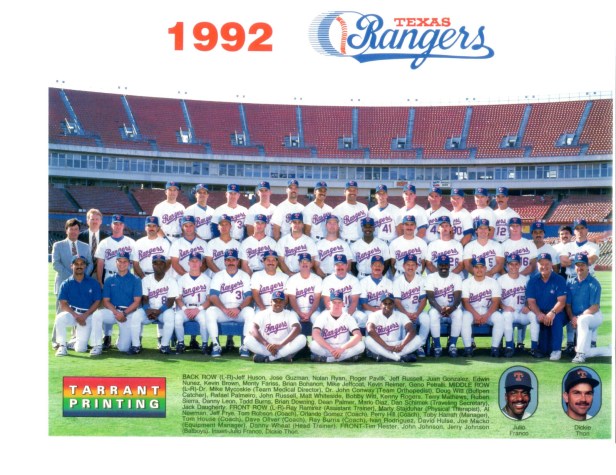
The 1992 edition of the Texas Rangers won eight less games than in 1991. Texas finished in fourth place, nineteen games behind the division-winning Oakland Athletics. The Rangers played solid if uninspiring ball through the end of June with a mark of 43-37. An 11-15 mark in July cost manager Bobby Valentine his job after seven seasons at the helm. Toby Harrah was named as the interim manager, and the Rangers finished the season 32-44.
Catcher Ivan Rodriguez (.260/8/37) earned an All-Star invitation and won a Gold Glove for best defensive backstop in the league. Right fielder Ruben Sierra (.278/14/70) joined Rodriguez in San Diego for the All-Star festivities. All-Star Jose Canseco (.233/4/15) was acquired from the Athletics in a late August trade for Sierra, Jeff Russell and Bobby Witt. Third baseman Dean Palmer (.229/26/72) paced the league in strikeouts with 154. Center fielder Juan Gonzalez (.260/43/109) led the American League in home runs (43) earning a Silver Slugger Award and MVP consideration.

A. L. Home Run Leader (43)
Juan Gonzalez (TEX)


The Ranger’s starting five consisted of Jose Guzman (16/3.66/179), Bobby Witt (9/4.46/100), Nolan Ryan (5/3.72/157), Roger Pavlik (4/4.21/45) and Kevin Brown (21/3.32/173). Brown led the league in wins (21), innings pitched (265.2), hits allowed (262) and batters faced (1108) earning an All-Star invite and a sixth-place finish in the Cy Young voting.

A. L. Co-Wins Leader (21)
Kevin Brown (TEX)
Prior to the August trade with Oakland, Jeff Russell (2/1.91/43) saved twenty-eight games out of the Ranger’s bullpen. Kenny Rogers (3/3.09/70) took over as closer and saved six games appearing in a league-high eighty-one games.
1993

The 1993 season would be the Ranger’s last at Arlington Stadium as they prepared to move into their new home, Globe Life Park. Kevin Kennedy was hired to take over the managerial duties from interim skipper Toby Harrah. Texas had a solid year winning 86 games and losing 76 to end the year in second place just eight games behind the Chicago White Sox. The Rangers played .500 ball through the end of May, but a 10-16 June dropped them in the American League West standings. Texas had a strong second half posting a 51-36 record the rest of the way but could not catch the front-running pale hose.
First baseman Rafael Palmeiro (.295/37/105) led the league in runs scored with 124 and finished eighth in the MVP voting. Catcher Ivan Rodriguez (.273/10/66) secured a gold glove award and was selected for the All-Star game in Baltimore. Joining Rodriguez at Camden Yards was left fielder Juan Gonzalez (.310/46/118). Gonzalez led the league in home runs (46) and slugging percentage (.632) and earned a silver slugger award along with a fourth-place finish in the MVP voting.

A. L. Home Run Leader (46)
Juan Gonzalez (TEX)


Third baseman Dean Palmer (.245/33/96) and designated hitter Julio Franco (.289/14/84) added additional long ball power to the Texas lineup. Center fielder David Hulse hit .290 and finished eighth on the Rookie of the Year ballots. 1993 was a less than stellar season for Jose Canseco (.255/10/46). On May 26th, Canseco lost a fly ball hit by Carlos Martinez in the lights and the ball bounced off his head and over the fence for a home run. Three days later, Canseco convinced his manager to let him pitch in mop up duty and Canseco injured his arm requiring Tommy John surgery and ending his season.
Texas featured a five-man rotation again in 1993: Kevin Brown (15/3.59/142), Kenny Rogers (16/4.10/140), Roger Pavlik (12/3.41/131), Charlie Leibrandt (9/4.55/89) and Nolan Ryan (5/4.88/46) got the bulk of the starting nods. Closer Tom Henke (5/2.91/79) notched forty saves out of the Texas bullpen. 1993 would mark the end of the Hall of Fame career of Nolan Ryan. Ryan tore a ligament in his pitching arm in Seattle and retired before the end of the season. On August 4th, Ryan was involved in a famous one-sided brawl with the White Sox Robin Ventura.
BaseBrawl
Nolan Ryan (TEX) vs. Robin Ventura (CHW)
 Curve in the Dirt.com