


1898


Team founder Charles Byrne died in the offseason prior to the 1898 season. Charles Ebbets took over ownership of the Bridegrooms and moved the team to the second edition of Washington Park. Manager Billy Barnie was shown the door after thirty-five games and Ebbets took the helm until Mike Griffin was named the new skipper. Brookly struggled form the jump, posting a losing record from May through October. The Bridegrooms would manage only 54 wins and finished in tenth place in the National League, forty-six games behind the Boston Beeneaters.
Outfielder, Fielder Jones (.304/1/69), led the Bridegrooms in batting average (.304) and RBIs (69) while nabbing a team high 36 bags. Outfield mate Jimmy Sheckard (.277/4/64) led the Grooms in long balls with four. Outfielder John Anderson topped the senior circuit in triples (22) while splitting his time between the Bridegrooms and Senators. Anderson was sent to Washington on May 19th and returned to Brooklyn on September 1st.

N. L. Triples Leader (22)
John Anderson (BKN/WAS)
The Brooklyn pitchers struggled with a team ERA of 4.01 for the season and surrendered 811 runs. Brickyard Kennedy (16/3.37/73), Jack Dunn (16/3.60/66), Joe Yeager (12/3.65/70) and Ralph Miller (4/5.34/43) started 130 of the 145 games. Kit McKenna (2/5.63/27) would post a 2-6 mark as a starter/reliever.
1899
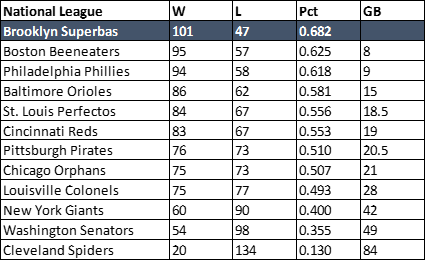
In 1899, the Brooklyn Bridegrooms merged with the Baltimore Orioles ownership and changed their name to the Superbas. Baltimore owner Harry Von der Horst and Ned Hanlon became co-owners of the Brooklyn squad and Hanlon was named Manager, replacing Mike Griffin. As part of the merger, the Superbas added a number of quality players including Bill Dahlen, Hughie Jennings, Willie Keeler, Joe Kelley, Jay Hughes, Al Maul, Doc McJames and Dan McGann. The Superbas showed immediate improvement moving from tenth place in 1898 to first in 1899. Brooklyn won 101 games and won the National League by eight games over the second place Beeneaters of Boston.
The pitching staff blossomed with its latest editions. Jay Hughes (28/2.68/99) led the National League in wins (28) and winning percentage (.824). Doc McJames posted a 19-15 record with a 3.50 ERA and a team leading 105 punchouts. Al Maul (2/4.50/2) went 2-0 in four starts while incumbent starters Jack Dunn (23/3.70/48) and Brickyard Kennedy (22/2.79/55) combined for a 45-22 record.
Offensive additions Dan McGann (.243/2/32), Joe Kelley (.325/6/93) and “Wee” Willie Keeler (.379/1/61) provided much needed lift foe an offense that struggled in 1898. Keeler led the National League in runs scored with 140 during the 1899 campaign. Keeler also led the team in thievery, swiping 45 bags and besting second baseman Tom Daly’s (.313/5/88) 43 successful attempts.
1900


The Superbas won their second straight National League crown in 1900 winning 82 games and finishing 3.5 games ahead of the Pittsburgh Pirates. The Superbas spent 117 days in first place and finished over .500 in each month of the season.
The Superba pitching staff was anchored by three starters: Brickyard Kennedy (20/3.91/111), Frank Kitson (15/4.19/55) and Joe McGinnity (28/2.94/93). Kitson led the league in saves (4) and home runs allowed (12). McGinnity, who was reassigned from the now defunct Orioles to the Superbas, led the league in wins (28), winning percentage (.778), innings pitched (343.0), walks (113) and hit batters (40). Harry Howell (6/3.75/26) posted a 6-5 record in relief and led the league in games finished with eleven.

N. L. Wins Leader (28)
Joe McGinnity (BKN)
“Wee” Willie Keeler (.362/4/68) led the Brooklyn offense while leading the league in hits (204). Outfielder Joe Kelley hit .319 with a team high six home runs and 91 runs driven in. Second baseman Tom Daly (.312/4/55) and outfielder Fielder Jones (.310/4/54) both topped the .300 mark for the year.
1901


The championship era ended for the Brooklyn nine in 1901. The Superbas still played respectable ball, winning 79 games on the season, but finished 9.5 games behind the champion Pittsburgh Pirates in the National League. The Superbas ended May with a 14-15 record and despite a strong finish to the year, could never catch the Pirates or the Phillies.
Bill Donovan (25/2.77/226) anchored the pitching staff, leading the National League in wins (25), games (45), saves (3), walks (152) and home runs per 9 innings (0.0).

N. L. Wins Leader (25)
Bill Donovan (BKN)
Donovan was supported by strong years from fellow starters Frank Kitson (19/2.98/127) and Jay Hughes (17/3.27/96). The staff combined to allow only 600 runs during the ’01 campaign.
Second baseman Tom Daly (.315/3/90) led the Senior Circuit in doubles with 38. Willie Keeler posted a .339 batting average with two home runs and forty-three RBIs while stealing twenty-three bags. The offensive star for Brooklyn was outfielder Jimmy Sheckard. Sheckard led the league in triples (19) and slugging percentage (.534) while leading the team in average (.354), homers (11) and RBIs (104).
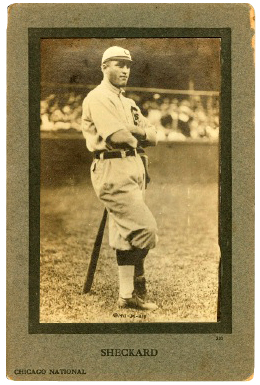
N. L. Triples Leader (19)
Jimmy Sheckard (BKN)
1902

The Superbas won 75 games in 1902 but finished in second place in the National League, 27.5 games behind the champion Pirates. Another slow start saw the Superbas at 17-19 at the end of May and strong play in June (16-8), July (16-13) and September (14-9) could not make up ground on the front runners. Brooklyn only tasted first place for two days during 1902.
Outfielder Cozy Dolan (.280/1/54) led the league in games (141), plate appearances (640) and at-bats (592). Willie Keeler led the team in average at .333 and first baseman Tom McCreery topped the team in RBIs (57). McCreery and outfielder Jimmy Sheckard both hit four home runs to lead the Superbas. Second baseman Tim Flood led the league in whiffs with 70.
A quartet of starting pitchers would each win fifteen or more games for Brooklyn: Bill Donovan (17/2.78/170), Frank Kitson (19/2.78/114), Doc Newton (15/2.42/107) and Jay Hughes (15/2.94/87). Fifth starter, Roy Evans, posted a 5-6 mark in eleven starts on the bump.
1903


The 1903 season saw the Superbas regress even further in the National League standings. Brooklyn finished the year at 70-66 and dropped to fifth place overall. The Superbas hovered around the .500 mark most of the season and never stood in first place during the course of the year.
Outfielder Judge McCredie (.324/0/20) sported a .324 average and first baseman Jack Doyle (.313/0/91) purchased in the offseason from the Senators, hit .313. Outfielder Jimmy Sheckard (.332/9/75) led the National League in home runs (9) and stolen bases (67).

N. L. Home Run Leader (9)
Jimmy Sheckard (BKN)
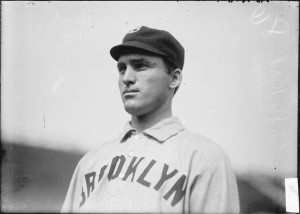
N. L. Co-Stolen Base Leader (67)
Jimmy Sheckard (BKN)
Henry Schmidt (22/3.83/96) topped the Brooklyn starters with a 22-13 record despite leading the league in hit batters (21). Oscar Jones (19/2.94/95) and fellow righty Ned Garvin (15/3.08/154) would each contribute 15+ wins for the Superbas. Spot-starter Grant Thatcher posted a 3-1 record in four starts with a 2.89 ERA.
1904

The downward spiral continued for Brooklyn in 1904. The Superbas managed only 56 wins in 153 games and placed sixth in the National League a distant 50 games behind the pennant-winning Giants. A 6-5 record in April would be Brooklyn’s only winning month as they never spent a day in first place.
Shortstop Charlie Babb (.265/0/53) was one of the few bright spots offensively as he led the team in stolen bases with 34. Outfielder John Dobbs batted .248 with zero home runs and 30 RBIs for a team that scored only 497 runs on the year. Harry Lumley (.279/9/78) was the lone standout on the Brooklyn squad. Lumley led the National League in triples (18) home runs (9) and strikeouts 106).

N. L. Home Run Leader (9)
Harry Lumley (BKN)

N. L. Triples Leader (18)
Harry Lumley (BKN)
Oscar Jones (17/2.75/96) and Jack Cronin (12/2.70/110) started almost half of Brooklyn’s games but suffered from a lack of run support. Jones would lead the league in losses (25) and hits allowed (387) while Cronin topped the league in home runs allowed (10). Ned Garvin (5/1.68/86), Ed Poole (8/3.39/67) and Doc Scanlan (6/2.16/40) would fill out the starting rotation.
1905

The Superbas bottomed out in 1905 winning just 48 games and finishing last in the National League 56.5 games behind the New York Giants. Brooklyn dug a hole early starting 18-48 at the end of June and never recovered.
The Brooklyn hurlers struggled mightily throughout the season surrendering 807 runs. Harry McIntire (8/3.70/135) and Mal Eason (5/4.30/64) both lost 21 or more decisions. McIntire would lead the league in hits allowed (340), earned runs (127) and hit batters (20). Elmer Stricklett (9/3.34/77) posted a 9-18 record but led the league in home runs per 9 innings (0.0) allowing no round-trippers in 237.1 innings. Doc Scanlan (14/2.92/135) was the only Superba to post a winning record at 14-12.
Outfielder Harry Lumley (.293/7/47) led the team in average (.293) and home runs (7). Third baseman Emil Batch (.252/5/49) topped the team in RBIs with forty-nine. Outfielder Jimmy Sheckard (.292/3/41) led the team in stolen bases with 61.
1906

The Superbas showed improvement in 1906 winning sixty-six games and jumping to fifth place in the National League. Despite replacing Manager Ned Hanlon with Patsy Donovan, the Brooklyn squad wound up 50 games back of the pennant winning Chicago Cubs.
The offense struggled to score runs, tallying just 495 for the season. An offseason trade with the Cubs saw outfielder and offensive stalwart Jimmy Sheckard shipped out of town. In return for Sheckard, the Superbas received position players Billy Maloney (.221/0/32), Jack McCarthy (.304/0/35) and Doc Casey (.233/0/34). Maloney would lead the league in strikeouts with 116. Harry Lumley (.324/9/61) and Tim Jordan (.262/12/78) picked up the slack in Sheckard’s absence. Jordan led the National League in home runs with twelve while Lumley led in slugging percentage (.477) and OPS+ (179).

N. L. Home Run Leader (12)
Tim Jordan (BKN)
The Brooklyn pitching staff fared well with the lack of run support posting a collective 3.13 ERA. All five starting pitchers notched 10 or more wins on the year: Elmer Stricklett (14/2.72/88), Doc Scanlan (18/3.19/120), Harry McIntire (13/2.97/121), Mal Eason (10/3.25/64) and Jim Pastorius (10/3.61/58). Scanlan led the Senior Circuit in walks (127) yet had the only winning record on the Superba staff. 3,200 fans watched McIntire make history on August 1st when he threw a no hitter against the Pirates for 10 2/3 innings before allowing a single and an unearned run in a 1-0 loss.

No Hitter:
Harry McIntire
vs. Pittsburgh (0-1)
McIntire wouldn’t be the only pitcher to throw a no-no at Washington Park that season. On May 1st, John Lush of the visiting Phillies, no-hit the Superbas in a 6-0 Phillies victory before 2,250 spectators.
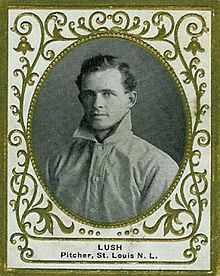
No Hitter:
John Lush (PHI)
vs. Brooklyn Superbas (6-0)
1907


The Superbas maintained their fifth place standing in 1907 winning one less game than the prior campaign. Brooklyn started the year horribly posting a 1-11 record in their first twelve contests. The Superbas played solid ball in June, July and August, but it was not enough to overcome their slow start.
Tim Jordan led the offense with a .274 batting average including four home runs and 53 RBIs. Harry Lumley hit a team high 9 home runs to pair with his sixty-six RBIs. Outfielder Billy Maloney (.229/0/32) topped the league in strikeouts with 97. Second baseman Whitey Alperman (.233/2/39) led the National League in triples with sixteen.

N. L. Co-Triples Leader (16)
Whitey Alperman (BKN)
The pitching staff suffered from lack of run support once again posting a team ERA of 2.38. Six pitchers shared the bulk of the starting duties: Nap Rucker (15/2.06/131), George Bell (8/2.25/88), Elmer Stricklett (12/2.27/69), Jim Pastorius (16/2.35/70), Harry McIntire (7/2.39/49) and Doc Scanlan (6/3.20/59). Weldon Henley posted a 1-5 record in seven starts with a 3.05 ERA.
3,000 fans were on hand on April 26th when Johnny Bates of the Visiting Boston Doves hit for the cycle in a 4-2 Boston victory.

Cycle:
Johnny Bates (BOS)
vs. Brooklyn Superbas
1908

The Brooklyn nine dropped to seventh place in the 1908 standings winning 53 games and finishing 46 games behind the champion Cubs. The Superbas never contended and posted their first winning month in October (4-3).
The Brooklyn offense was anemic scoring only 375 runs and hitting a collective .213 on the season. Third baseman Tommy Sheehan, acquired from the Pirates in the offseason, hit .214 with zero home runs and 29 RBIs. Outfielder Harry Lumley (.216/4/39) had a subpar season versus prior years. First sacker Tim Jordan was the brightest star in the dark Superba sky, leading the league in home runs (12) and hitting a team high .247 including his league high 74 strikeouts.

N. L. Home Run Leader (12)
Tim Jordan (BKN)
The offense spoiled another superb season by the Brooklyn twirlers who allowed 515 runs for a combined 2.47 ERA. Nap Rucker (17/2.08/199) topped the team in wins with 17 while leading the league in walks (125). Irvin Wilhelm (16/1.87/99) had the lowest ERA on the staff at 1.87. Harry McIntire (11/2.69/108) topped the league in hit batters with 20. Lefty Jim Pastorius (4/2.44/54) and righty George Bell (4/3.59/63) won only eight of their combined forty-three decisions. Rucker provided the highlight of the season on September 5th when he tossed a no-hitter against the Boston Doves in front of 3,000 fans.
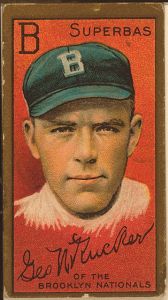
No Hitter:
Nap Rucker
vs. Boston Doves (6-0)
1909

The ’09 Superbas won two more games than the prior season, enough to move up to sixth place in the National League. Harry Lumley took over as manager for Brooklyn when Patsy Donovan was relieved of his duties after the ’08 season. The change at the helm provided little lift as Brooklyn finished 55.5 games behind the 1st place Pirates.
The team batting average improved to .229 in 1909 and the runs scored climbed to 442. First baseman Tim Jordan led the team in both batting average (.273) and home runs (3). Harry Lumley’s (.250/0/14) offensive numbers fell off as he was pulling double duty. Third baseman Ed Lennox (.262/2/44) topped the team in RBIs with 44. Outfielder Al Burch (.271/1/30) swiped a team high 38 bases.
The pitching staff was solid but regressed from the prior two years posting a team ERA of 3.10 and surrendering 627 runs. Shoddy defense did not help the hurlers as 150 runs were unearned. George Bell (16/2.71/95) and Doc Scanlan (8/2.93/72) were the only starters with winning records. Harry McIntire (7/3.63/84) led the league in plunked batsmen with 21. Lefty George Hunter notched a 4-10 record in 13 starts.
1910
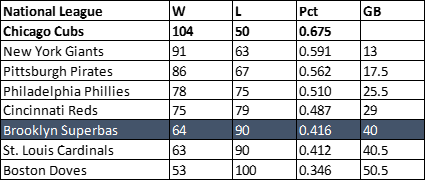
Harry Lumley was out as Brooklyn manager in 1910, and Bill Dahlen was in. The change in skipper did little to improve the Superbas standings as they once again finished in the bottom half of the National League at 64-90.
A young outfielder by the name of Zack Wheat (.284/2/55) played his first full season in Brooklyn and led the team in average (.284) and topped the National League in games played (156). First baseman Jake Daubert (.264/8/50) led the team in homers with eight. Second baseman John Hummel (.244/5/74) led the team in RBIs with 74 despite leading the league in strikeouts with 81.
Rotation staple Harry McIntire was traded to the Cubs at the beginning of the season leaving big shoes to fill. Nap Rucker (17/2.58/147) topped the National League in games started (39), complete games (27), innings pitched (320.1), hits (293) and batters faced (1261). George Bell (10/2.64/102) led the league in losses with twenty-seven. Cy Barger (15/2.88/87), Doc Scanlan (9/2.61/103) and Elmer Knetzer (7/3.19/56) would wound out the starting five. Knetzer would post the teams only winning record at 7-5.
1911


The Brooklyn club changed their name from Superbas to Trolley Dodgers in 1911. The name was derived from fans dodging the Trolleys outside of Washington Park. The Brooklyn performance on the field was not changed as they again won 64 games but dropped to seventh place in the National League. The Trolley Dodgers started poorly in April going 4-10 and finished the season 33.5 games behind the pennant winning Giants. Brooklyn strangely found success against the Cubs and Pirates combining to win 27 off 44 games but struggled against the rest of the National League.
Lefty starter Nap Rucker (22/2.71/190) anchored the Brooklyn staff and led the National League in WAR (8.6) in 33 starts. Cy Barger (11/3.52/60) and Elmer Knetzer (11/3.49/66) each won eleven games for the Trolley Dodgers. Bill Schardt (5/3.59/77), Doc Scanlan (3/3.64/45) and George Bell (5/4.28/28) rounded out the starting staff. Pat Ragan (4/2.11/39) finished 14 games out of the bullpen.
First baseman Jake Daubert (.307/5/45) led the team in average and finished 9th in the MVP voting. Zach Wheat (.287/5/76) and John Hummel (.270/5/58) each homered five times to tie Daubert for the team lead. Wheat also led the team in runs driven in with 76.
1912

In their final season at Washington Park, the Trolley Dodgers remained mired in seventh place. Brooklyn posted a 58-95 record and ended the season 46 games behind the New York Giants.
Brooklyn struggled once again out of the gate and never reached .500 after April 13th. Jake Daubert (.308/3/66) and Zach Wheat (.305/8/65) fueled the offense for Brookly with Daubert placing 8th in the MVP voting. Wheat would pace the team in home runs with eight and Daubert had a team high 3.3 WAR.
Doc Scanlan was sent to the Phillies in an offseason trade for right Eddie Stack. Stack (7/3.36/45) would be the only Trolley Dodger pitchers to record a winning record at 7-5. Nap Rucker (18/2.21/151) led the senior circuit in WAR (8.4) and shutouts (6). Earl Yingling (6/3.59/51), Pat Ragan (7/3.63/101), Frank Allen (3/3.63/58) and Cy Barger (1/5.46/30) rounded out the Brookly rotation.
After the end of the 1912 season, Brooklyn moved into their new home at Ebbets Field.
 Curve in the Dirt.com