1914
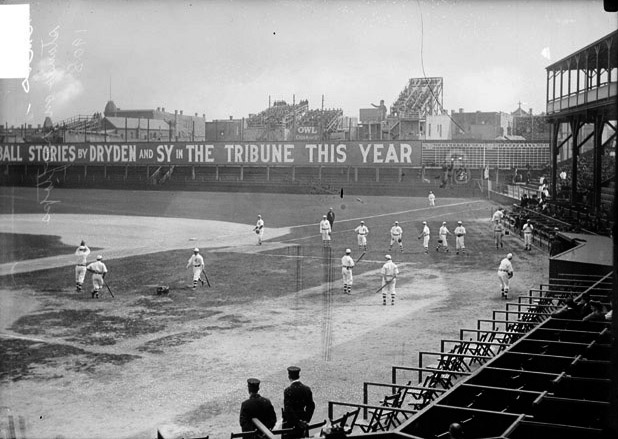
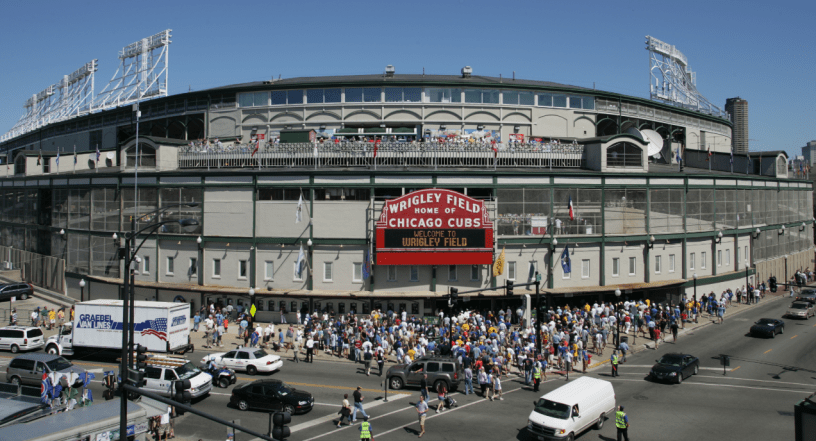
Wrigley Rooftops

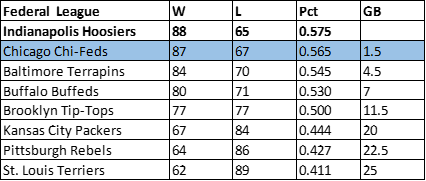
The 1914 Chicago Chi-Feds placed second in the Federal League in 1914. This was the second year of the Federal League, but first as a “Major League”. The Chi-Feds played their home games at Weeghmann Park. Outfielder, Dutch Zwilling, led the team offensively, hitting .313 with 95 RBIs and a Federal League leading 16 home runs.
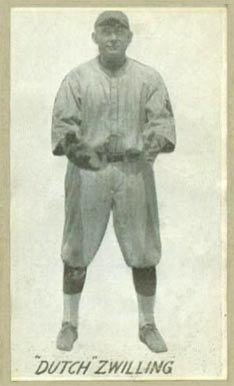
F. L. Home Run Leader (16)
Dutch Zwilling (CHF)
Catcher, Art Wilson and first baseman, Fred Beck each contributed with double digit long balls. Outfielder, Al Wickland, received a league-high 81 free passes.
Claude Hendrix was the ace of the pitching staff posting a league-high 29 wins.
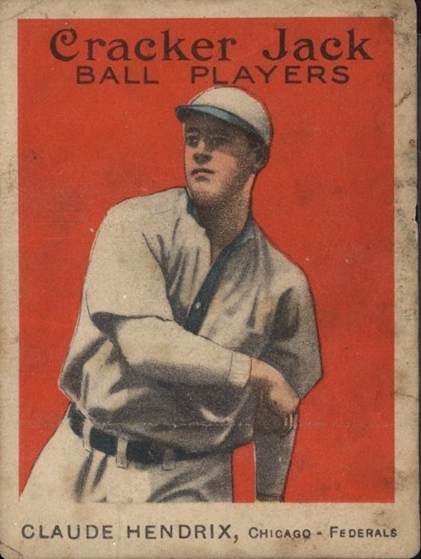
F. L. Wins Leader (29)
Claude Hendrix (CHF)
Hendrix also led the Fed League in ERA with a miniscule 1.69. Hendrix led the league in games with 45 and complete games (34).
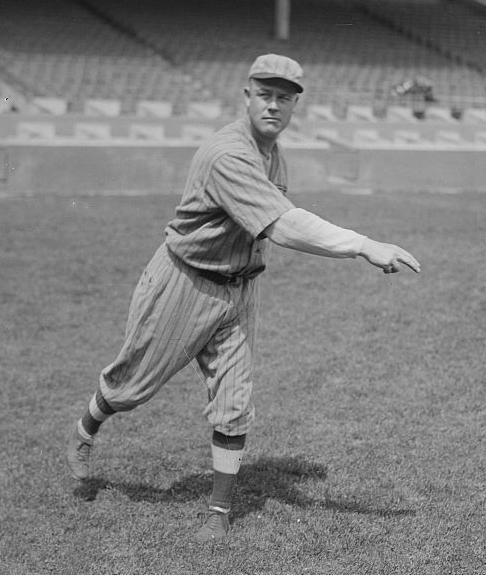
F. L. ERA Leader (1.69)
Claude Hendrix (CHI)
Righthanders, Max Fiske and Fry Lange each won 12 decisions to help Chicago to their second place finish.
1915
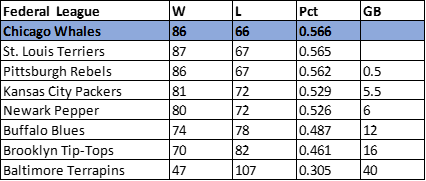
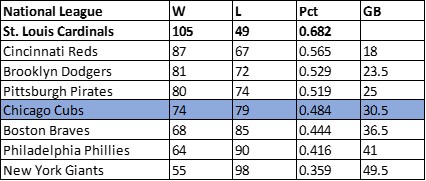
In the third and penultimate season of the Federal League, the Chicago entry would win the league by a percentage point over the St. Louis Terriers. After participating without a team nickname, the 1915 Chicago club would be officially crowned the Whales.
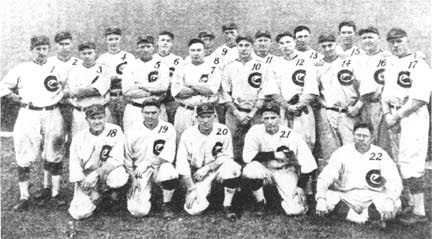
Federal League Champions
The pitching staff would be the strength of the club posting a team ERA of 2.64. Four starters would each post double digit wins. Claude Hendrix won 16 games against 15 losses. Mike Prendergast would win 14 while losing 12. Veteran Mordecai “Three Finger” Brown won 17 of 25 decisions. Staff ace, George McConnell lead the league in Wins (25) and Winning Percentage (.714).
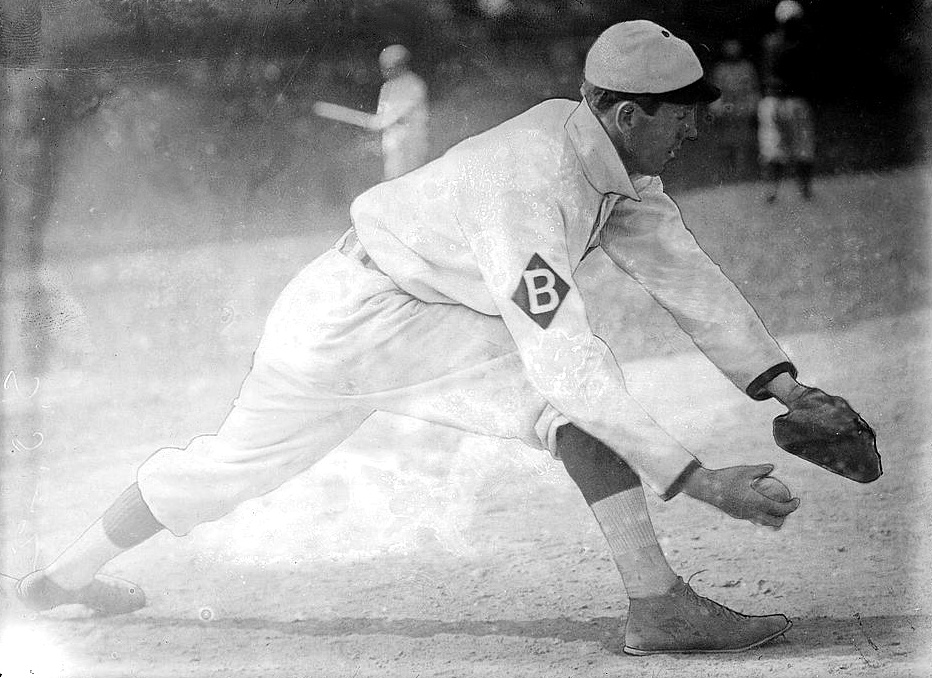
F. L. Wins Leader (25)
George McConnell (CHF)
Outfielder, Max Flack, led the batsmen with a .314 batting average. Outfielder Dutch Zwilling plated a league high 94 runs batted in and fellow outfielder Les Mann led the Federal League with 19 triples.
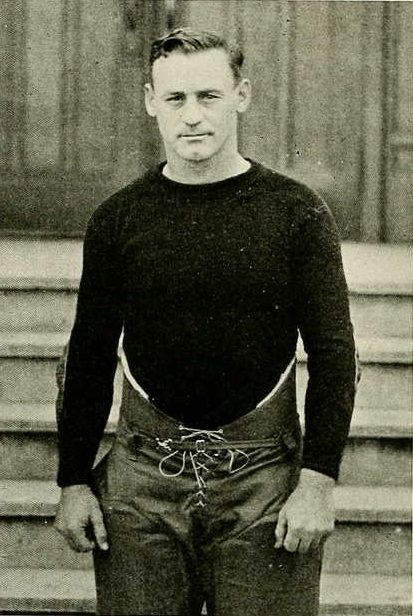
F. L. Triples Leader (19)
Les Mann (CHW)
The Federal League would disband after the 1915 season when the majority of teams were bought out by the American and National Leagues. Charles Weeghmann purchased the Chicago Cubs of the National League and moved their games to Weeghmann Park for the 1916 season.
1916
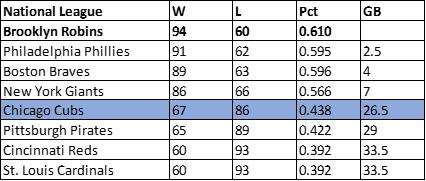
Charles Weeghmann’s first year as owner of the Cubs saw them finish in the bottom half of the National League. The Cubs ended 26.5 games off the pace of the N.L. champion Brooklyn Robins. The light-hitting Cubs managed just a collective .239 batting average. Outfielder, Cy Williams, tied for the league lead in home runs with 12 (Dave Robertson).
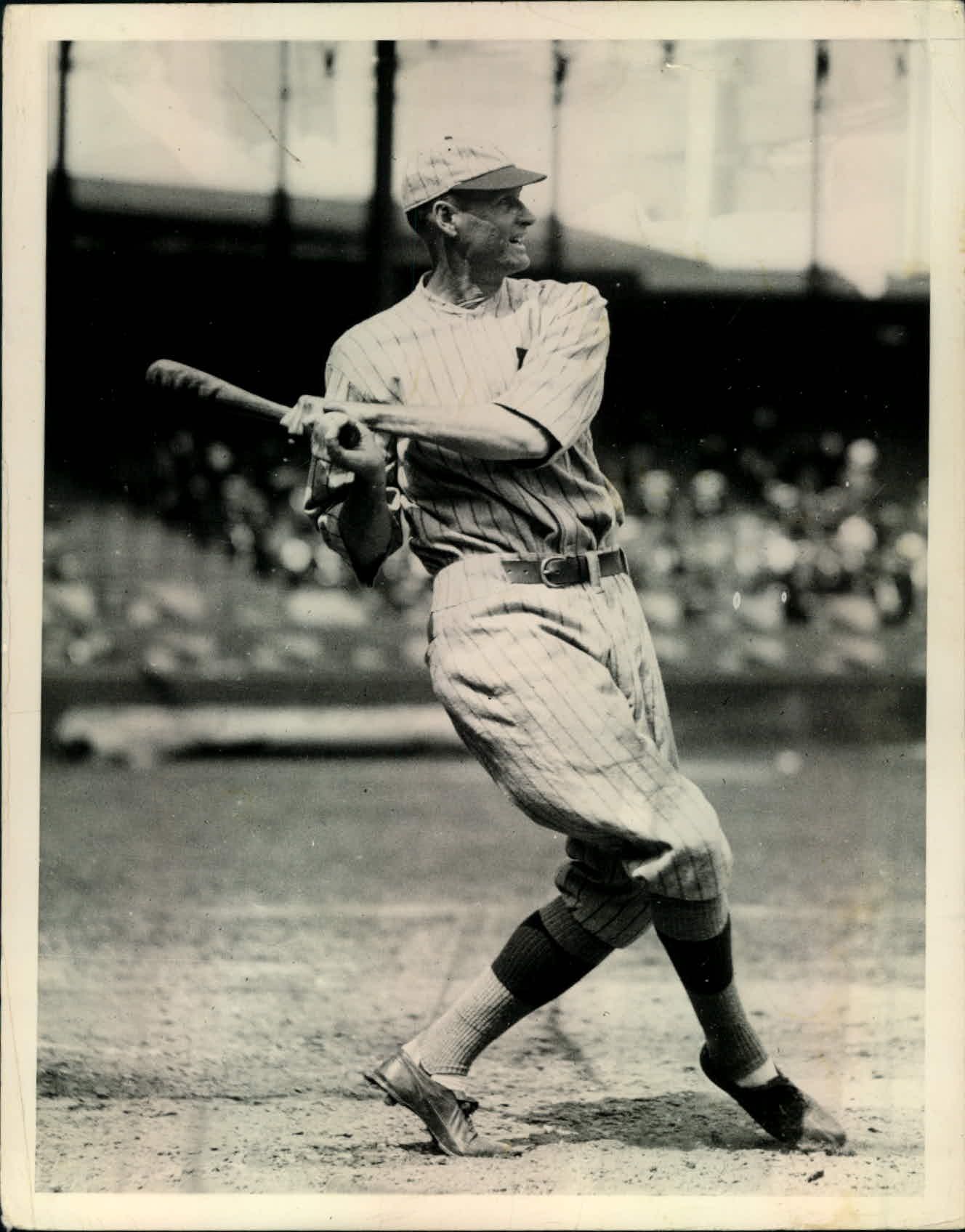
N. L. Co-Home Run Leader (12)
Cy Williams (CHC)
Third-sacker, Heinie Zimmerman was traded on August 28th to the New York Giants for Larry Doyle, Herb Hunter and Merwin Jacobson. Zimmerman totaled 83 RBIs between the two teams for best in the Senior Circuit.
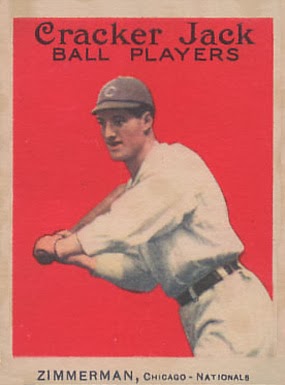
N. L. RBI Leader (83)
Heinie Zimmerman (CHC/NYG)
Lefty starter, Hippo Vaughn, topped the Cubs with 17 wins in 32 decisions. Righthander, Jimmy Lavender posted 10 wins in 24 outcomes. Southpaw closer, Gene Packard, notched 10 wins and 5 saves while posting a 2.78 ERA. The staff as a whole combined for a 2.65 ERA.
1917
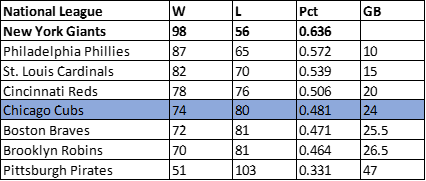
In their second season at Weeghmann Park, the Cubs finished six games under the .500 mark, 24 games behind the N. L. champion New York Giants. Fred Mitchell would take over managerial duties from player/manager Joe Tinker and saw middling success in his first season at the Chicago helm. Outfielder, Leslie Mann led all Cubs regulars with a .273 average. Second baseman, Larry Doyle, provided the power with six home runs and sixty-one runs batted in. Outfielder, Cy Williams, contributed some pop with five dingers and forty-two RBIs while leading the league in strikeouts with seventy-eight.
The pitchers were once again the strength of the organization posting a combined 2.62 ERA. Claude Hendrix, Phil Douglas and Jim “Hippo” Vaughn each contributed double-digit wins, with Douglas leading the league in games with 51. Vaughn would become part of history on May 2nd, when he and Red’s hurler Fred Toney each threw nine innings of no-hit ball. Jim Thorpe drove in the winning run for the Reds in the 10th inning. This remarkable feat still stands today as the only “Double No-Hitter” over nine innings of play.
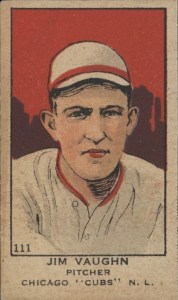
No Hitter:
Jim Vaughn (CHC)
vs. Cincinnati Reds (0-1)
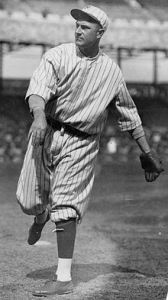
No Hitter:
Fred Toney (CIN)
vs. Chicago Cubs (1-0)
1918

The 1918 edition of the Chicago Cubs won the National League pennant posting a record of 84-45, good enough to be 10.5 games clear of the second place New York Giants. The Cubs would ultimately lose in the Fall Classic in six games to the Boston Red Sox.

N. L. Champions
Chicago Cubs
The North-siders were driven by triple crown winning pitcher Hippo Vaughn. Vaughn led the National League in wins (22), ERA (1.74) and strikeouts (148).
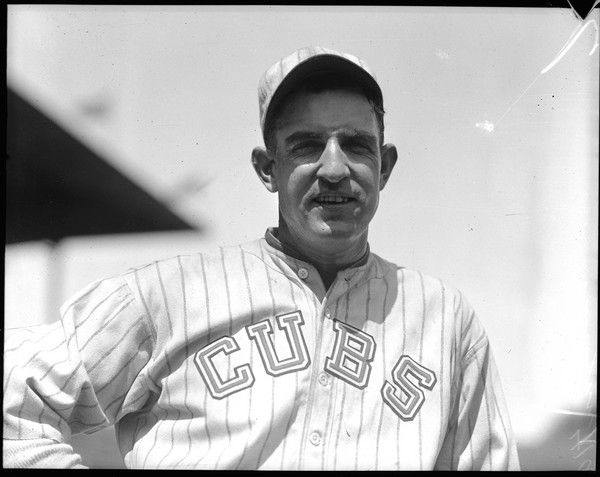
N. L. Wins Leader (22)
Hippo Vaughn (CHC)
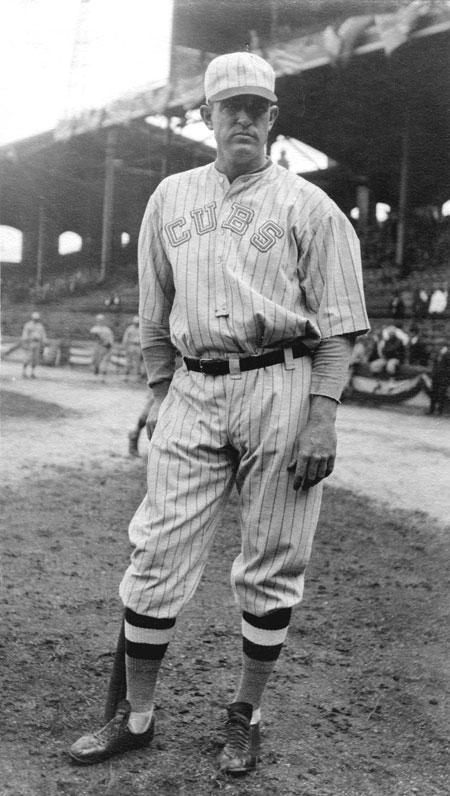
N. L. ERA Leader (1.74)
Hippo Vaughn (CHC)

N. L. Strikeout Leader (148)
Hippo Vaughn (CHC)
Vaughn also led the league in WAR (7.7), shutouts (8) and innings pitched (290.1). The pitching corp, as a whole, had a phenomenal season posting a combined 2.18 earned run average. Lefty Tyler won 19 of 27 decisions while Claude Hendrix was 20-7. Phil Douglas won 10 games with an ERA of 2.13.
Shortstop, Charlie Hollocher, hit a team high .316, while leading the National League in games (131), plate appearances (588), at-bats (509) and hits (131). Outfielder, Max Flack led the team in homers (4) and triples (10) while fellow outfielder Dode Paskert topped the team in RBIs with 59.
1919

The Chicago Cubs finished the 1919 campaign ten games over .500, good for third place in the National League. The baby bears were 21 games behind the champion Cincinnati Reds. Outfielder, Max Flack led the team in average (.294) and home runs (6). First baseman, Fred Merkle drove in 62 runs to lead the team. Third baseman, Charlie Deal, hit a solid .289 while plating 52 runs.
Grover Cleveland Alexander led the National League in WAR (7.4), shutouts (9) and ERA (1.72) while notching 16 wins.
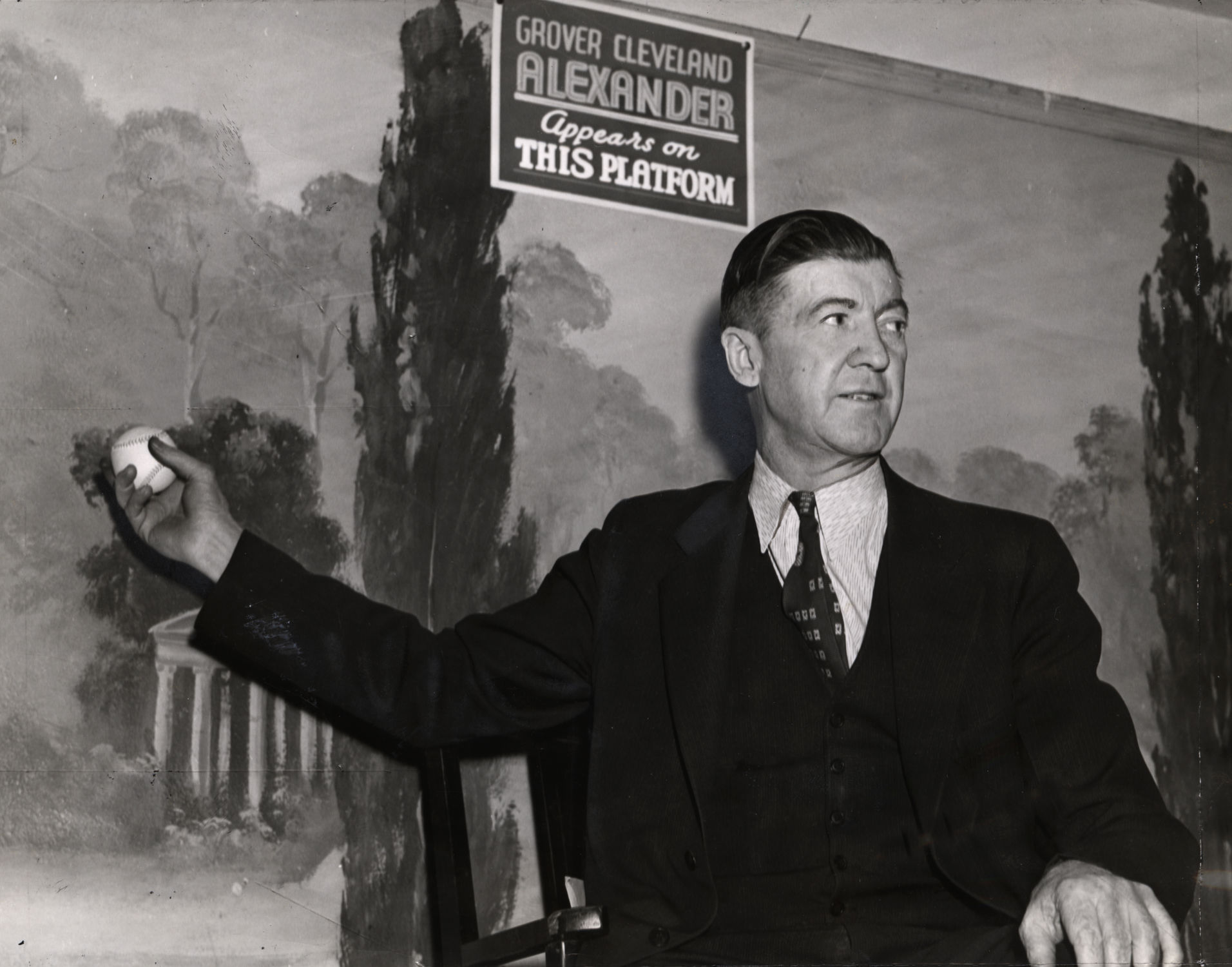
N. L. ERA Leader (1.72)
Grover Cleveland Alexander (CHC)
Jim “Hippo” Vaughn won 21 games for the Cubs while leading the league in starts (37), innings pitched (306.2) and strikeouts (141).
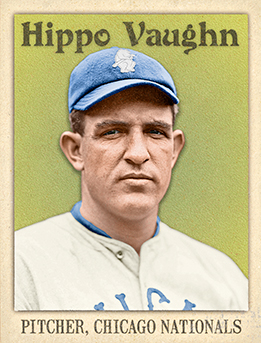
N. L. Strikeout Leader (141)
Hippo Vaughn (CHC)
Righthanded starters, Phil Douglas and Claude Hendrix each contributed 10 wins and reliever Speed Martin posted 8 more.
1920
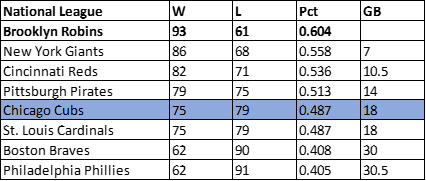
The 1920 season saw the Cubs drop into the bottom half of the National League. They finished with a 75-79 record, 18 games off the pace of the front-running Brooklyn Robins. Weeghmann Park was renamed Cubs Park during the 1920 season. Offensively, the Cubs were led by a trio of players. Shortstop, Charlie Hollocher and outfielders Max Flack and Dave Robertson all hit .300 or higher for the year. Robertson also led the team in home runs (10) and RBIs (75).
Grover Cleveland Alexander delivered a Triple Crown performance in 1920, leading the league in wins (27), ERA (1.91) and strikeouts (173).

N. L. Wins Leader (27)
Grover Cleveland Alexander (CHC)
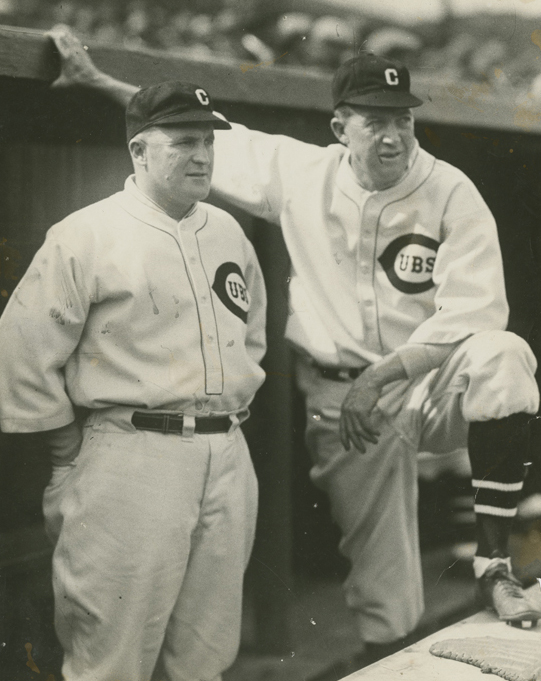
N. L. ERA Leader (1.91)
Grover Cleveland Alexander (CHC)
N. L. Strikeout Leader (173)
Grover Cleveland Alexander (CHC)
Alexander also led the National League in WAR (12.0), games started (40) and innings pitched (363.1). Lefty starters, Hippo Vaughn and Lefty Tyler, recorded 19 and 11 wins respectively.
1921
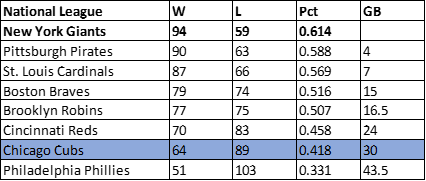
The 1921 edition of the Chicago Cubs tumbled even further down the National League standings, placing seventh overall, thirty games back of the New York Giants. Charles Weeghmann lost majority ownership of the Cubs to chewing gum magnate William Wrigley Jr due to Weeghmann’s flailing restaurant empire. The pitching staff struggled as a unit combining for a 4.39 ERA. Grover Cleveland Alexander won 15 games while Speed Martin and Virgil Cheeves each won 11.
First baseman, Ray Grimes, led the team in average (.321), home runs (6) and RBIs (79). Outfielder Max Flack also hit 6 round trippers while hitting .301 for the season. Outfielders, Turner Barber and George Maisel each hit over .300 for the year.
1922
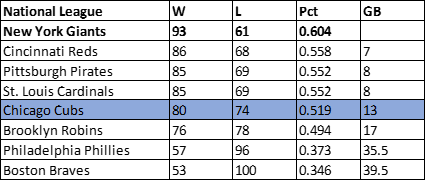
The 1922 Cubs finished 6 games above sea level but 13 games behind the pennant winning New York Giants. The Cubs were a solid offensive team with a combined .293 batting average. First-sacker, Ray Grimes paced the team with a .354 average, 14 home runs and 99 RBIs. Bob O’Farrell, Charlie Hollocher, Bernie Friberg and Hack Miller all finished the year batting above .300. Outfielder, Miller added 12 homers and 78 RBIs. Hollocher pilfered 19 bases while being caught stealing a league high 29 times.
On August 25th, the Cubs and Phillies participated in a slugfest. The teams combined for 49 runs on 51 hits with the Cubs prevailing 26-23. The teams set the marks for both hits and runs to date in MLB history.
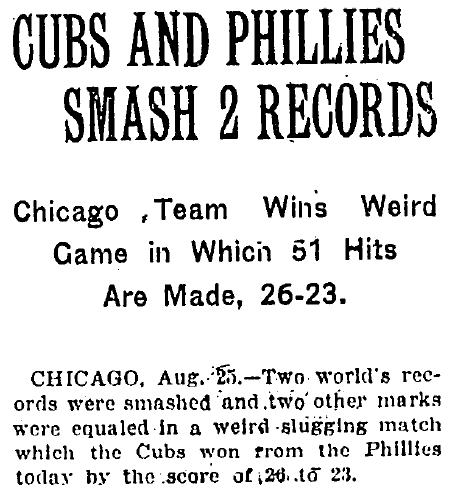
49 Runs
51 Hits
Phillies vs. Cubs (23-26)
The pitching staff struggled during the year but managed a team ERA of 4.34. Grover Alexander and Vic Aldridge both recorded 16 victories on the season with the latter plunking a league leading 12 batters. Virgil Cheeves contributed 12 wins in 23 decisions. Tony Osborne and George Stueland each won 9 games out of the bullpen.
1923
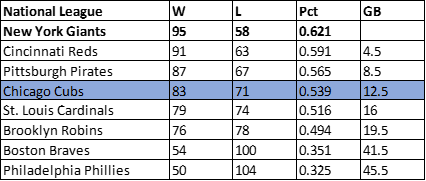
The ’23 version of the Cubs improved by 3 games over the prior campaign and moved into the top half of the National League, 12.5 games behind the Giants when the final game had been played. The pitching trio of Grover Alexander, Vic Aldridge and Tony Kaufmann combined for 52 wins against 31 losses. Alexander and Aldridge found success despite both surrendering a league high 17 home runs apiece.
First baseman, Ray Grimes led the team with a .329 batting average. Outfielder, Hack Miller hit .301 with a team leading 20 homers and 88 RBIs. Third Baseman, Bernie Friberg, also had 88 RBIs while hitting .318 with 12 dingers. Catcher, Bob O’Farrell, had a career year, slashing .319/12/84. Second baseman, George Grantham hit .281/8/70 while leading the National League in games played (154) and at-bats (655).
1924
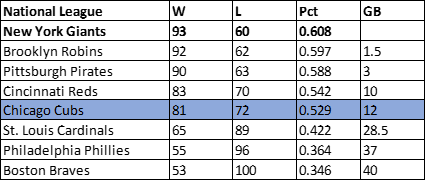
The 1924 Cubs saw a two-game regression in wins and dropped into the fifth slot in the National League. The Cubs were led offensively by catcher, Gabby “Old Tomato Face” Hartnett who slashed .299/16/67. Second baseman, George Grantham topped the team in average hitting .316 and added 12 home runs and 60 RBIs. Keystone corner, Bernie Friberg drove in a team high 82 runs.
The Cub hurlers posted a team ERA of 3.83 and all five starters (Vic Aldridge, Vic Keen, Elmer Jacobs, Grover Alexander and Tony Kaufmann) posted double-digits wins. Righty, Kaufmann allowed a league high 21 round trippers.
1925
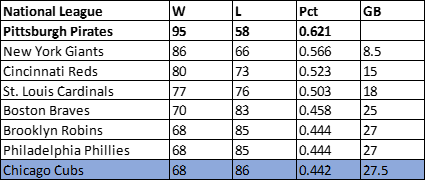
The 1925 version of the Chicago Cubs fell thirteen games in the win column and dropped to the bottom of the National League. The Cubs started the year managed by Bill Killefer who was replaced after 75 games by shortstop Rabbit Maranville in a player/manager capacity. Maranville performed his dual role for the next 53 games to similar results and was ultimately replaced by George Gibson for the balance of the season.
Gabby Hartnett fueled the offense with a .289 average, 24 homers and 67 RBIs despite leading the league in strikeouts with 77. Third baseman, Howard Freigau, paced all regulars with a .307 batting average. First Baseman, Charlie Grimm, contributed a slash line of .306/10/76. Outfielder, Mandy Brooks provided solid numbers posting a .281 average with 14 home runs and 72 runs batted in. Second baseman, Sparky Adams topped the senior circuit in at-bats with 677.
The Cubs’ pitching staff struggled to a team 4.41 ERA during ’25. The Cubs quartet of starting pitchers, Grover Alexander, Sheriff Blake, Wilbur Cooper and Tony Kaufmann, each won double-digit games but combined for a 50-56 record. Reliever, Guy Bush, led the league in saves with four.
1926
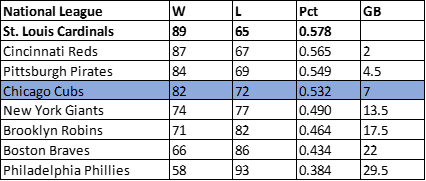
Under new Manager, Joe McCarthy, the 1926 Cubs jumped back into the first division of the National League winning 82 and dropping 72, to finish fourth overall. Outfielder, Riggs Stephenson, topped all regulars with a .338 average. Fellow outfielder, Cliff Heathcote added 10 home runs, 53 RBIs and a respectable .276 average. Outfielder, Hack Wilson led the National League in walks (69) and home runs (21) while clubbing a team best 109 RBIs.
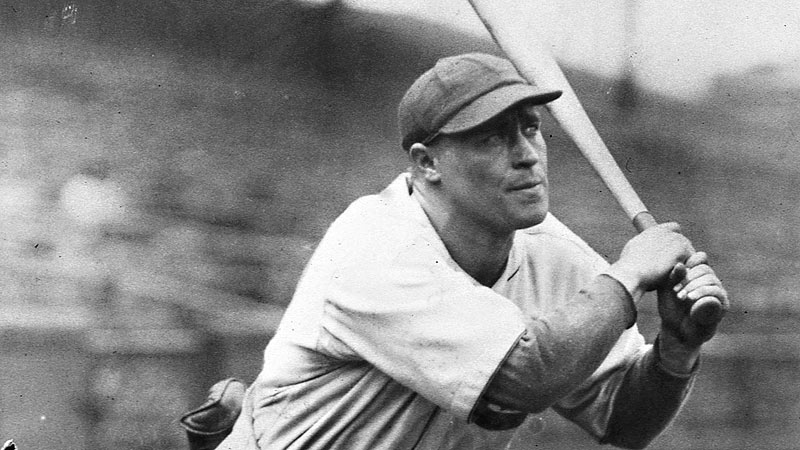
N. L. Home Run Leader (21)
Hack Wilson (CHC)
Catcher, Gabby Hartnett, provided solid numbers once again hitting .275 with eight long balls and 41 RBIs. First baseman, Charlie Grimm, contributed a slash line of .277/8/82.
Starting pitcher, Charlie Root, won a team-high 18 games while losing a league-high 17 games. Sherrif Blake won 11 of 23 decisions while walking a league-most 92 batters. Lefty starter, Percy Jones, won 12 games and posted a 3.09 ERA. Reliever, Guy Bush won 13 games out of the bullpen.
1927
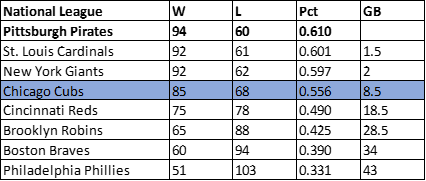
The ’27 Cubs retained their fourth place standing as over one million fans passed through the turnstiles at the newly renamed Wrigley Field. Hack Wilson fueled the offense with a league leading 30 home runs despite striking out a league-high 70 times. Wilson also added 129 RBIs to the aid Cubs cause.
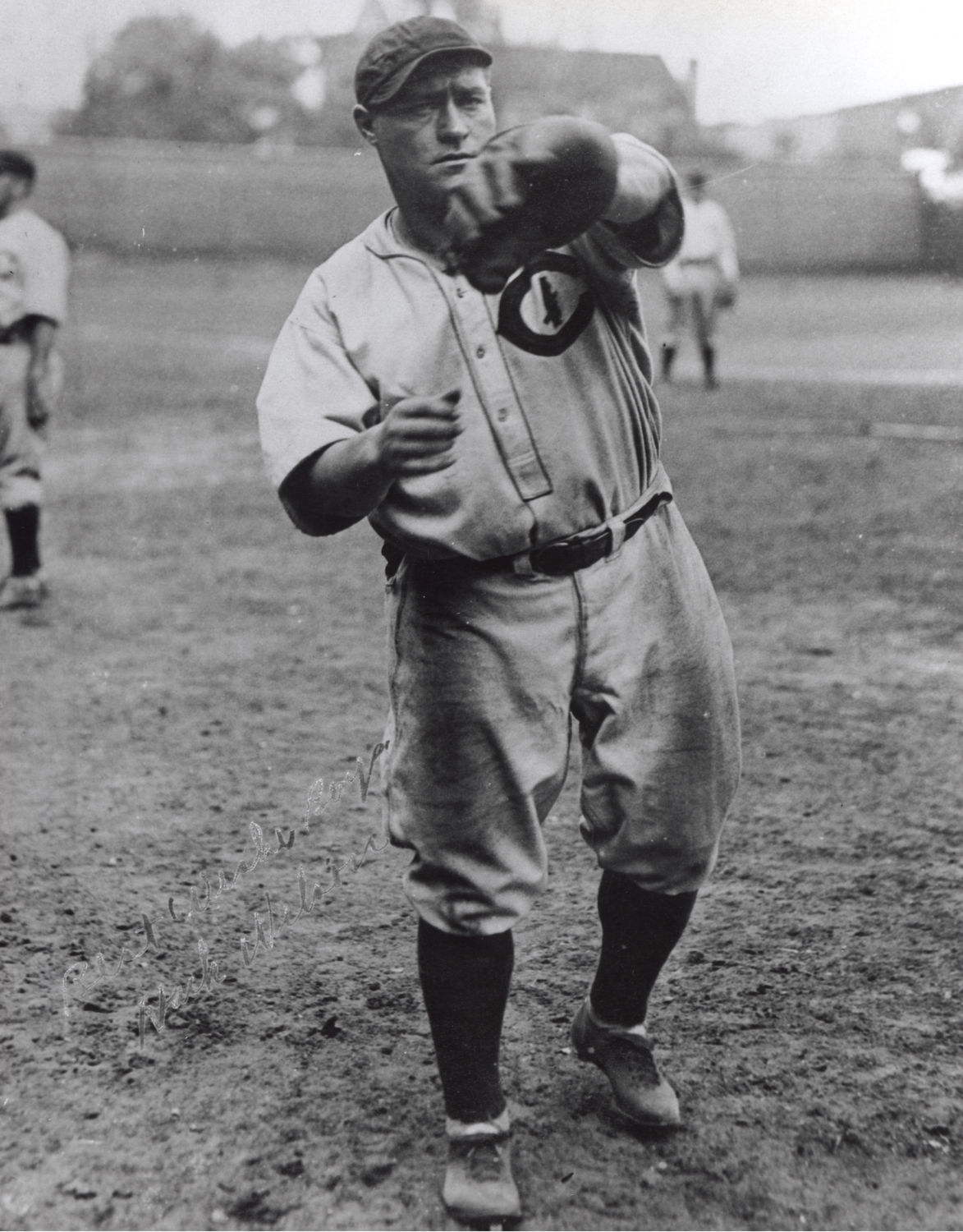
N. L. Co-Home Run Leader (30)
Hack Wilson (CHC)
Third baseman, Sparky Adams, topped the National League in at-bats with 647 and posted a .292 batting average. Outfielder, Riggs Stephenson, led the Senior Circuit in doubles (46) while driving in 82 runs. Catcher, Gabby Hartnett, again provided solid numbers, slashing .294/10/80. Outfielder, Earl Webb, added a .301/14/52 stat line.
Starting pitcher, Charlie Root, won a league high 26 games against 15 defeats in a league leading 48 games and 309 innings.

N. L. Wins Leader (26)
Charlie Root (CHC)
Fellow starters, Sherrif Blake and Hal Carlson, combined to win 25 games for the baby bears. Guy Bush added 10 wins to the tally.
On May 30th, Cubs shortstop Jimmy Cooney made history by completing the sixth unassisted triple play. Cooney caught a line drive hit by Paul Waner, stepped on second to retire Lloyd Waner and tagged Clyde Barnhart advancing to second.
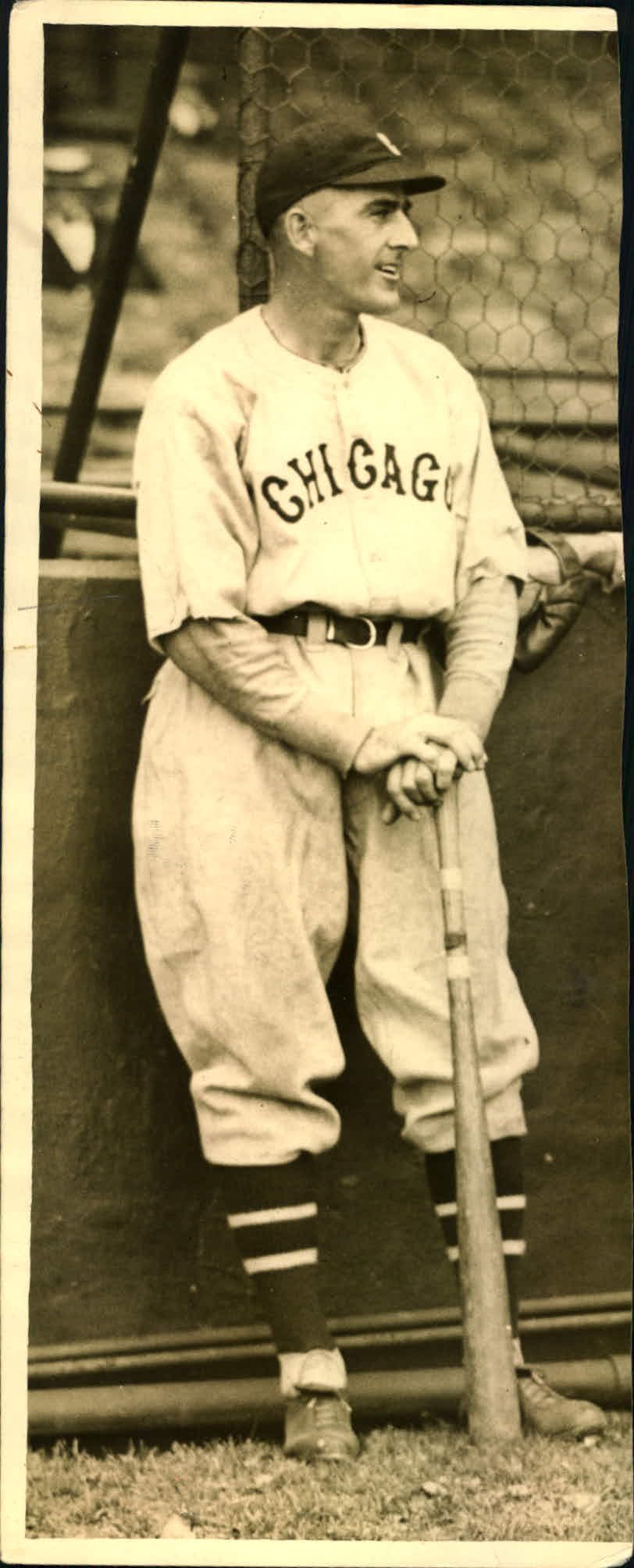
Unassisted Triple Play
Jimmy Cooney
1928
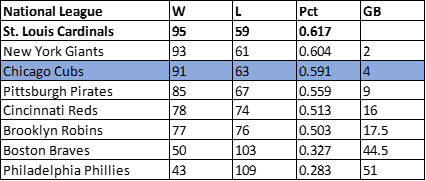
The Cubs improved by six wins in 1928 and moved into third place in the National League. Gabby Hartnett provided offensive firepower for the Cubs, slashing .302/14/57. Hartnett also contributed a league high 102 assists. Hack Wilson tied for the league lead in home runs (31) with Jim Bottomley of the Cardinals. Wilson’s 94 strikeouts were also tops in the league.
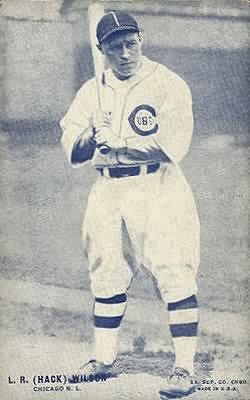
N. L. Co-Home Run Leader (31)
Hack Wilson (CHC)
Offseason acquisition from the Pirates, Kiki Cuyler provided instant results hitting .285 with 17 home runs and 79 RBIs. Cuyler would top the National League in stolen bases with 37.
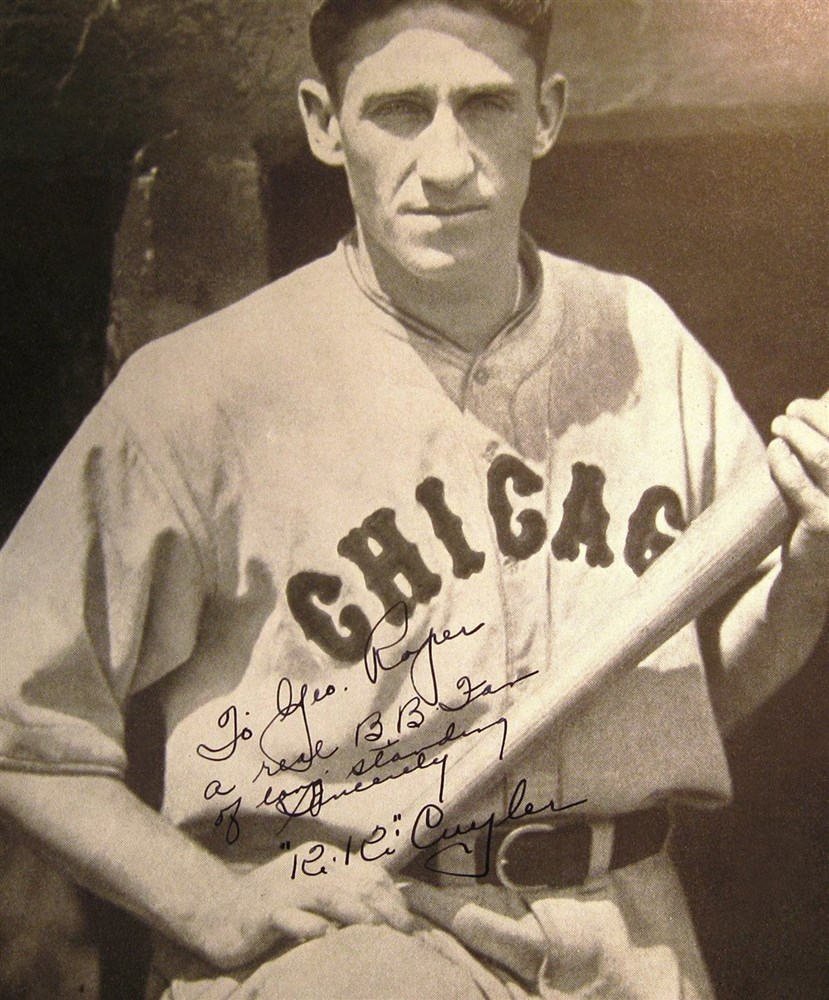
N. L. Stolen Base Leader (37)
Kiki Cuyler (CHC)
The Cubs quintet of starting pitchers all hit double digits in victories led Pat Malone with 18. Sherrif Blake won 17 games and had a league high four shutouts. Guy Bush, Charlie Root and lefty Art Nehf won 15, 14 and 13 respectively. Percy Jones won 10 games and had four saves coming out of the pen.
1929
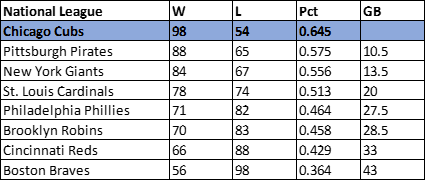
Joe McCarthy’s Cubs soared to the top of the National League in 1929, winning the pennant by 10.5 games over the second place Pittsburgh Pirates. The Cubs would fall in five games to the Philadelphia Athletics in the World Series, but the Cubs were champions of the National League.
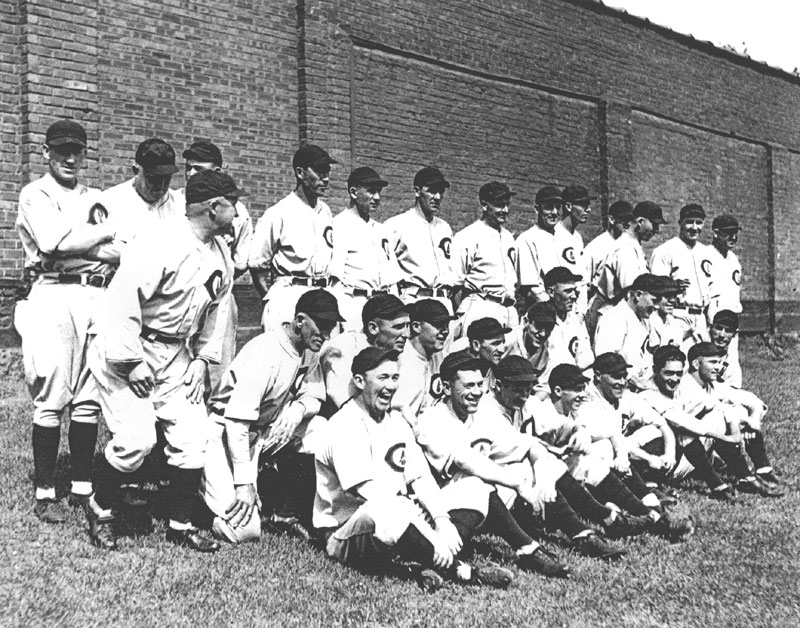
N. L. Champions
Chicago Cubs
Prior to the ’29 season, the Cubs traded five players and cash to the Boston Braves to acquire future hall of fame second baseman, Rogers Hornsby from the Boston Braves. Hornsby would not disappoint in his first year on the North side winning the National League’s Most Valuable Player Award.
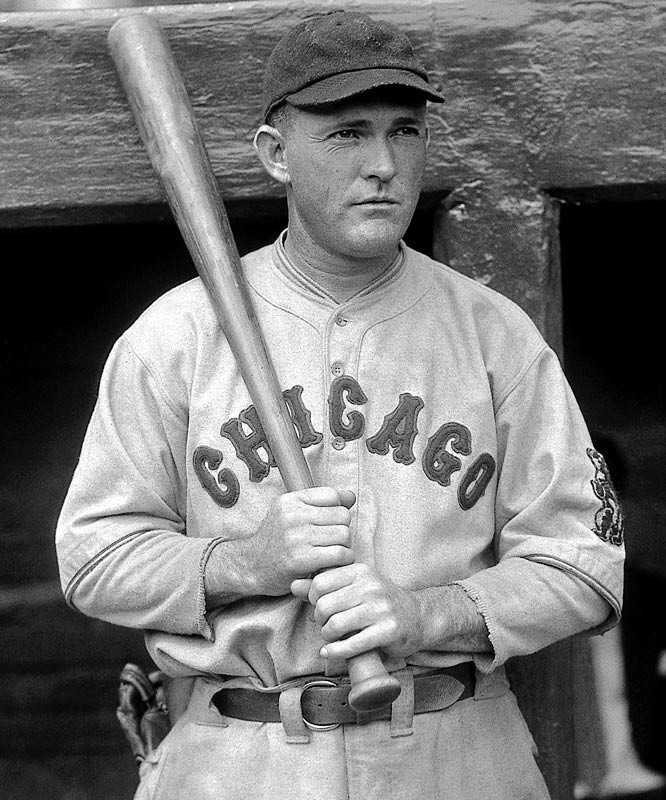
N. L. Most Valuable Player
Rogers Hornsby (CHC)
Hornsby would lead the National League in WAR (10.6), Games (156), Runs (156), Slugging Percentage (.679) and OPS (1.139) while batting .380 for the season. Aiding the Cubs offensively was Hack Wilson who tallied 159 runs batted in to top all players in the Senior Circuit. Wilson hit .345 for the year and left Wrigley Field 39 times.
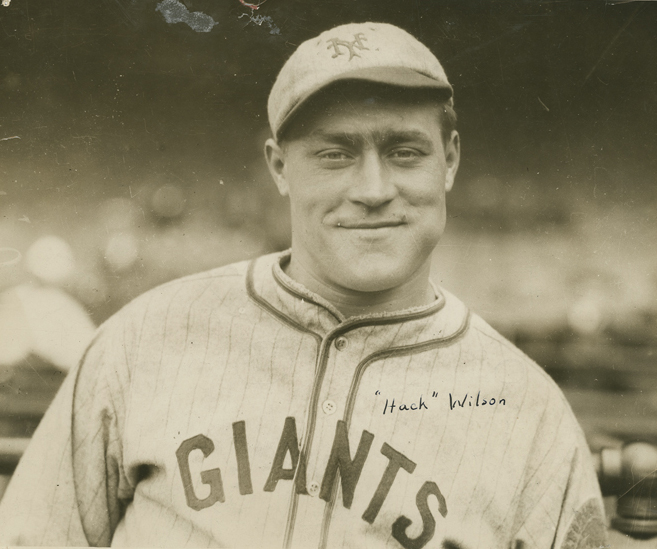
N. L. RBI Leader (159)
Hack Wilson (CHC)
Outfielder, Riggs Stephenson had a strong year batting .362 with 17 home runs and 110 RBIs. Fellow outfielder, Kiki Cuyler, hit .360 with 15 homers and 102 RBIs while leading the National League in stolen bases with 43.
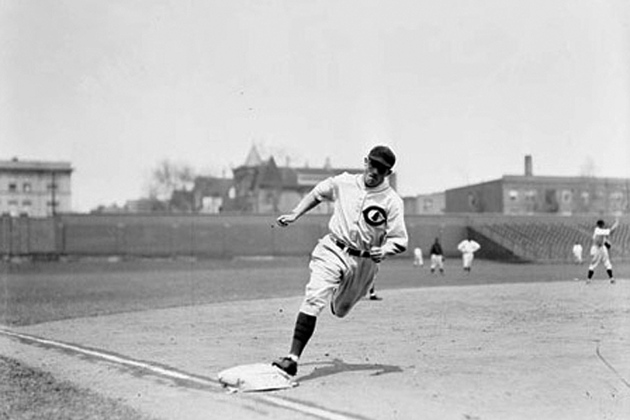
N. L. Stolen Base Leader (43)
Kiki Cuyler (CHC)
The pitching staff was anchored by Pat Malone who led the league in Wins (22), shutouts (5) and strikeouts (166).
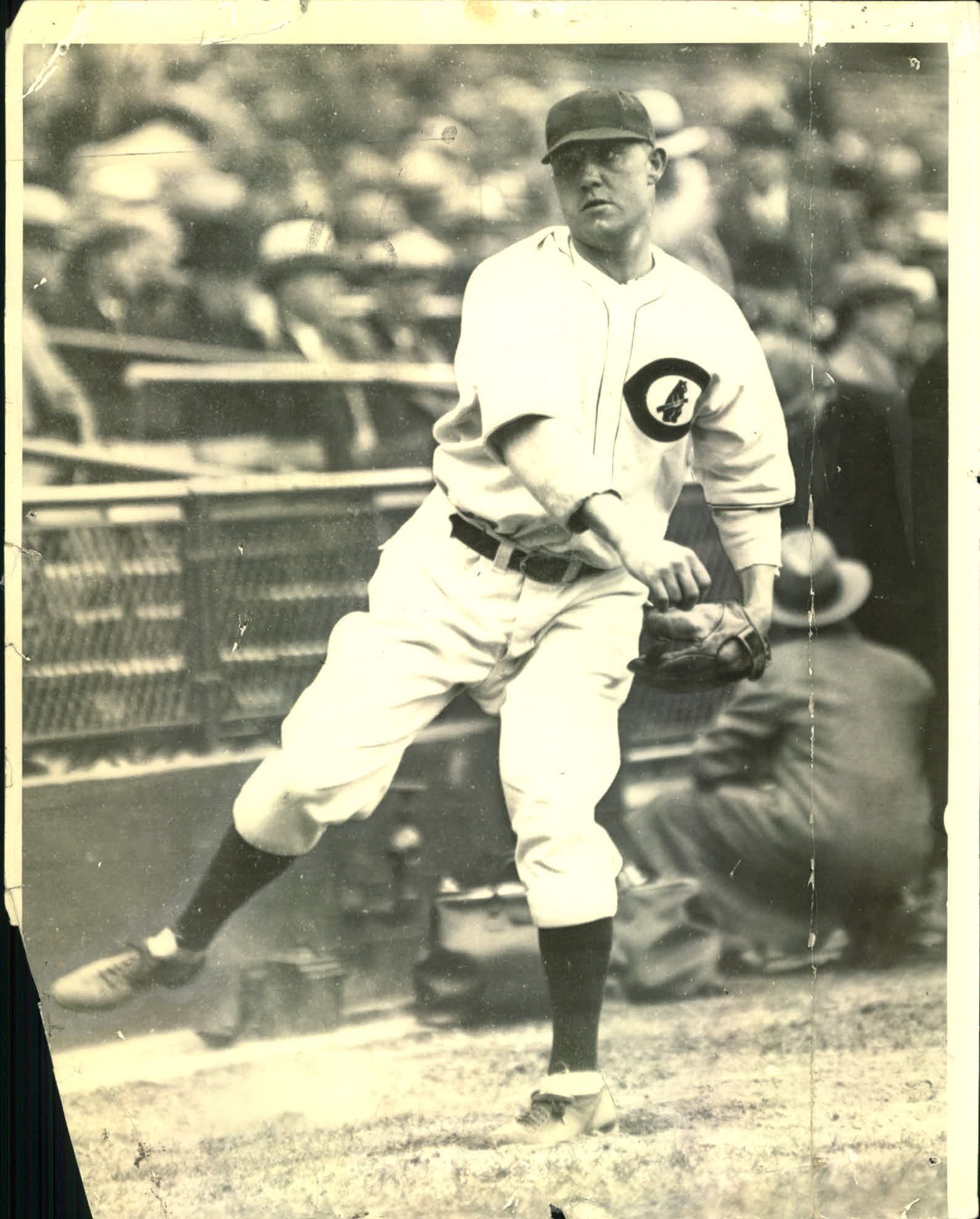
N. L. Wins Leader (22)
Pat Malone (CHC)
N. L. Strikeout Leader (166)
Pat Malone (CHC)
Charlie Root won 19 games with 6 losses for the best winning percentage among all qualified pitchers in the National League. Guy Bush won 18 games and lost 7 while recording league highs in games (50) and saves (8). Sherriff Blake rounded out the starting rotation by winning 14 games and dropping 13. Hal Carlson added 11 wins out of the bullpen.
1930
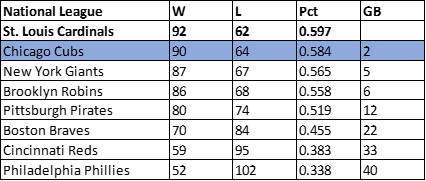
The 1930 version of the Cubs fell back to second place despite a tremendous year offensively across the board. The Cubs hit .309 as a team and were led by Hack Wilson who recorded one of the best offensive seasons ever. Wilson led the N. L. in home runs (56), RBIs (191), walks (105), slugging percentage (.723) and OPS (1.177). Wilson hit .356 for the year despite tallying the most strikeouts in the league with 84.
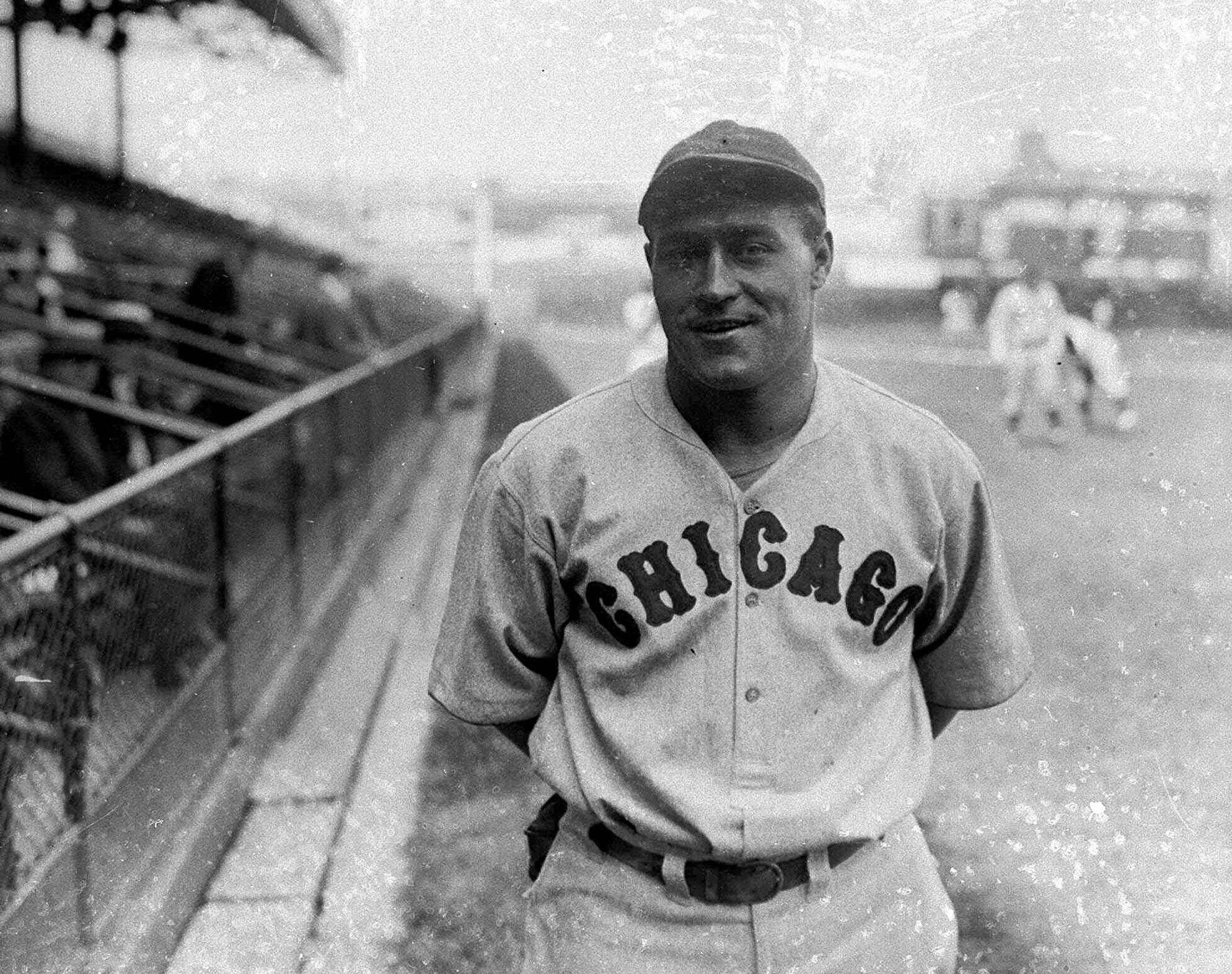
N. L. Home Run Leader (56)
Hack Wilson (CHC)

N. L. RBI Leader (191)
Hack Wilson (CHC)
On June 23rd, Wilson hit for the cycle against the visiting Philadelphia Phillies on his way to winning Most Valuable Player in the National League. Wilson’s record-breaking mark of 191 runs batted in still stands to-date and will probably never be matched.
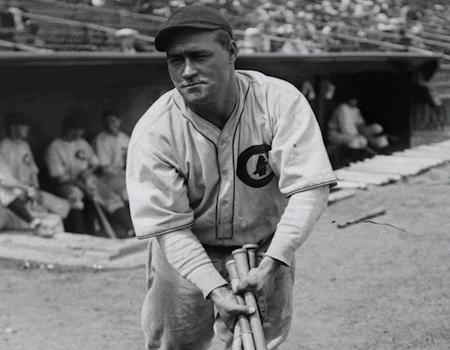
Cycle:
Hack Wilson (CHI)
vs. Philadelphia Phillies
Third baseman, Woody English and outfielder Kiki Cuyler each appeared in a league high 156 games, while English topped the N.L. in plate appearances with 755 and Cuyler again led the league in stolen bases with 37.
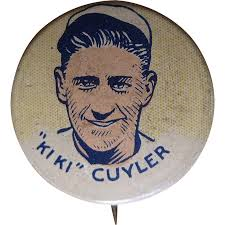
N. L. Stolen Base Leader (37)
Kiki Cuyler (CHC)
Catcher, Gabby Hartnett, contributed exceptional numbers slashing .339/37/122. Third baseman, Woody English provided a solid stat line of .335/14/59.
The pitching staff regressed from their pennant-winning form of 1929 recording a team ERA of 4.80. Pat Malone tied for the most wins (20) in the National League with Ray Kremer of the Pittsburgh Pirates including a league high 22 complete games.
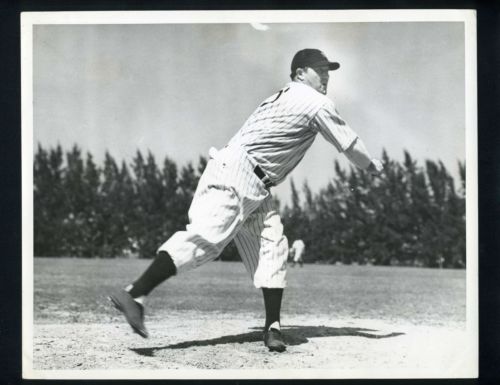
N. L. Co-Wins Leader (20)
Pat Malone (CHC)
Fellow starter, Guy Bush won 15 games while losing 10. Charlie Root won 16 of 30 decisions while notching a league high 4 shutouts. Sherriff Blake won 10 of 24 decisions to round out the starting staff. Lefty, Bud Teachout and righty, Bob Osborn added 21 wins out of the bullpen. Rogers Hornsby would relieve Joe McCarthy of managerial duties for the last four games of the year and retain the position into 1931.
1931
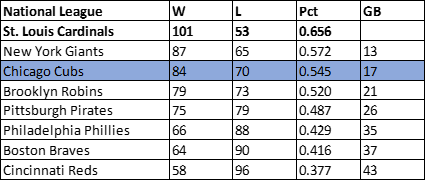
The Cubs would drop another spot in the National League in 1931, finishing third, 17 games behind the pennant-winning St. Louis Cardinals. The pitching staff would show improvement over the prior campaign combining for a team ERA of 3.97. Starters, Charlie Root, Bob Smith, Pat Malone and Guy Bush would all win 15 or more games for the Cubs.
Shortstop, Woody English would again lead the National League in games (156) and plate appearances (727) while slashing .319/2/53. Rogers Hornsby led the league in On-Base Percentage (.421) and OPS (.996) while recording a .331 average and drove in 90 runs. First baseman, Charlie Grimm hit .331 with four home runs and 66 RBIs. Hack Wilson’s numbers declined to .261/13/61 due to a prolonged slump during the ’31 season.
1932
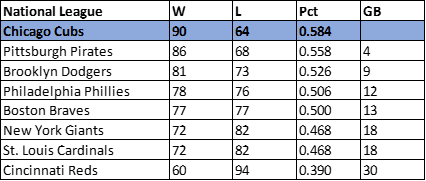
The Cubs returned to the top of the National League by winning 90 games and securing the National League pennant.
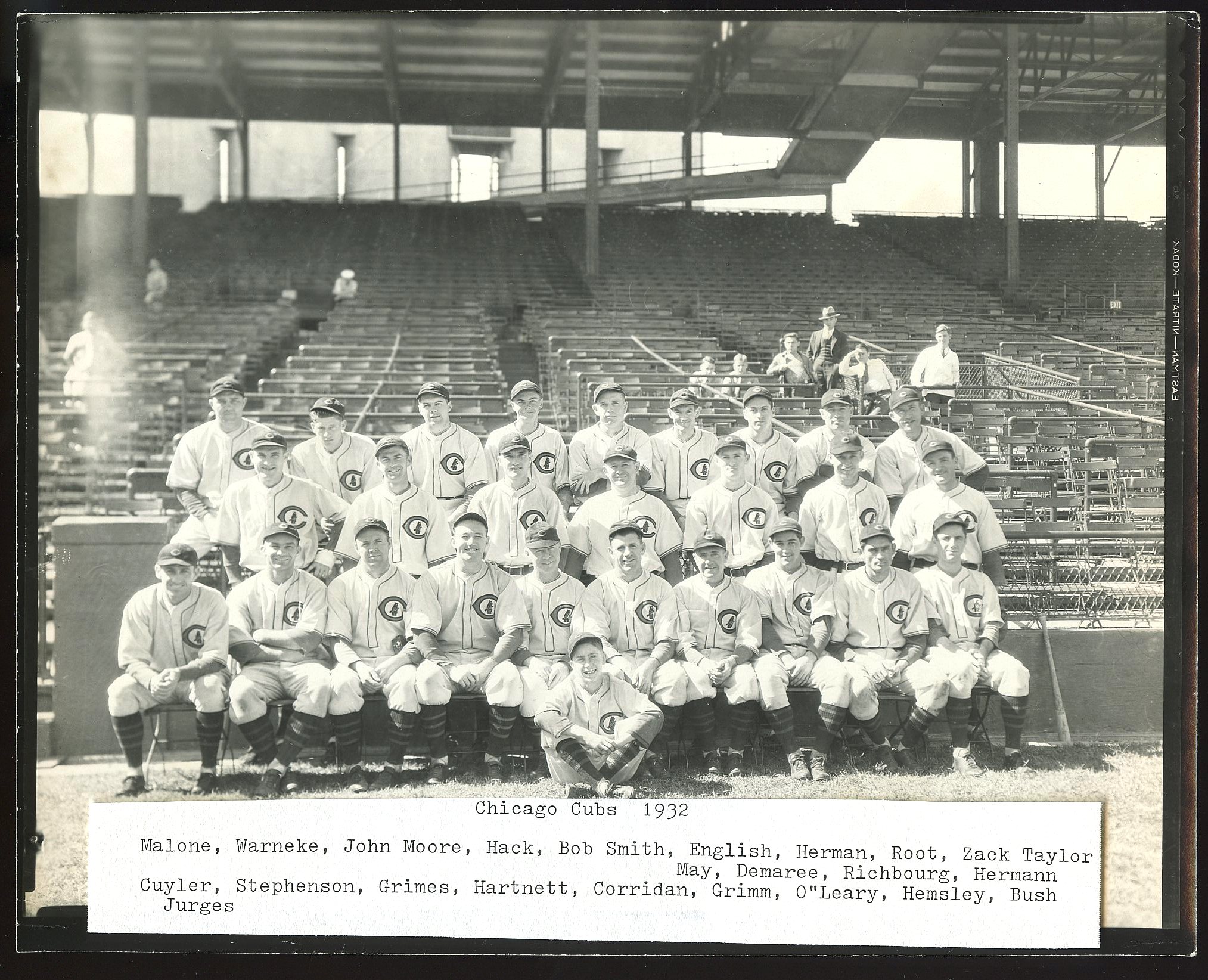
N. L. Champions
Chicago Cubs
Lon Warneke would anchor the pitching staff winning a league high 22 games along with a league low 2.37 ERA.
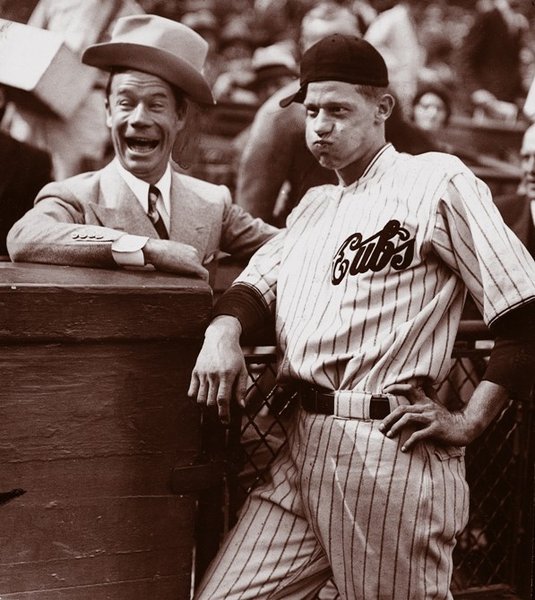
N. L. Wins Leader (22)
Lon Warneke (CHC)
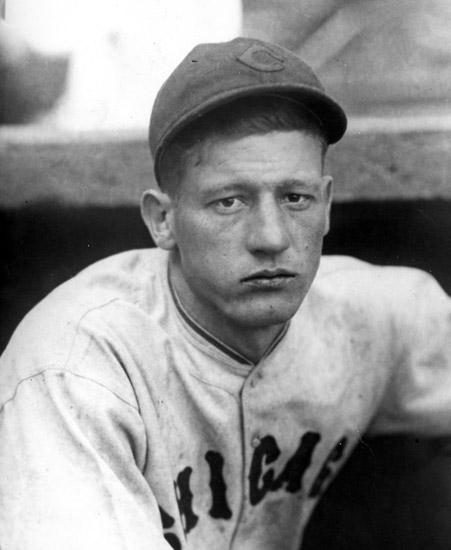
N. L. ERA Leader (2.37)
Lon Warneke (CHC)
Warneke would top the N. L. in WAR (6.9), winning percentage (.786) and shutouts (4). Pat Malone and Charlie Root would each win 15 games while Guy Bush would record 19 victories.
Outfielder, Riggs Stephenson, would lead the team in batting average (.324) and RBIs (85). Outfielder, Johnny Moore and catcher, Gabby Hartnett, would hit 13 and 12 home runs respectively. Second baseman, Billy Herman would lead the league in three categories including games (154), plate appearances (723) and caught stealing (18).
On August 3rd, Rogers Hornsby was released from the Cubs as Player/Manager. First Baseman, Charlie Grimm, would take over managerial duties for the remainder of the season.
The Cubs would go on to face the New York Yankees in the World Series and were swept in four straight games.
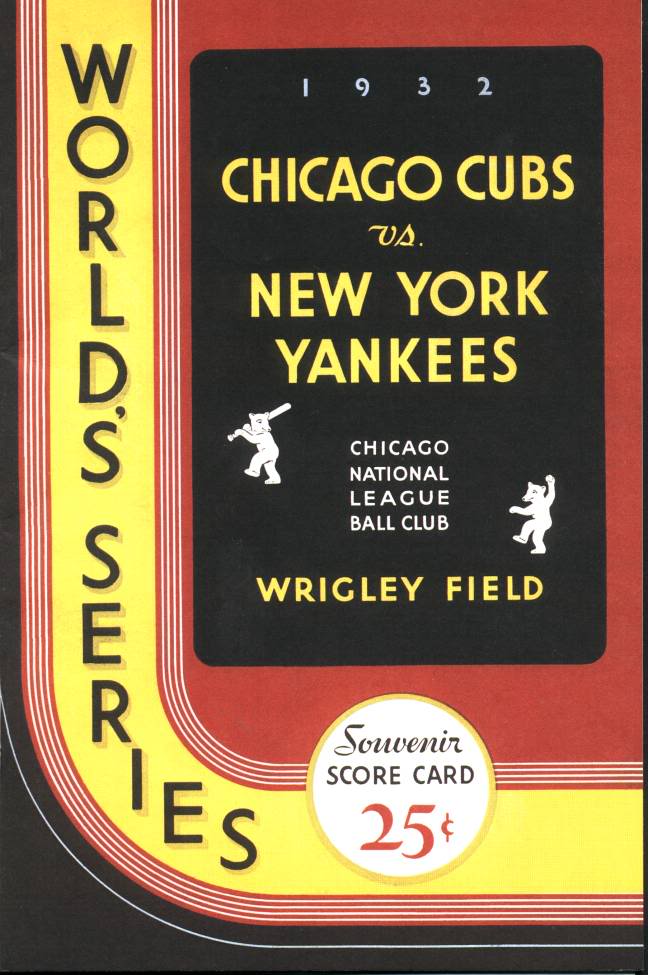
Yankees Defeat Cubs
Win World Series 4-0
During game 3 at Wrigley Field, Babe Ruth pointed toward the outfield seemingly calling his home run to follow. The veracity of the actual event remains unclear to this day.
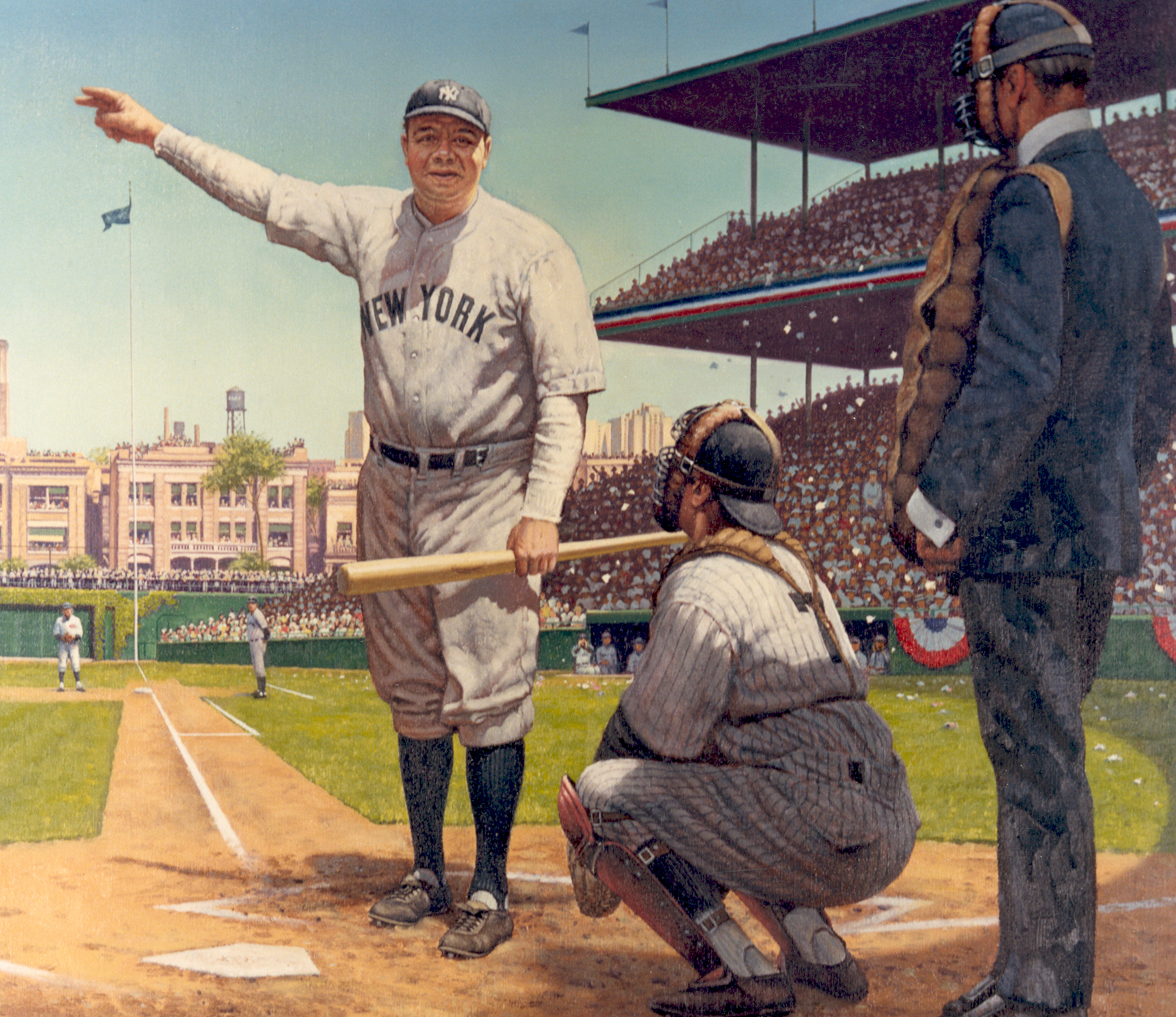
The Called Shot
Babe Ruth
1933
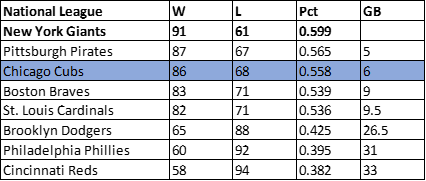
The Cubs of 1933 fell back into third place in the National League, six games behind the pennant-winning New York Giants. Outfielder, Riggs Stephenson, led the regulars in batting average at a .329 clip. The Chicago offense was powered by catcher Gabby Harnett and offseason acquisition, Babe Herman. Each tallied 16 home runs on the season with Hartnett providing 88 RBIs and Herman 93. Hartnett along with third baseman Woody English would receive invites to the first Major League All-Star game at Chicago’s Comiskey Park.

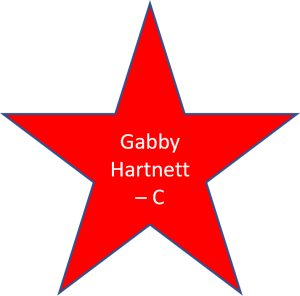
The pitching staff performed admirably, combining for a 2.93 ERA. Lon Warneke was named an All-Star based on an 18-13 record and a league high 26 complete games. Guy Bush led the team in wins with 20 opposed by 12 losses. The remaining starters, Charlie Root, Pat Malone and Bud Tinning all won 10 plus games on the year. Tinning led the National League in winning percentage with his 13-6 record.
1934
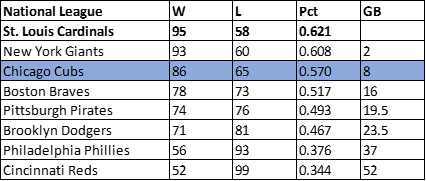
The Cubs maintained their third-place status in 1934 finishing eight games back of the St. Louis Cardinals. The Cubs had two major acquisitions for 1934 in the form of the Wrigley Field Marquee and future Hall of Famer Chuck Klein.
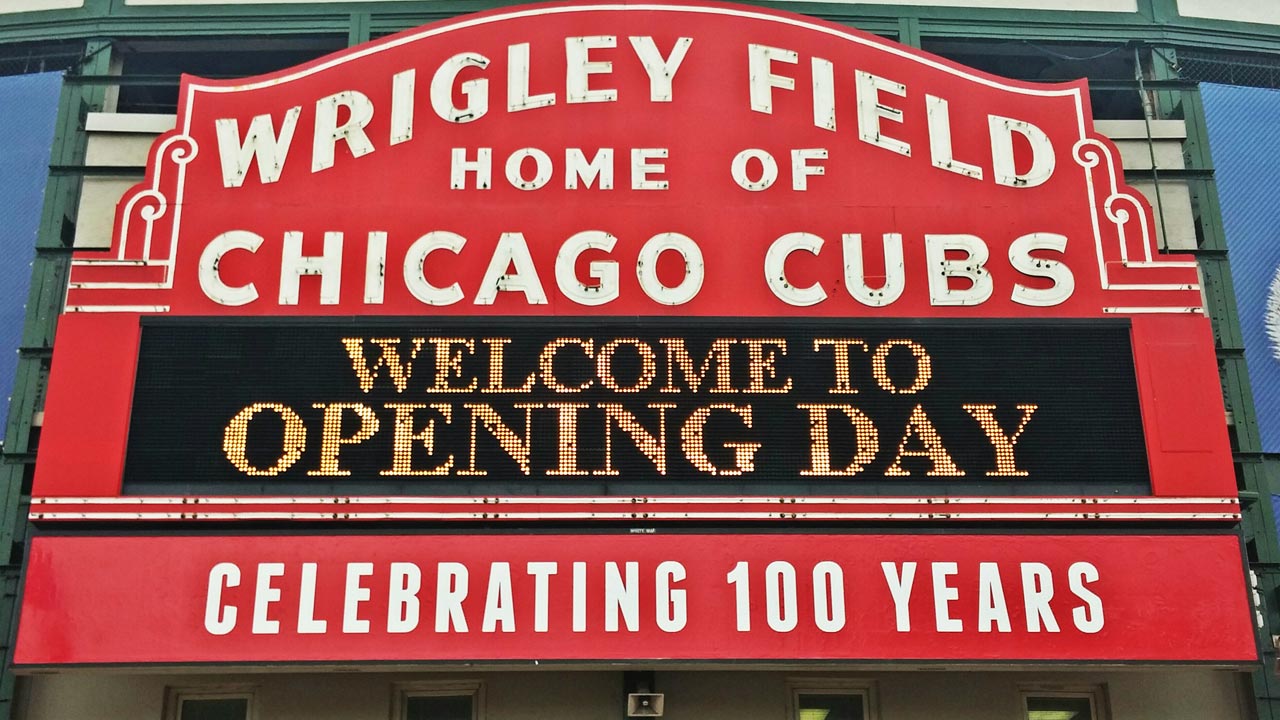
Wrigley Field Marquee
Klein arrived from Philadelphia via a four-player trade plus cash in November of 1933. Klein would hit .301 with 20 home runs and 80 RBIs. Solid enough numbers to garner an All-Star invite. Kiki Cuyler and Gabby Hartnett both received starting nods for the Midsummer Classic by slashing .338/6/69 and .299/22/90 respectively. Second baseman, Billy Herman, was also invited to the All-Star game based on his .303/3/42 stat line.
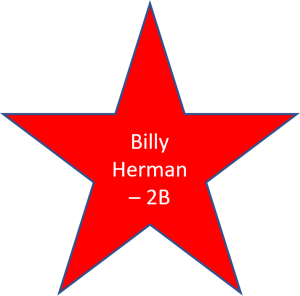
Lon Warneke received his second All-Star bid based on his 22 wins, 143 strikeouts and 3.21 ERA. The remaining starters, Bill Lee, Guy Bush, Pat Malone and Jim Weaver all won 11 or more games to round out the rotation. Bud Tinning and Charlie Root each won 4 games in relief roles.
1935
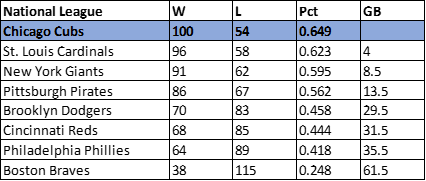
The Cubs returned to the top of the National League in 1935, winning 100 games and claiming the pennant by four games over the St. Louis Cardinals. The Cubs had a 21-game winning streak in September to capture the gonfalon.

N. L. Champions
Chicago Cubs
The ’35 Cubs were led by the Most Valuable Player performance of catcher Gabby Hartnett. Harnett batted .344 with 13 home runs and 91 RBIs. Hartnett became the first catcher in the National League to win the MVP award.

N. L. Most Valuable Player
Gabby Hartnett (CHC)
Hartnett and Billy Herman each received invites to the All-Star Game in Cleveland. Herman got the nod as starting second baseman due to his .341/7/83 slash line. Herman also led the National League in hits (227) and doubles (57).
Outfielder, Augie Galan, was an integral part of the Cubs success in ’35, leading the N. L. in plate appearances (748), runs (133) and stolen bases (22).
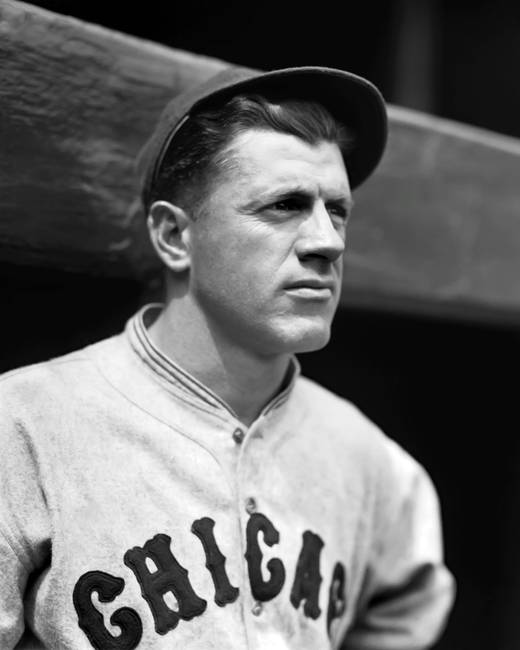
N. L. Stolen Base Leader (22)
Augie Galan (CHC)
The Cubs rotation combined for a team ERA of 3.26 and were led by 20-game winners Lon Warneke and Bill Lee. Lee topped the Senior Circuit in winning percentage at .769. Lefty, Larry French, posted 17 victories and his 4 shutouts were the most in the National League. Tex Carleton and Roy Henshaw rounded out the starters will 11 and 13 wins respectively. Veteran Charlie Root added 15 wins in a relief role. The Cubs would fall short again in the World Series losing in six games to the Detroit Tigers.
1936

After winning the pennant in 1935, the Cubs dropped to second place in ’36. The baby bears won 87 games and finished five back of the New York Giants. The season started on a high note for second baseman, Billy Herman. Herman collected five hits on opening day, a feat that would not be replicated for the rest of the 20th century. Herman slashed .334/5/93 for the year and earned a starting spot in the midsummer classic in Boston’s National League Park. Outfielders, Frank Demaree (.350/16/96) and Augie Galan (.264/8/81) along with catcher Gabby Hartnett (.307/7/64) also earned starters roles in the All-Star game.
A quartet of Cubs starters, Bill Lee, Larry French, Tex Carleton and Lon Warneke each recorded four shutouts, tops in the National League. Warneke, along with fellow starter, Curt Davis, were both all-star invitees. All five starters won 11 or more games and combined for a team ERA of 3.54.
1937
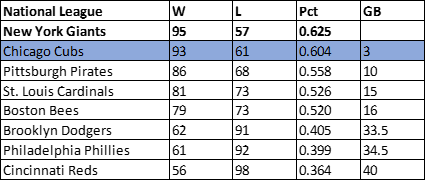
The Cubs finished second in the National League for the second straight year, trailing the Newy York Giants by three games. The offseason provided four new additions to Wrigley Field. The construction of centerfield bleachers was completed in time for the ’37 season.
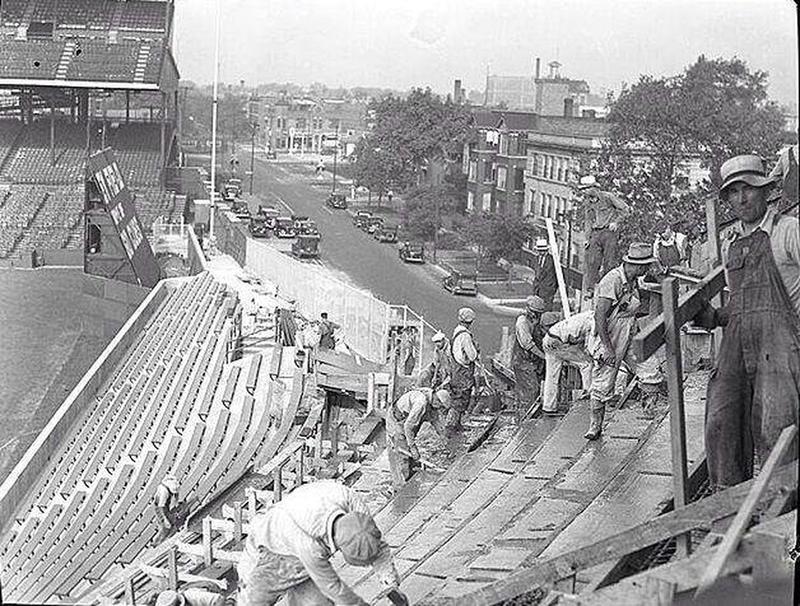
Wrigley Field Bleachers Built
1937
Atop the newly built bleachers, the Cubs installed a large hand turned scoreboard.

Wrigley Field
Hand-Turned Scoreboard
Ivy was planted on the outfield wall, which would become an iconic trademark of Wrigley Field.
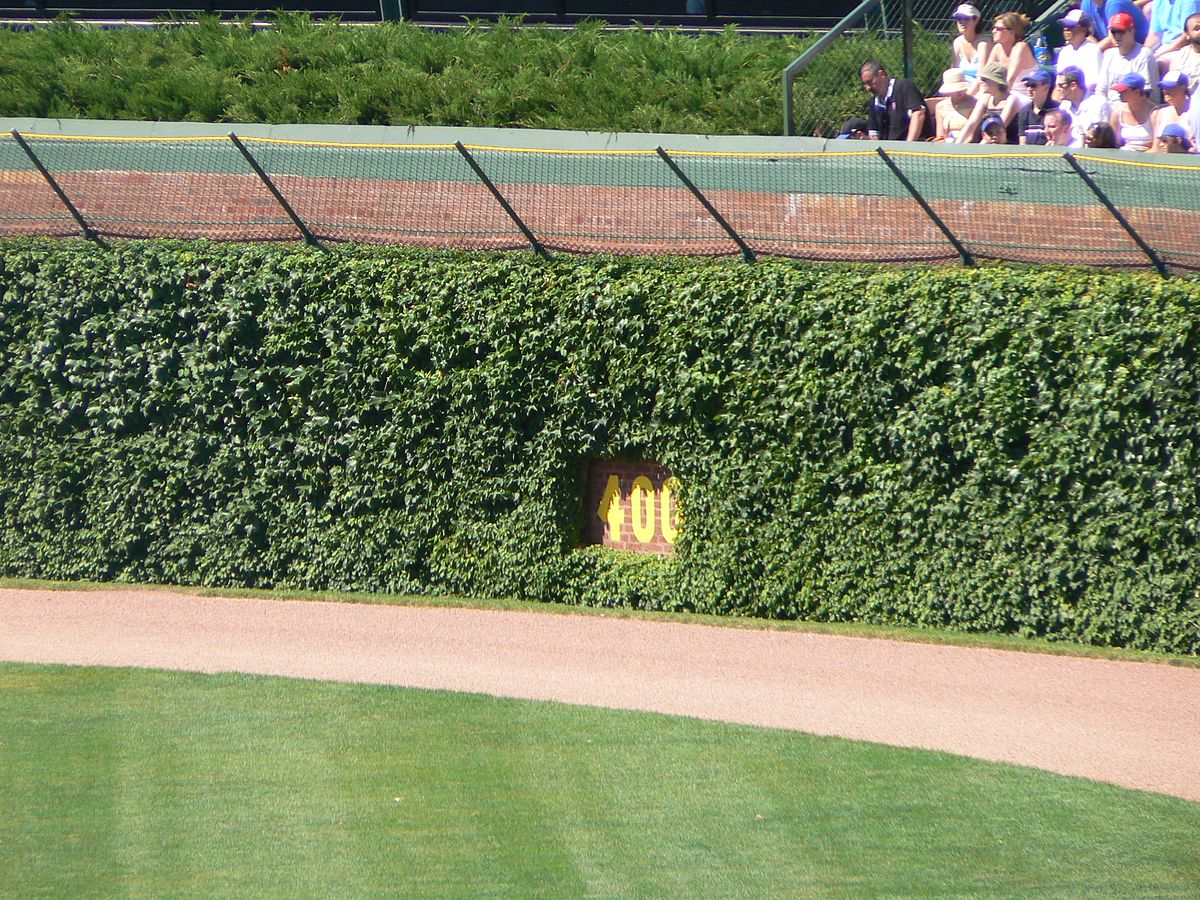
Ivy Planted on The Outfield Wall
William Wrigley Jr. purchased the Catalina Island Company in 1919. He also purchased the Wilmington Transportation Company. The “W” flag was flown on Catalina Island and Wrigley Field as advertisement. Starting in 1937, the flag was repurposed to represent a win for the Cubs. A tradition that continues to this day.
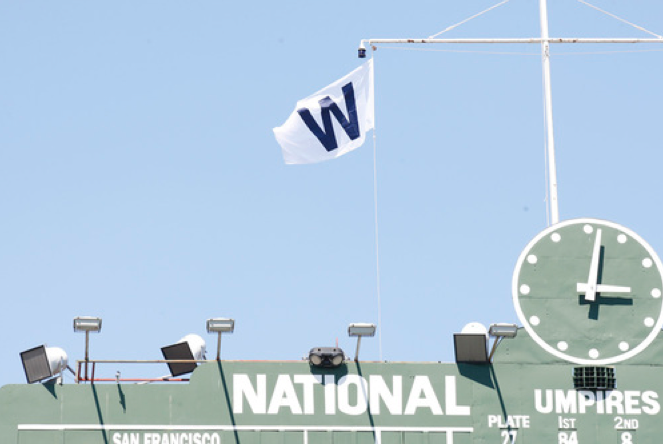
Cubs Win Flag
The Cubs pitching staff sported a 3.97 ERA for the season. Bill Lee led the league in games started but managed a middling 14-15 record. Righty, Tex Carleton and Lefty, Larry French each won 16 games for the Cubbies. Charlie Root and Curt Davis provided 13 and 10 wins respectively out of the bullpen.
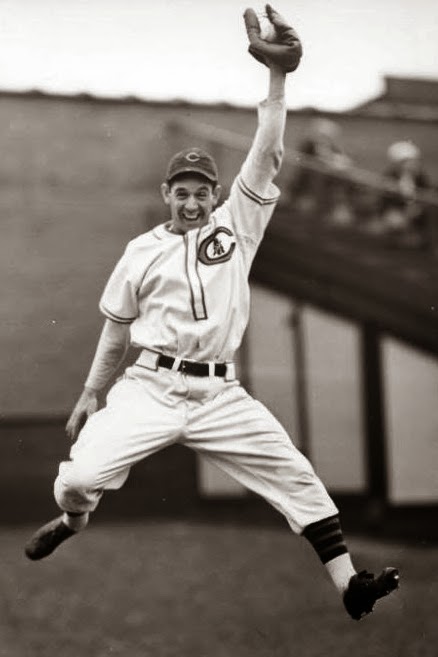
The Cubs sent five position players to the All-Star game in the nation’s capital. Frank Demaree (.324/17/115), Gabby Hartnett (.354/12/82) and Billy Herman (.335/8/65) were all named starters for the game at Griffith Stadium. Billy Jurges (.298/1/65) and Ripper Collins (.274/16/71) were named as reserves for the National League squad.


Outfielder, Augie Galan, led the National League in plate appearances (695) and stolen bases (23).
N. L. Stolen Base Leader (23)
Augie Galan (CHC)
1938
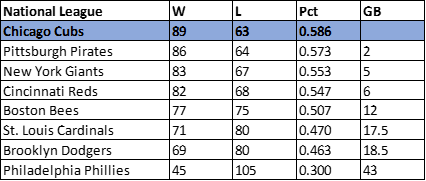
The Cubs returned to the top of the National League in 1938, exceeding the Pirates win total by three games. Gabby Hartnett replaced Charlie Grimm as Manager on July 20th and pushed the Cubs from third place to the National League crown.
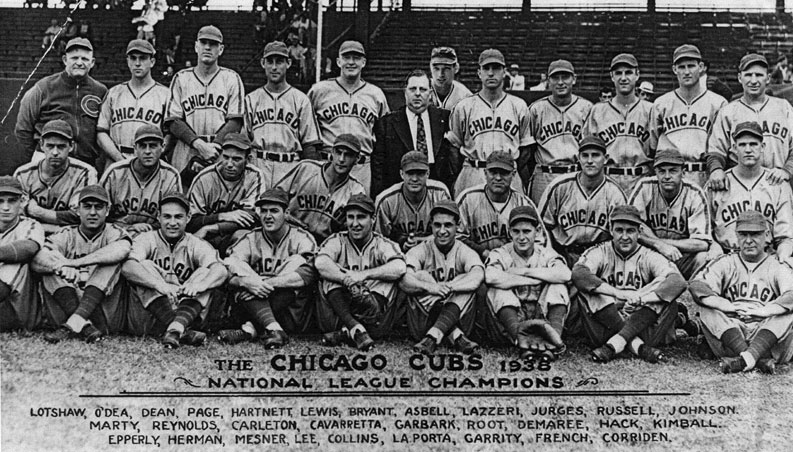
N. L. Champions
Chicago Cubs
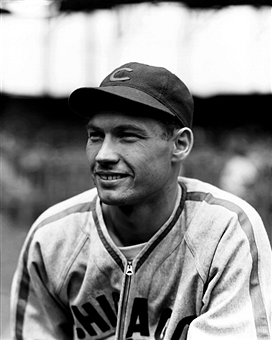
The Cubs acquired future Hall of Famer Dizzy Dean in the offseason, and he rewarded the Cubs with a 7-1 record and 1.81 ERA. Fellow starter, Bill Lee was the ace of the staff, leading the National League in WAR (8.0), wins (22), winning percentage (.710), games started (37), shutouts (9) and ERA (2.66). Lee was named an All-Star for the game in Cincinnati.

N. L. Wins Leader (22)
Bill Lee (CHC)
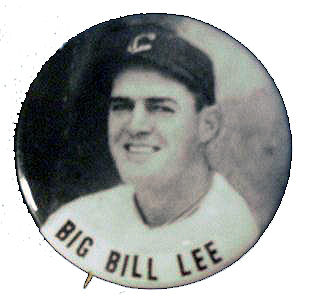
N. L. ERA Leader (2.66)
Bill Lee (CHC)
Clay Bryant was a formidable number two starter recording a 19-11 record and leading the senior circuit in strikeouts with 135.
N. L. Strikeout Leader (135)
Clay Bryant (CHC)
Both Tex Carleton and Larry French won 10 games to round out the starting staff. Charlie Root, Jack Russell and Al Epperly combined to win 16 games out of the bullpen.
Third baseman, Stan Hack, was named an All-Star starter for leading the league in games played (152), plate appearances (707) and stolen bases (16).
N. L. Stolen Base Leader (16)
Stan Hack (CHC)
Billy Herman and Gabby Hartnett were also selected for the All-Star game at Crosley Field. Herman was named the starting second baseman based on his .277/1/56 stat line. Hartnett participated as a reserve with a .274/10/59 slash. Hartnett’s “Homer in the Gloamin” helped the Cubs clinch the pennant against the Pirates on September 28th.

“Homer in the Gloamin”
Gabby Hartnett (CHC)
The Cubs would face the New York Yankees in the World Series and dropped four straight games. Bill Lee lost both decisions to Yankees ace Red Ruffing.
1939
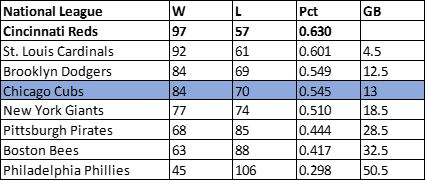
The 1939 edition of the Chicago Cubs dropped to fourth place in the National League, 13 games behind the front-running Cincinnati Reds. Bill Lee once again led the pitching staff with a 19-15 record paired with a league-high games started (36). For his efforts, Lee was named to the All-Start team in the Bronx. Mid-Season acquisition from the Phillies, Claude Passeau, led the National League in strikeouts with a combined total of 137.
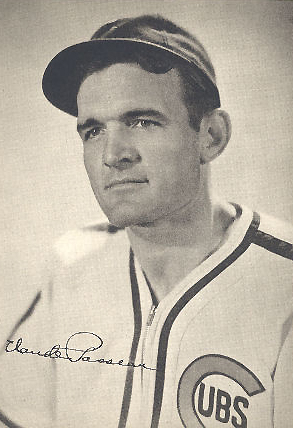
N. L. Co-Strikeout Leader (137)
Claude Passeau (CHC/PHI)
Third baseman, Stan Hack was named an All-Star starter leading the N. L. in plate appearances (724) and stolen bases (17).
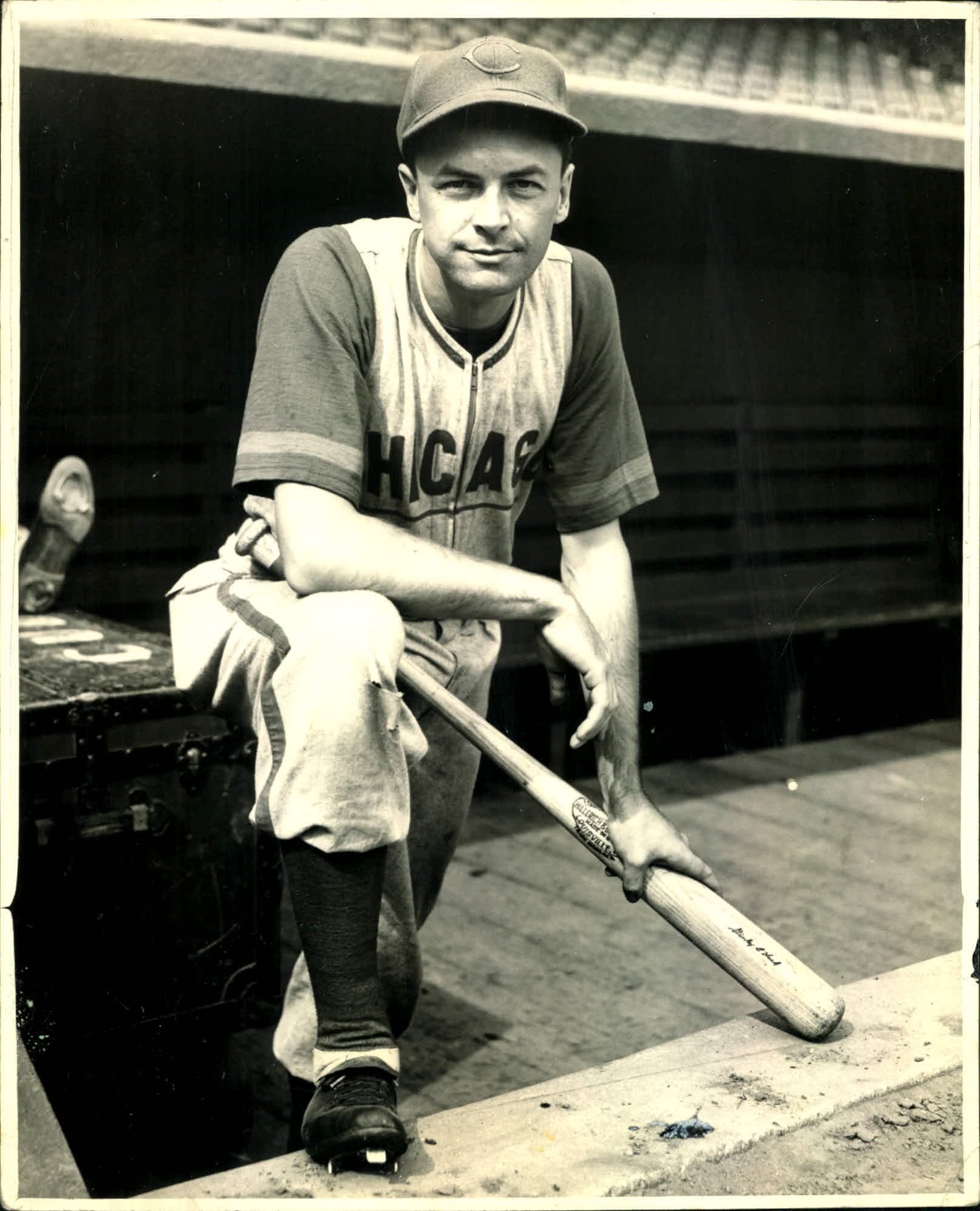
N. L. Co-Stolen Base Leader (17)
Stan Hack (CHC)
Second baseman, Billy Herman slashed .307/7/70 and led the National League in triples with 18 earning himself a reserve role in the All-Star game at Yankee Stadium. 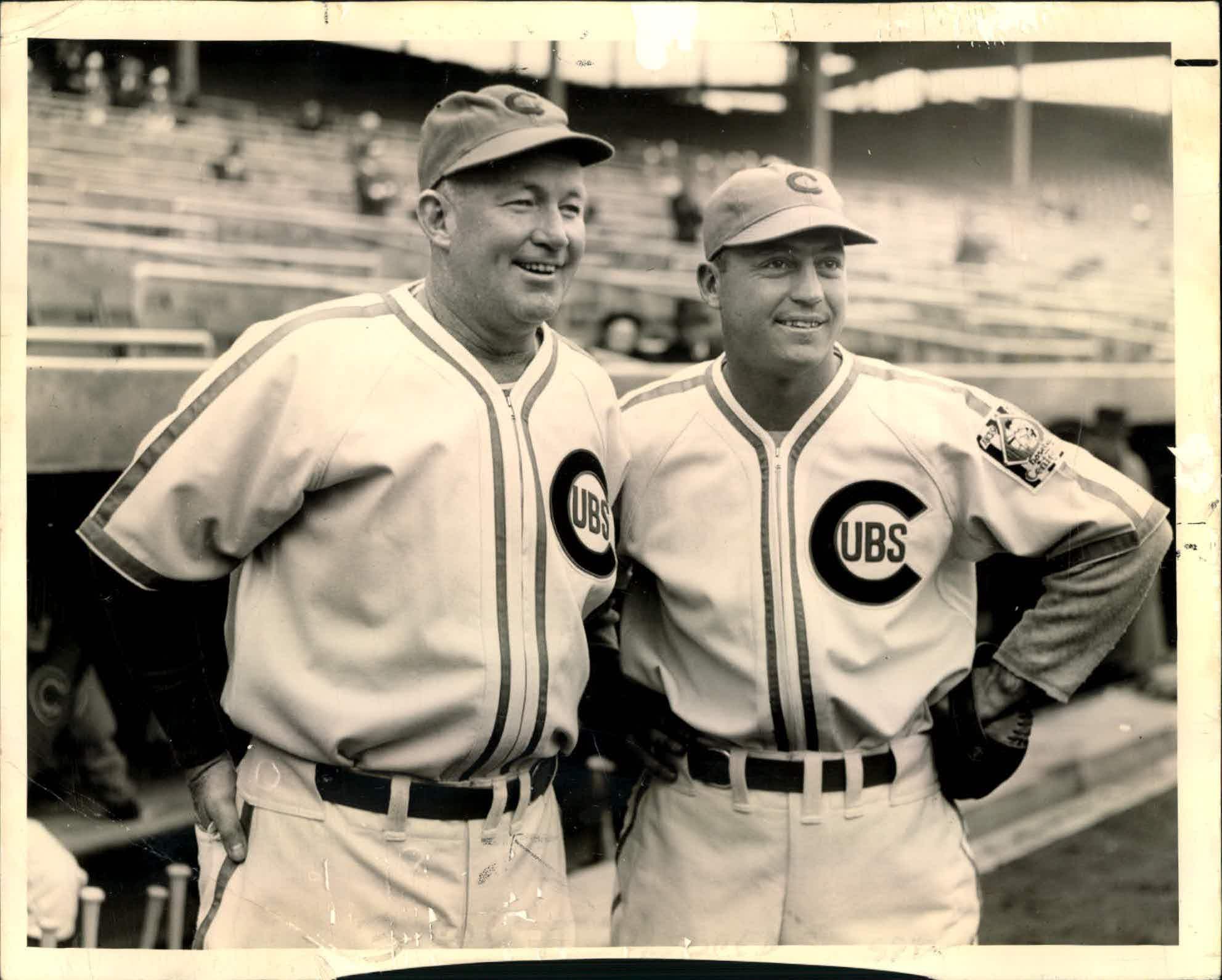
N. L. Triples Leader (18)
Billy Herman (CHC)
1940
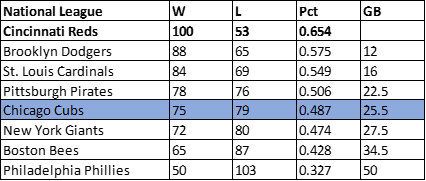
The 1940 Cubs never challenged for the pennant, dropping five of their first seven games and finishing in fifth place, 25.5 games behind the Cincinnati Reds. The pitching staff had a respectable season posting a combined 3.54 ERA. 20-game winner, Claude Passeau, led the National League in WAR (6.9). Vern Olsen won 13 games while recording a 2.97 ERA in 211+ innings. Lefty, Larry French, won 14 of 28 decisions but made the All-Star team based on a strong first half showing.
Second baseman, Billy Herman, earned a starting nod at the midsummer classic in St. Louis by slashing .292/5/57. Outfielders, Bill “Swish” Nicholson (.297/25/98) and Hank Leiber (.302/17/86) both earned reserve roles for the All-Star game at Sportsman’s Park. Third baseman, Stan Hack, led the National League in hits (191) and caught stealing (22).
1941
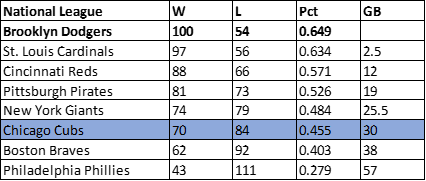
The 1941 Cubs dropped to sixth in the National League standings. The starting rotation held their own as the staff combined for a team ERA of 3.72. Claude Passeau notched 14 wins against 14 defeats and was named to the All-Star game in Detroit. The remaining starters, Vern Olsen, Bill Lee, Larry French and Charlie Root combined to win just 31 games for the Cubbies.

Stan Hack led the National League in hits (186) and plate appearances (694) while slashing .317/7/45 and earning the starting third base role in the All-Star game. Outfielder, Bill Nicholson, was also selected to start the All-Star game at Briggs Stadium. Nicholson (.254/26/98) would join fellow outfielder, Hank Leiber (.216/7/25) who was selected as a reserve. Leiber missed the second half of the ’41 season after being beaned by Giants pitcher Cliff Melton on June 23rd.
1942

The 1942 version of the Chicago Cubs maintained their sixth place standing in the National League, winning two less games than the prior campaign. The pitchers combined for a respectable team ERA of 3.60. Starting pitchers, Claude Passeau, Bill Lee, Vern Olsen, Lon Warneke and Jake Mooty would join to win 45 games. Passeau posted a 19-14 record despite giving up a league high 284 hits. Passeau would be the only Cubs representative at the All-Star game at the Polo Grounds in New York.
Offensively, Stan Hack and outfielder Lou Novikoff led the regulars in batting average hitting .300 apiece. Outfielder, Bill Nicholson led the team in home runs (21) and RBIs (78). Infielder, Rip Russell, contributed 8 home runs and 41 RBIs in 102 games.
1943
The 1943 Cubs improved by six wins and moved up one spot in the National League to fifth overall, 30.5 games behind the pennant winning Cardinals. The Cubs were fueled offensively by Bill “Swish” Nicholson who led the N. L. in home runs (29) and RBIs (128) to go with his team leading .309 batting average.
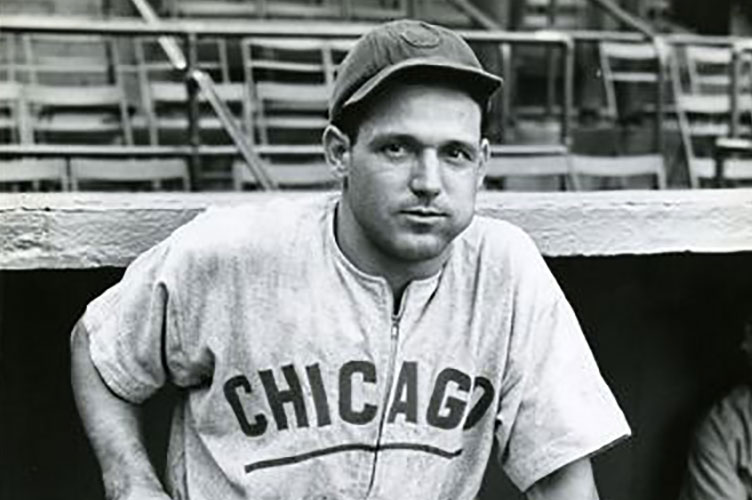
N. L. Home Run Leader (29)
Bill Nicholson (CHC)
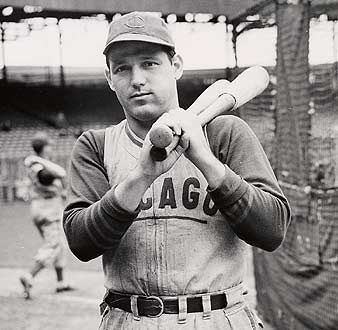
N. L. RBI Leader (128)
Bill Nicholson (CHC)
Nicholson would earn a starting spot in the All-Star game in Philadelphia. Joining Nicholson as a starter at Shibe Park was third baseman, Stan Hack. Hack slashed .289/3/35 in 144 games.

Claude Passeau received an All-Star invite based on his 15-12 record and 2.91 ERA. Hiram Bithorn won 18 of 30 decisions and posted a league high 7 shutouts in the year. Paul Derringer, whose contract was purchased from the Reds in the offseason posted a 10-14 mark for the Cubbies.
On July 1st, Wrigley Field hosted the first All American Girls Professional Baseball League All-Star Game between Rockford/South Bend versus Racine/Kenosha. Temporary light stanchions were placed behind home plate and first and third base for the 6PM local start time.
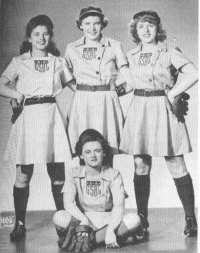
AAGPBL All Star Game
Temporary Lights
1944
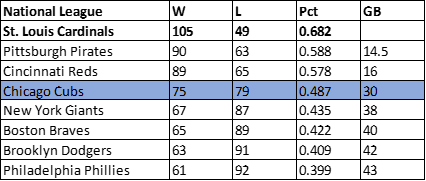
The 1944 Cubs improved by one win in 1944 but managed to move into the top half of the National League. Despite their improvement, the Cubs would finish 30 games behind the St. Louis Cardinals in fourth place. Bill Nicholson would fuel the Cubs offensively, leading the National League in home runs (33), RBIs (122) and runs scored (116). Nicholson would earn a reserve role at the All-Star game in Pittsburgh.
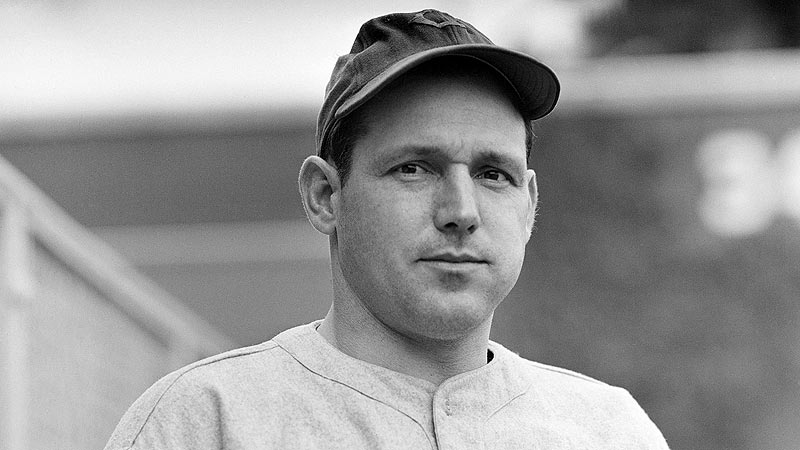
N. L. Home Run Leader (33)
Bill Nicholson (CHC)
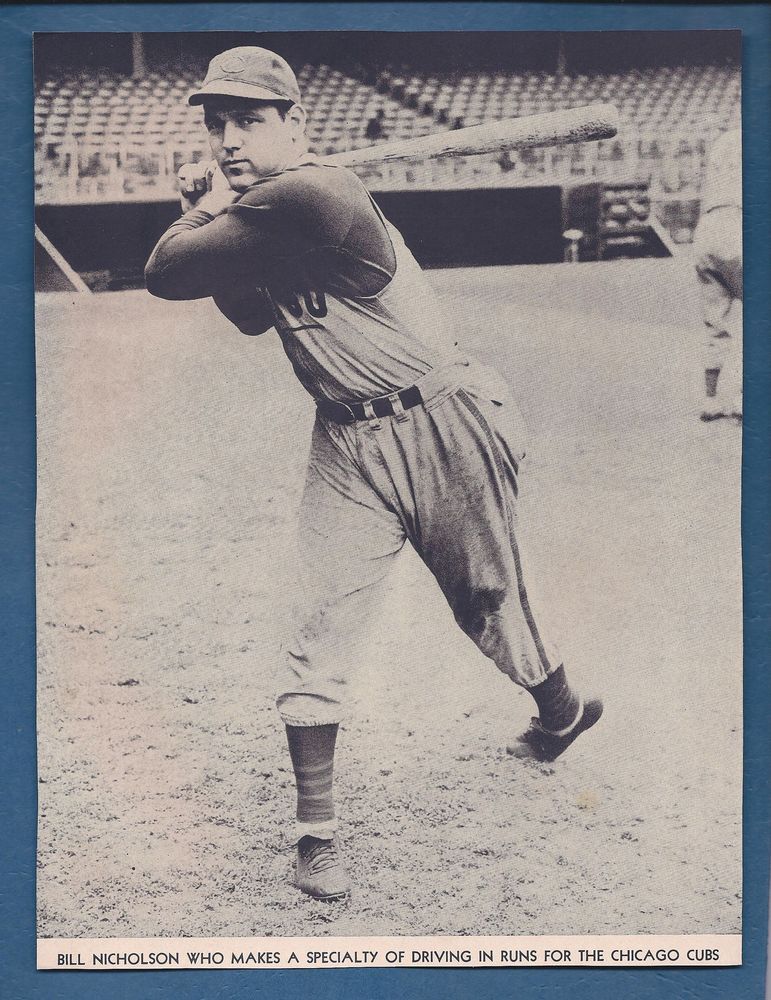
N. L. RBI Leader (122)
Bill Nicholson (CHC)
Second baseman, Don Johnson, would also earn a reserve role by slashing .278/2/71. First baseman, Phil Cavaretta, would earn a starting nod for the midsummer classic at Forbes Field posting a .321/5/82 stat line while leading the senior circuit in hits (197).

Righthander, Hank Wyse led the starting staff with a 16-15 record and a 3.15 ERA. Veteran, Claude Passeau, would win 15 of 24 decisions with a 2.89 ERA. Lefthander, Bob Chipman would post a respectable 9-9 record and a 3.49 ERA. Relief pitchers, Paul Derringer, Bill Fleming and Hy Vandenberg would all contribute 7+ wins out of the bullpen.
1945
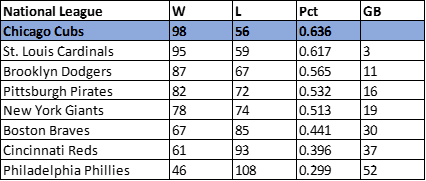
The Chicago Cubs returned to the top of the National League, winning the pennant by three games over the defending champion St. Louis Cardinals. The Cubs win total came up two short of the century mark, but as World War II was ending, the Cubbies were National League champs.

N. L. Champions
Chicago Cubs
The Cubs offense was driven by the MVP season of first baseman, Phil Cavaretta. Cavaretta led the National League in batting average (.355) and on-base percentage (.449). Cavaretta hit six home runs and drove in ninety-seven on his way to securing a spot in the All-Star game. The game would be cancelled due to wartime travel restrictions.
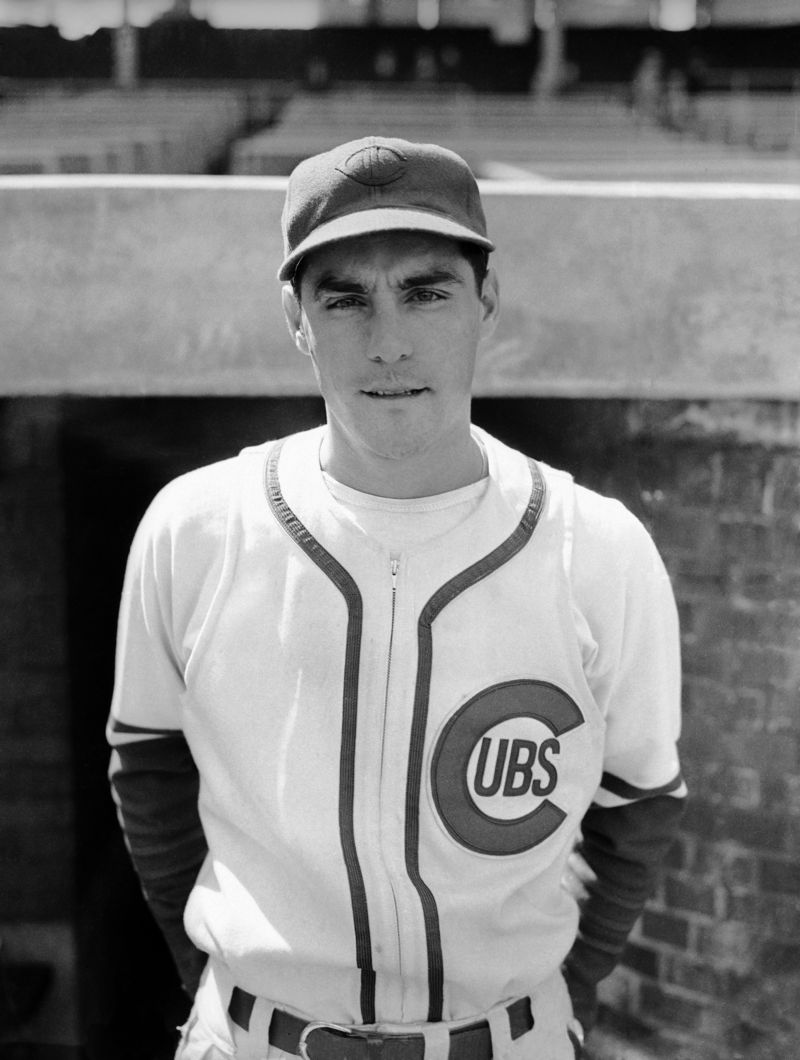
N. L. Most Valuable Player
Phil Cavaretta (CHC)
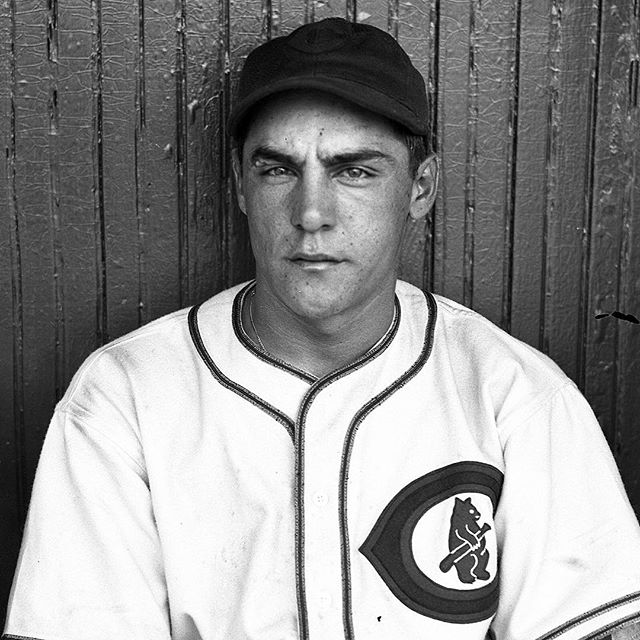
N. L. Batting Champion (.355)
Phil Cavaretta (CHC)
Joining Cavaretta in earning All-Star nods were Andy Pafko (.298/12/110), Bill Nicholson (.243/13/88), Stan Hack (.323/2/43) and Don Johnson (.302/2/58).
A trio of Cubs pitchers were named All-Stars as well. Paul Derringer (16/3.45/86), Hank Wyse (22/2.68/77) and Claude Passeau (17/2.46/98) all earned spots on the squad. Passeau led the National League in shutouts with 5. Lefthander, Ray Prim, did not make the midsummer classic despite leading the National League in ERA (2.40) and WHIP (0.998).
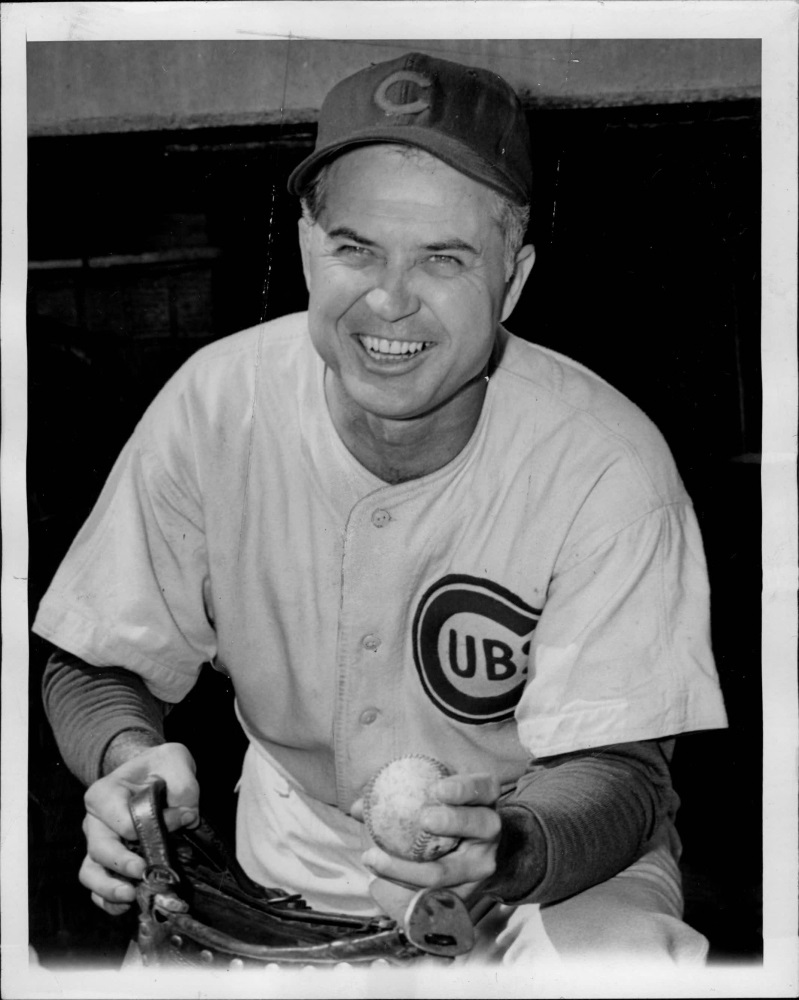
N. L. ERA Leader (2.40)
Ray Prim (CHC)
Prior to the fourth game of the World Series, tavern owner William “Billy Goat” Sianis was prevented from bringing his goat into Wrigley Field. The curse of the Billy Goat began for the Cubs.
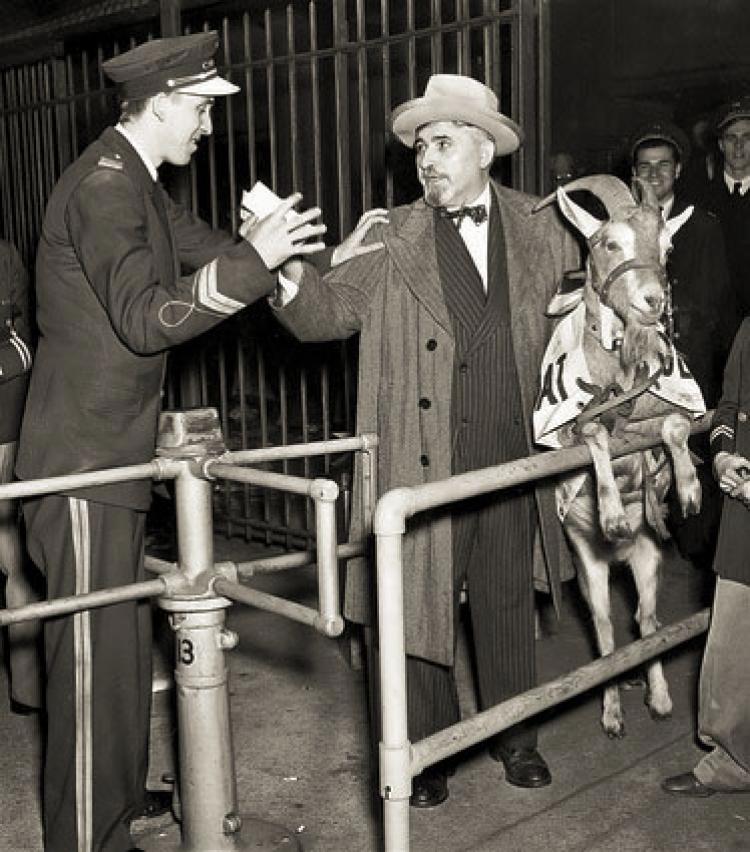
Curse of the Billy Goat
The Cubs would ultimately fall to the Detroit Tigers in seven games in the World Series. This would be the Cubs last World Series appearance until 2016.
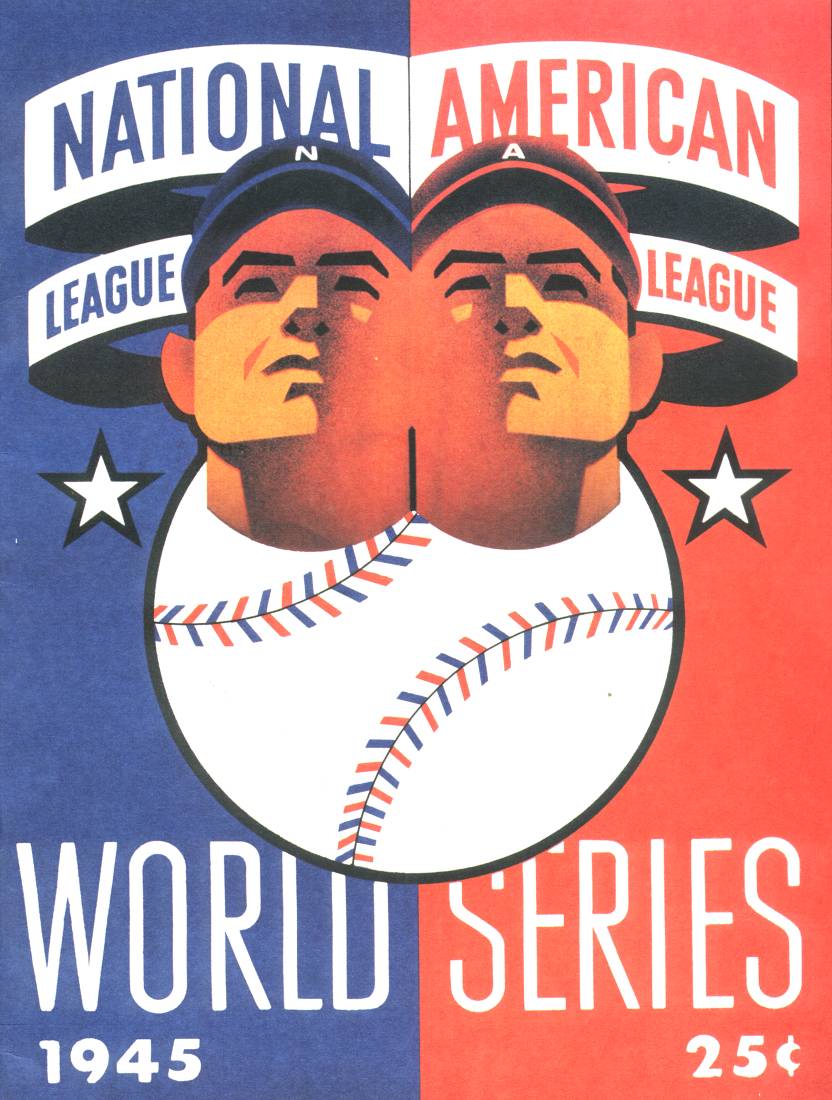
Tigers Defeat Cubs
Win World Series 4-3
1946

The Chicago Cubs fell back to third place in the National League in 1946. The Cubs would not touch first place after April 20th but managed two seven-game winning streaks at the beginning of June and the end of August. The Cub twirlers composed a team ERA of 3.24 during the campaign. Veteran, Claude Passeau posted a 9-8 record with a 3.13 ERA and 47 strikeouts in 21 games. Passeau was named the National League’s starter for the All-Star Game in Boston. Lefthander, Johnny Schmitz, led the National League in strikeouts (135) while winning 11 games and recording a 2.61 ERA. Schmitz was named as a reserve for the game at Fenway Park.
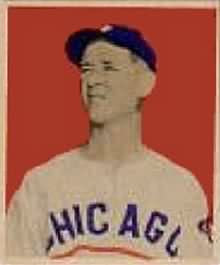
N. L. Strikeout Leader (135)
Johnny Schmitz (CHC)
Joining Schmitz as a reserve in Boston, were outfielders Phil Cavaretta (.294/8/78) and Peanuts Lowery (.257/4/54). First baseman, Eddie Waitkus, returning from World War II, led the team in batting average at .304. Outfielder, Bill Nicholson, shared the team league in home runs (8) with Cavaretta, coming off the bench for the Cubs.
1947
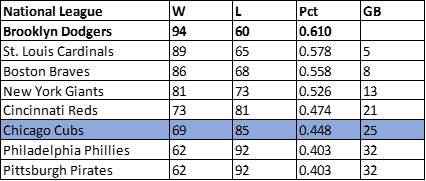
The 1947 Cubs plummeted to the bottom half of the National League, finishing 25 games behind the Brookly Dodgers in sixth place. The Cubs last saw first place on June 14th and a 9-game losing streak in early July dashed their pennant hopes.
On May 18th, Jackie Robinson played hist first game at Wrigley Field before 46,572 fans while an estimated 20,000 more fans waited outside the “Friendly Confines”. Robinson would go 0-4 with a walk and two strikeouts, but the Dodgers would win the game 4-2.
Outfielder, Bill Nicholson, provided the offensive firepower for the Cubs with 26 home runs and 75 RBIs despite a league high 83 punchouts. First baseman, Phil Cavaretta (.314/2/63) and outfielder, Andy Pafko (.302/13/66) were named All-Star reserves for the game at Wrigley Field.
The American League won 14th All-Star Game 2-1 in a low scoring affair. The National League’s only run came off the bat of Johnny Mize in the fourth inning, a solo shot to right field. The American League’s two runs came across the plate via Luke Appling in the sixth inning and Bobby Doerr in the seventh. Spec Shea of the Yankees would record the win and Johnny Sain of the Braves would receive the loss.
American League 2
National League 1
The Cubs pitching staff regressed in ’47 to the tune of a combined 4.10 ERA. Johnny Schmitz and Doyle Lade were the only hurlers to win double-digit games with Schmitz recording a league high 18 losses. Reliever, Emil Kush, provided lift from the bullpen, winning eight games and saving five more.
1948

The 1948 version of the Chicago Cubs tumbled to the bottom of the National League standings. The Cubs would finish one-half game behind the Cincinnati Reds and 27.5 games off the pace of the pennant-winning Braves. The Cubs finished the month of April at 4-6 and would never challenge for the National League title. Johnny Schmitz posted the best record of all the pitchers at 18-13, earning himself a spot on the All-Star team in St. Louis. Righthander, Russ Meyer, posted a 10-10 record, with no other pitchers reaching ten wins on the season.
Third baseman, Andy Pafko (.312/26/101), powered the Cub’s offense and was selected as a starter for the All-Star game at Sportsmans Park. First baseman, Eddie Waitkus (.295/7/44), and backup catcher, Clyde McCullough (.209/1/7), were selected as reserves for the National League squad. 1948 would mark the first year that the Cubs were televised on WGN-TV, a longstanding partnership that still exists today.
1949
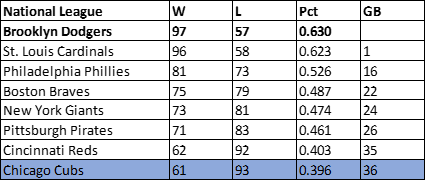
The Cubs of 1949 maintained their spot at the bottom of the National League, winning three fewer games than the prior season. The Cubs hovered around the .500 mark for the first two months of the season, but an eight-game skid in late July/early August would seal their fate. Andy Pafko would again be selected to the All-Star game as a reserve hitting .281 with 18 home runs and 69 runs batted in. Pafko would only be outdone statistically by fellow outfielder, Hank Sauer. Sauer was acquired from the Reds on June 15th and would combine to slash .291/27/83 for the season.
The Cub’s pitching staff posted a 4.50 team ERA with Johnny Schmitz (11/4.35/92) and Bob Rush (10/4.07/80) being the only hurlers to reach ten or more wins on the year. Offseason trade acquisition, Dutch Leonard, would post a 7-16 mark while leading the league in wild pitches (7), fielding independent pitching (2.71) and home runs per 9 innings (0.2).
1950

The Cubs of 1950 moved up one spot in the National League standings to seventh place, 26.5 games behind the pennant-winning Phillies. The Cubs played .500 ball for most of the season, but a disastrous July and September drove the Cubbies from contention. The pitching staff was anchored by Johnny Schmitz and Bob Rush who won 10 and 13 games respectively. Rush would lead the league in losses (20) and home runs per 9 innings (0.4) on his way to securing a spot at the All-Star game in Chicago’s South side. Reliever, Frank Hiller, would shine out of the bullpen, posting a 12-5 record with a 3.53 ERA.

Hank Sauer would earn a starting spot at Comiskey Park with his .274/32/103 slash line. Andy Pafko would also be chosen for the midsummer classic based on his .304 batting average, 36 home runs and 92 RBIs. The Cubs also received offensive contribution from shortstop, Roy Smalley Jr. Smalley would add 21 home runs and 85 RBIs to the Cubs cause. Smalley also provided the highlight of the season on June 28th, when he hit for the cycle against the St. Louis Cardinals.
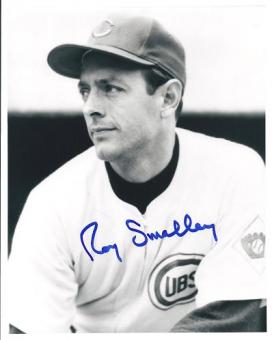
Cycle:
Roy Smalley (CHC)
vs. St, Louis Cardinals
1951

The Cubs returned to the bottom of the National League standing in 1951, 34 1/2 games off the pace of the New York Giants. Two four-game losing streaks in June and an eight-game skid in July dropped the Cubs out of contention for good. Righthanded starter, Bob Rush, was the only man in the rotation to win double-digit games with an 11-12 record. Lefthander, Paul Minner, posted a 6-17 record to lead the league in losses. Dutch Leonard won 10 games out of the bullpen with a 2.64 ERA earning him the Cub’s lone All-Star selection.
Outfielder, Hank Sauer, fueled the offense, hitting .263 with 30 long balls and 89 runs driven in. Third baseman, Randy Jackson, slashed .275/16/76 in his sophomore season with the Cubs. Offseason trade acquisition, Chuck “The Rifleman” Connors hit .239 with 2 home runs and 18 RBIs for the Cubbies. A midseason trade with the Dodgers saw Johnny Schmitz, Rube Walker, Andy Pafko and Wayne Terwilliger all depart Chicago.
1952
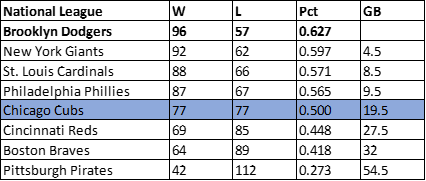
The 1952 Cubs improved by fifteen games in the win column finishing 19 1/2 games behind the Brooklyn Dodgers in the National League. The Cubs remained in contention until mid-June when a 9-game losing streak ended their hopes. Hank Sauer led the Cub’s offense with an MVP season. Sauer led the National League in home runs (37) and RBIs (121) while posting a .270 batting average.
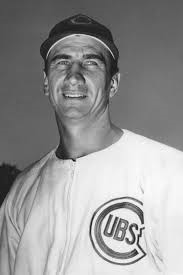
N. L. Most Valuable Player
Hank Sauer (CHC)
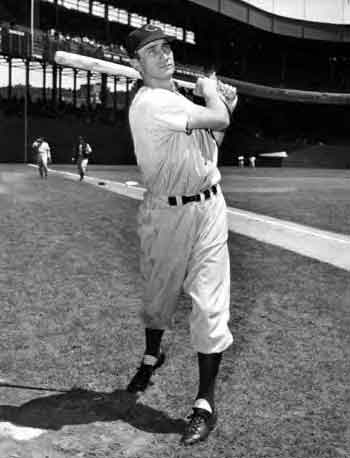
N. L. Co-Home Run Leader (37)
Hank Sauer (CHC)
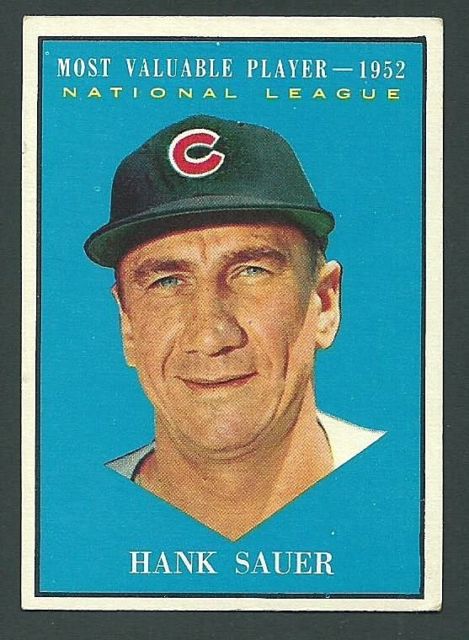
N. L. RBI Leader (121)
Hank Sauer (CHC)
Sauer earned a starting role on the All-Star team and was joined by catcher, Toby Atwell who was a National League reserve. Atwell slashed .290/2/31 and joined Sauer for the game in Philadelphia. Outfielder, Frank Baumholtz led the regulars in average, hitting .325.
Bob Rush led all starters with 17 wins against 13 losses gaining an All-Star spot at Shibe Park. Rotation mates, Warren Hacker and Paul Minner, won 15 and 14 respectively. Hacker led the National League in WHIP (0.946) and hits per 9 innings (7.0).
1953

The Cubs won 12 less games in 1953 and fell to seventh place in the National League, 40 games off the pace of the Brooklyn Dodgers. The Cubs never tasted first place during the season, dropping eight straight games from April 29th to May 8th. First baseman, Dee Fondy, led the starters in average, recording a .309 mark for the season. Outfielder, Ralph Kiner, was acquired on June 4th as part of a ten-player trade with the Pittsburgh Pirates. Kiner would provide the Cubs with much needed power, totaling 28 long balls and 87 RBIs between both teams, earning a spot on the All-Star team. Kiner was joined in Cincinnati by catcher, Clyde McCullough. McCullough slashed .258/6/23 for the year.
The Cub twirlers struggled through much of the ’53 campaign, combining for a 4.79 ERA. Starters, Paul Minner and Warren Hacker each won 12 games for the Cubbies. Hacker led the National League in losses (19), earned runs (108) and home runs allowed (35). Middle reliever, Johnny Klippstein, won 10 games in 167.2 innings out of the pen.
The Cubs rallied late in the season with a ten-game winning streak in early September. Help for the future was on the way as the Cubs signed Ernie Banks to an amateur contract on September 8th.
1954
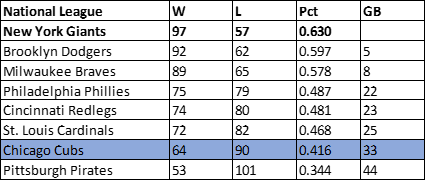
The Cubs maintained their seventh place standing in 1954, finishing 33 games behind the pennant-winning Giants. A disastrous June eliminated any postseason hopes as the Cubs posted a 4-21 mark. Rookie shortstop, Ernie Banks, played in a league-high 154 games and slashed .275/19/79 finishing second in the Rookie of the Year voting to the Cardinal’s Wally Moon. Hank Sauer had a monstrous season, hitting .288 with 41 long balls and 103 runs driven in. Third sacker, Randy Jackson, hit .273 with 19 home runs and 67 RBIs. Jackson would be the Cubs’ lone All-Star representative in Cleveland.

The Cubs pitching staff combined for a 4.51 ERA while allowing 766 runs on the season. Righthanded starter, Bob Rush, would win 13 of 28 decisions while leading the league in wild pitches (8) and home runs allowed per 9 innings (0.5). Lefty, Paul Minner, won 11 of 22 starts with a 3.96 ERA. Lefty reliever, Jim Davis contributed 11 wins out of Stan Hack’s bullpen.
1955

The 1955 Cubs gained some ground in the National League standings, moving up to sixth and winning eight more games than the prior campaign. Offseason acquisition from Cleveland, Sam “Toothpick” Jones, led the National League in strikeouts (198) and tossed a no-hitter on May 12th versus the Pirates.

N. L. Strikeout Leader (198)
Sam Jones (CHC)
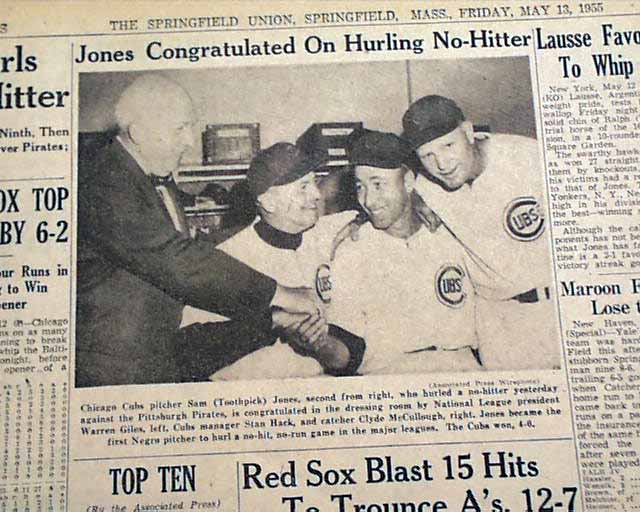
No Hitter:
Sam Jones
vs. Pittsburgh Pirates (4-0)
Jones would win 14 games for the Cubbies and led the National League in losses (20), walks (185), hit by pitch (14), hits per 9 innings (6.5) and strikeouts per 9 innings (7.4). Jones was selected to the All-Star game in Milwaukee.

Joining Jones at County Stadium, were Randy Jackson, Gene Baker and Ernie Banks. Jackson slashed .265/21/70 and Baker posted .268/11/52 to earn reserve roles on the N. L. squad. Ernie Banks had a tremendous sophomore season hitting .295 with 44 home runs and 117 RBIs. Banks would be named a starter for the All-Star game and would finish third in the National League Most Valuable Player voting.
1956
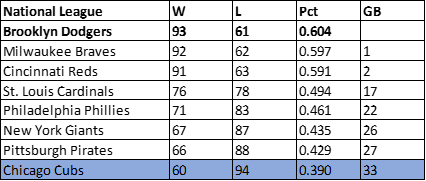
The North-siders dropped to the bottom of the National League in 1956, 33 games off the pace of the first place Brooklyn Dodgers. Bob Rush led the pitchers in wins with 13 to go with his 3.19 ERA and 104 strikeouts. Sam Jones led the National League in walks (115), strikeouts (176) and strikeouts per 9 innings (8.4). Closer, Turk Lown, posted a 9-8 record with 13 saves and a league-high 47 games finished.
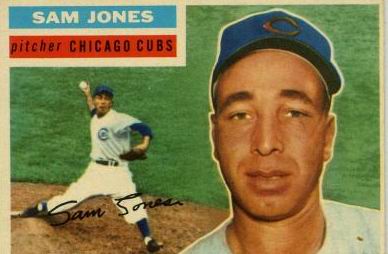
N. L. Strikeout Leader (176)
Sam Jones (CHC)
Ernie Banks fueled the Cub’s offense, hitting .297 with 28 home runs and 85 RBIs. Banks would be selected as a reserve for the All-Star game at Griffith Stadium in our nation’s capital.

Right fielder, Walt Moryn, contributed a .285 average to go with his 23 home runs and 67 RBIs. Left fielder, Monte Irvin provided some pop, hitting .271 with 15 homers and 50 RBIs.
1957
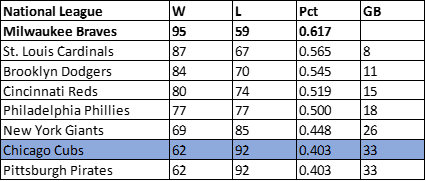
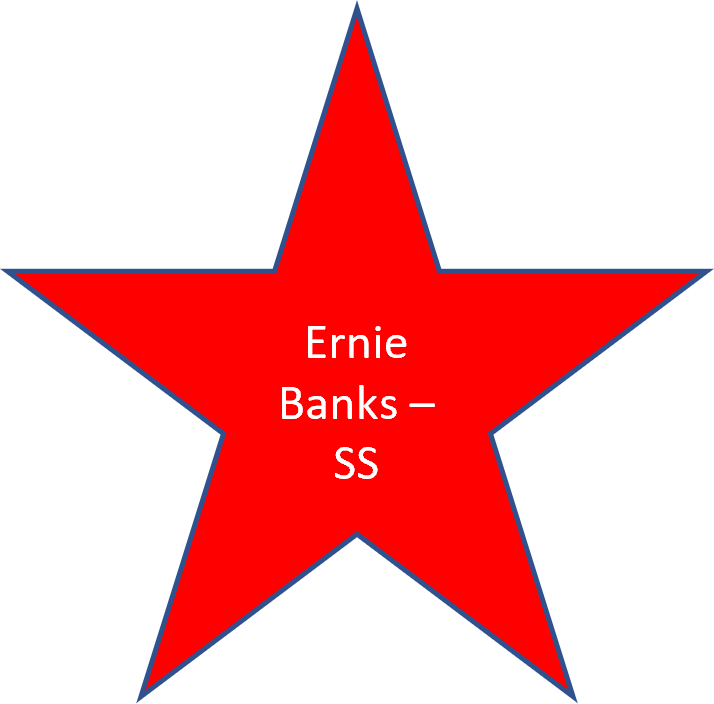
The 1957 Cubs tied for seventh place in the National League with the Pittsburgh Pirates. After splitting their first six games of the season against the Braves and Cardinals, the Cubs lost nine straight games and never contended for the N. L. pennant. Ernie Banks would be the sole Cub’s representative in the All-Star game in St. Louis. Banks batted .285 with 43 home runs and 102 RBIs.
First baseman, Dale Long, hit .305 with 21 dingers and 62 runs batted in. Outfielders, Bob Speake (.232/16/50) and Walt Moryn (.289/19/88) provided additional power to the Cub’s lineup. Left fielder, Lee Walls, provided the highlight of the season on July 2nd, when he hit for the cycle against the Cincinnati Reds.
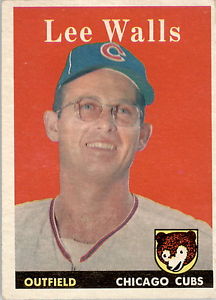
Cycle:
Lee Walls (CHC)
vs. Cincinnati RedLegs
The Cubbie pitchers allowed 722 runs on the year to the tune of a combined 4.13 ERA. Righty, Dick Drott, posted a 15-11 record with a 3.58 ERA, 170 strikeouts and a league high 129 walks. Fellow righty, Moe Drabowsky, won 13 of 28 decisions with a 3.53 ERA and 170 K’s. Cubs closer, Turk Lown, appeared in a league high 67 games and finished 47 games for most in the National League.
1958
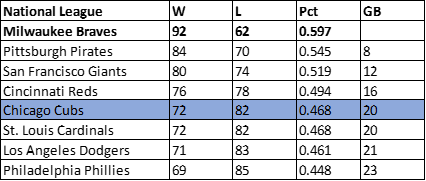
The 1958 Cubs won 72 games and finished in a fifth-place tie with the St. Louis Cardinals. The Cub’s pitching staff bordered on mediocre, allowing 725 runs with a combined ERA of 4.22. None of the five starting pitchers, Taylor Phillips, Dick Drott, Moe Drabowsky, Dave Hillman or John Briggs, reached double digit wins. Righthanded reliever, Glen Hobbie, was the only Cub’s hurler to win 10 games, notching a 10-6 record out of the pen. Closer, Don Elston, posted a 9-8 record, 2.88 ERA while appearing in a league high 69 games.
The Cubs offense was fueled by Ernie Banks who led the National League in games (154), at-bats (617), slugging percentage (.614), total bases (379), home runs (47) and RBIs (129). Banks would earn the National League’s Most Valuable Player Award for his exceptional season.
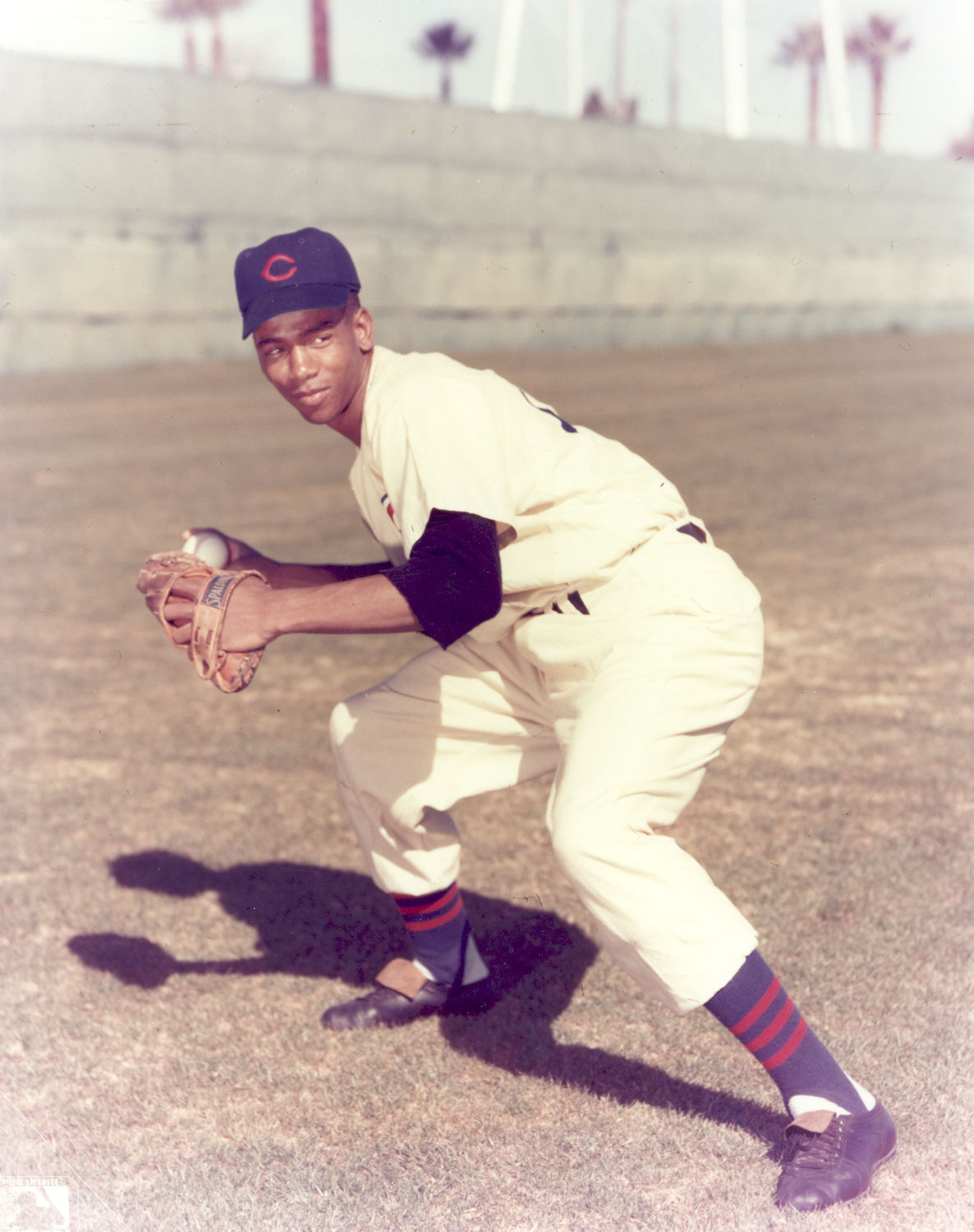
N. L. Most Valuable Player
Ernie Banks (CHC)
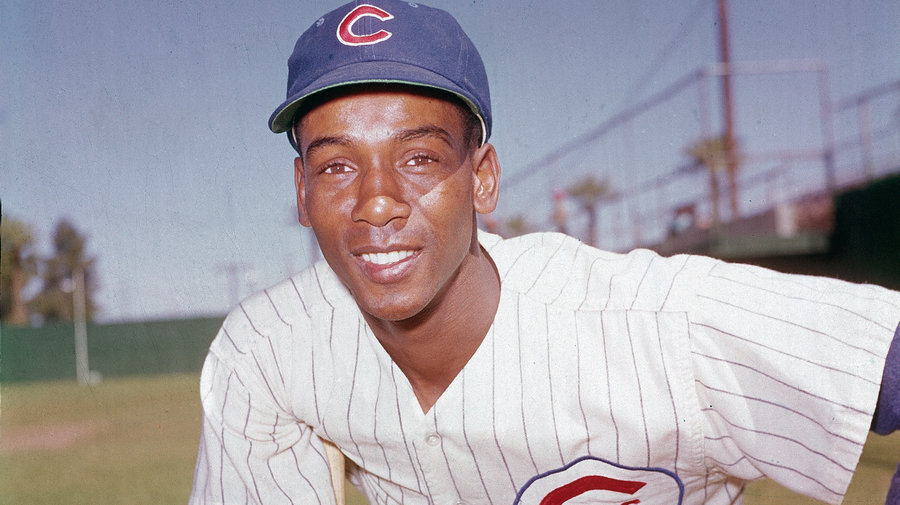
N. L. Home Run Leader (47)
Ernie Banks (CHC)

N. L. RBI Leader (129)
Ernie Banks (CHC)
Outfielders, Lee Walls (.304/24/72) and Walt Moryn (.264/26/77), would earn reserve roles on the All-Star team for the game in Baltimore. First baseman, Dale Long, had a strong season posting .271/20/75 along with outfielder Bobby Thomson (.283/21/82).
The Wrigley faithful would witness history on April 13th when Cardinal’s outfielder, Stan Musial, recorded the 3,000th hit of his career.
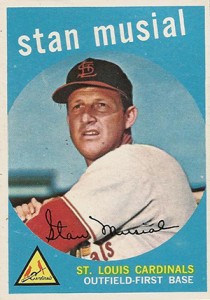
3000th Hit:
Stan Musial
1959
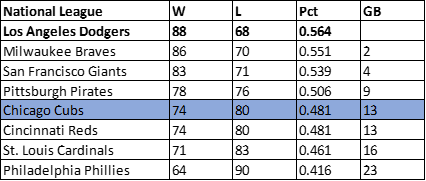
The Cubs remained in fifth place during the 1959 season, finishing 13 games back of the pennant-winning Dodgers. The Cubs were fueled by the second consecutive MVP season of Ernie Banks. Banks became the first shortstop in the National League to win back-to-back MVP awards. Banks led the National League in RBIs (143), WAR (10.2) and games played (155) while hitting .304 with 45 long balls.
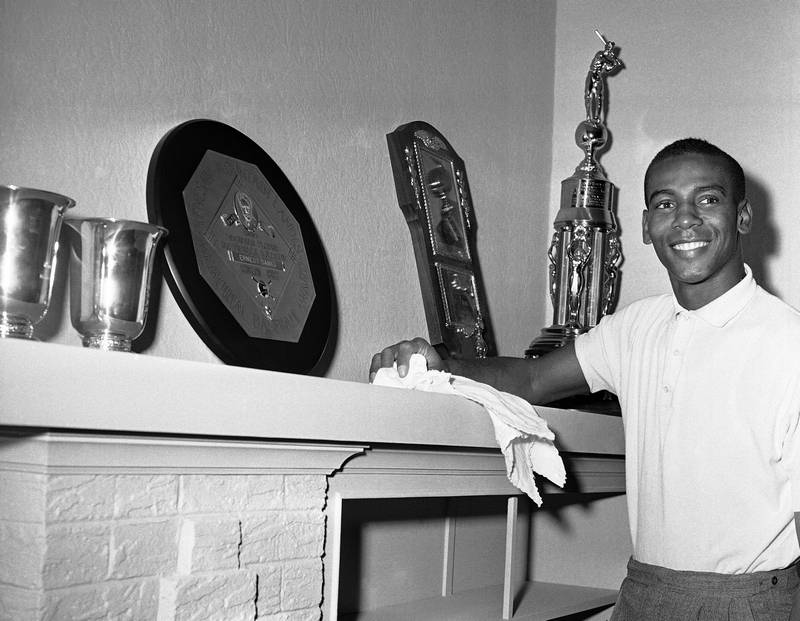
N. L. Most Valuable Player
Ernie Banks (CHC)
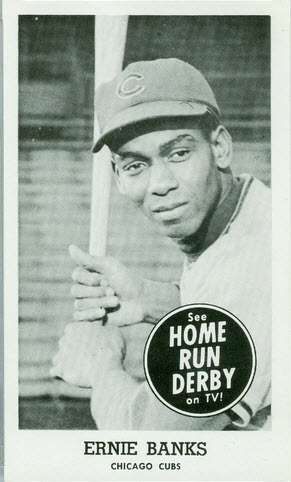
N. L. RBI Leader (143)
Ernie Banks (CHC)
Sammy Taylor (.269/13/43), Dale Long (.236/14/37) and George Altman (.245/12/47) supported Banks and the Cubs offense in scoring 673 runs on the season.
The Cubs pitchers combined for a 4.01 team ERA in 1959. The bullpen provided a one-two punch of righthander Don Elston and lefty Bill Henry. Elston won 10 games, saved 14 and along with Henry, appeared in a league high 65 games. Henry won 9 games, saved 12 with an ERA 2.68. Elston would be selected to appear at the All-Star games in Pittsburgh and Los Angeles. Glen Hobbie led all starters with 16 wins, 138 strikeouts and a 3.69 ERA. Starter, Bob Anderson won 12 of 25 decisions and fanned 113 batters.
1960
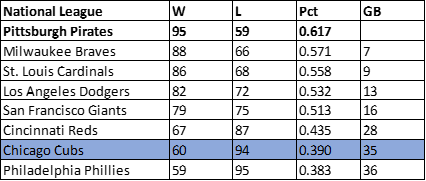
The Cubs dropped to seventh place in the National League in the 1960 season. A nine-game losing streak in mid-June ended the Cubs pennant hopes for the year. The Cubs were paced by perennial All-Star and MVP candidate Ernie Banks. Banks led the National League in games played (156), home runs (41) and intentional walks (28). Banks batted .271 with 117 RBIs to earn the starting shortstop position in the All-Star games in Philadelphia and New York.

N. L. Home Run Leader (41)
Ernie Banks (CHC)
Offseason acquisition and future Hall of Famer, Richie Ashburn led the league in walks (116) and on-base percentage (.415). Left fielder, Frank Thomas, added 21 home runs and 64 RBIs to the Cub’s cause.
Starting pitcher, Glen Hobbie, won 16 games for the Cubbies while leading the National League in losses (20) and earned runs (114). Righthander, Don Cardwell, provided the pitching highlight of the year when he no-hit the Cardinals on May 15th in the second game of a doubleheader.
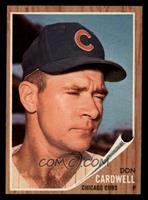
No Hitter:
Don Cardwell
vs. St. Louis Cardinals (4-0)
1961
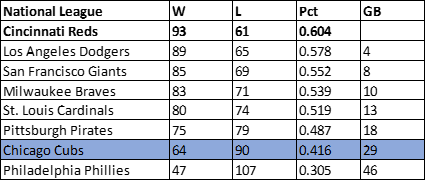
The 1961 Cubs remained mired in seventh place, finishing 29 games behind the pennant-winning Cincinnati Reds. Two eight-game losing streaks, one in early May and one in mid-September, sealed the Cubs postseason fate. The Cubs utilized a quartet of Managers known as the “College of Coaches” during the season. Vedie Himsl, Harry Craft, El Tappe and Lou Klein all took their turns managing the club throughout the course of the year, none achieving great success. First year outfielder, Billy Williams, slashed .278/25/86 on his way to capturing the National League’s Rookie of the Year award.
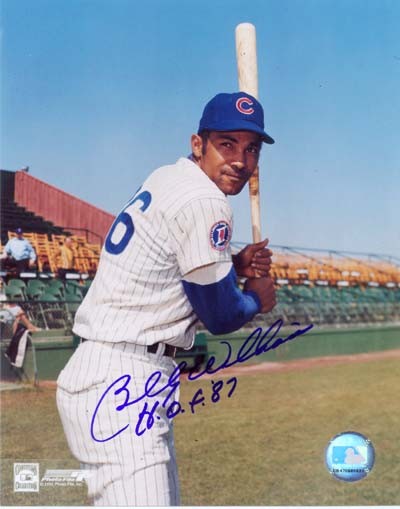
N.L. Rookie of the Year
Billy Williams (CHC)
Ernie Banks provided solid numbers hitting .278 with 29 home runs and 80 RBIs and garnered a spot on the All-Star team. Right fielder, George Altman joined Banks in San Francisco and led the National League in triples with 12.
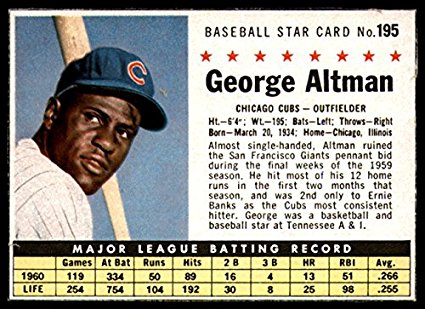
N. L. Triples Leader (12)
George Altman (CHC)
Second baseman, Don Zimmer, joined his teammates at Candlestick Park by slashing .252/13/40. Third-sacker, Ron Santo, provided additional power for the Cubs lineup, hitting .284 with 23 taters and 73 runs batted in.
The Cubs pitching staff bordered on abysmal, surrendering 800 runs on the season. Don Cardwell was the staff ace, winning 15 of 29 decisions while leading the senior circuit in WAR (6.1) and games started (38). Fellow starters, Dick Ellsworth and Jack Curtis, each notched 10 wins on the year.
1962
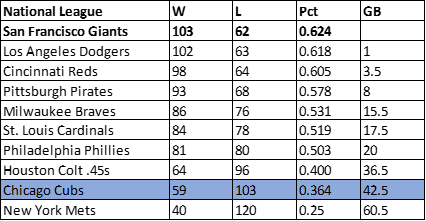
The Cubs went from bad to worse during the 1962 season, finishing in ninth place in the newly expanded National League. The Cubs would finish 42 1/2 games behind the San Francisco Giants and six games behind the expansion Houston Colt .45s. The Cubs would produce their second-straight Rookie of the Year in second baseman, Ken Hubbs. Hubbs would slash .260/5/49 while leading the league in strikeouts (129) and double plays (20) but showed his prowess in the field by winning the Gold Glove award.
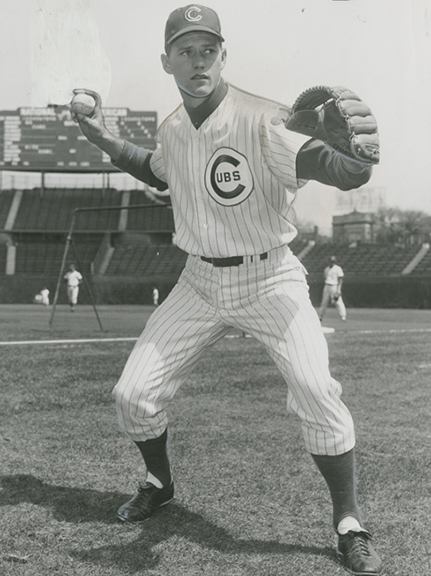
N.L. Rookie of the Year
Ken Hubbs (CHC)
The Cubs would have a trio of All-Stars for the game at Wrigley Field. Ernie Banks (.306/37/104), George Altman (.318/22/74) and Billy Williams (.298/22/91) would all be reserves for the game in Chicago, with Banks earning an invite to Washington D. C. as well.

The American League prevailed in the second All-Star game of 1962, 9 runs to 4. Pete Runnels, Rocky Colavito and Leon Wagner all homered for the A. L. squad with Wagner taking home the M.V.P. hardware.
American League 9
National League 4
The Cub pitchers continued to struggle in 1962, allowing 827 runs with a 4.54 team ERA. Bob Buhl won 12 of 25 decisions with 109 whiffs and a 3.69 ERA. Cal Koonce won 10 games and sported a 3.97 earned run average.
1963

The 1963 Cubs were vastly improved over the 1962 version, finishing over .500 and winning 82 games. The Cubs placed seventh in the National League, one of seven teams to complete the season with a winning record. Third baseman, Ron Santo, led the offense by slashing .297/25/99 and appearing in a league high 162 games. Santo would earn a spot in the midsummer classic in Cleveland. Left fielder, Billy Williams, batted .286 with 25 homers and 95 RBIs to help the Cubbies cause. Perennial All-Star, Ernie Banks had an off year, managing just a .227 batting average with 18 home runs and 64 RBIs.
Dick Ellsworth headed the Cubs pitching staff, winning 22 games with 185 strikeouts, a 2.11 ERA and a league best ERA+ of 167. Surprisingly, Ellsworth was not selected for the All-Star game. Fellow pitcher, Larry Jackson (14/2.55/153), acquired in an offseason trade with the Cardinals, was tabbed as a reserve for the game at Cleveland Municipal Stadium. Closer, Lindy McDaniel, acquired with Jackson in the Cardinals swap led the National League in games finished (48) and saves (22), earning the National League’s Fireman of the Year award.
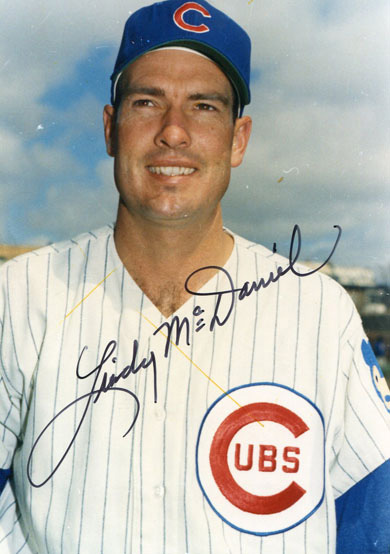
N.L. Fireman of the Year
Lindy McDaniel (CHC)
1964
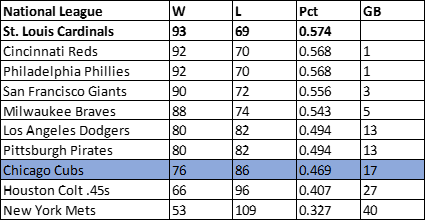
The 1964 Cubs won six less games and fell to eighth place overall in the National League. The ’64 season started under the cloud of second baseman Ken Hubbs death in a plane crash on February 13th. Joey Amalfitano was purchased from the San Francisco Giants to replace Hubbs in the starting lineup. The Cubs officially fell out of contention in August when they posted a 12-18 mark.
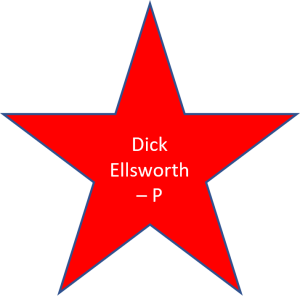
The Cubs pitching staff was paced by righthander Larry Jackson who won a league high 24 games with 148 strikeouts and a 3.14 ERA. Bob Buhl contributed 15 wins and 107 strikeouts to go with his 3.83 ERA. Fellow starter, Dick Ellsworth, won 14 games and led the league in hits allowed (267), earned runs (107) and home runs (34). Ellsworth was named as an all-star reserve in large part due to his performance in ’63.
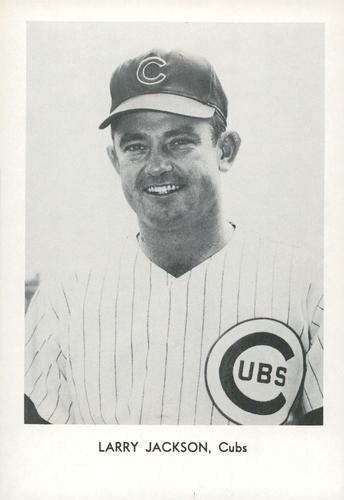
N. L. Wins Leader (24)
Larry Jackson (CHC)

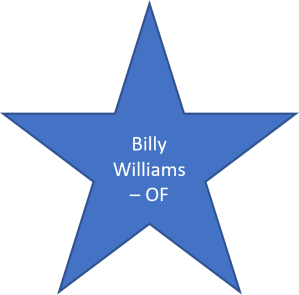
Veterans Billy Williams (.312/33/98) and Ernie Banks (.264/23/95) provided the Cubs lineup with much needed pop. Third baseman, Ron Santo, stood out among all Cubbie regulars. Santo led the league in triples (13), walks (86) and on-base percentage (.398) while collecting a gold glove and earning a role on the All-Star team.
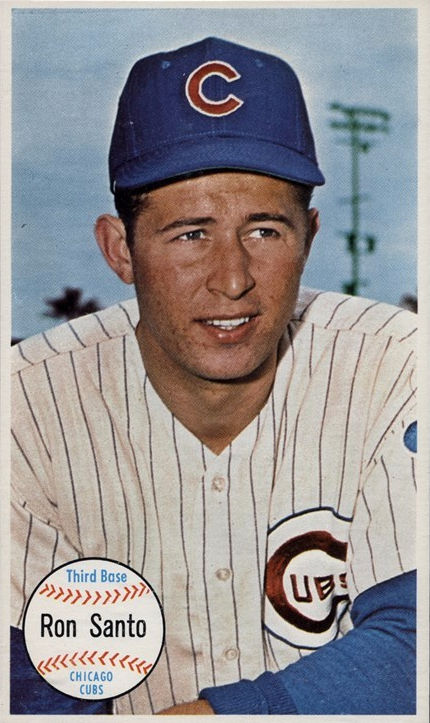
N. L. Co-Triples Leader (13)
Ron Santo (CHC)
On June 15th, the Cubs took part in one of the most lopsided trades in history. Chicago sent Lou Brock, Jack Spring and Paul Toth to the St. Louis Cardinals for Ernie Broglio, Doug Clemens and Bobby Shantz. While Brock would go on to win the World Series and have a Hall of Fame career, Broglio only won 3 games in his first two seasons with the Cubs and Shantz would retire after the 1964 season.
1965
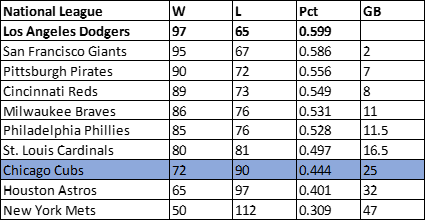
The Cubs continued to regress in 1965, winning 72 games and losing 90 while maintaining their eighth place standing. The North-siders would finish 25 games behind the pennant winning Los Angeles Dodgers. The Cubs hovered near the .500 mark for most of the season but won only nine of twenty-seven games in September and October. Offensively, the Cubs were piloted by their three veterans, Billy Williams (.315/24/108), Ron Santo (.285/33/101) and Ernie Banks (.265/28/106). All three would earn All-Star spots for the game in Minnesota. Williams and Santo would both play in a league high 164 games and be reserves, while Banks would be named a starter at first base.
The Cubs staff had a trio of starting pitchers that would all win thirteen or more games, Larry Jackson (14/3.85/131), Dick Ellsworth (14/3.81/130) and Bob Buhl (13/4.39/92). Fifth starter, Bill Faul became a history footnote as he was on the mound each time the Cubs turned a record three triple plays on the year. Cubs closer, Ted Abernathy, led the National League in games (84), games finished (62), and saves (31) earning the senior circuit’s Fireman of the Year Award.
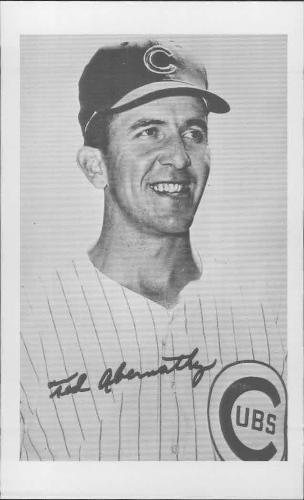
N.L. Fireman of the Year
Ted Abernathy (CHC)
Visiting pitcher, Jim Maloney of the Reds, made history on August 19th, when he no-hit the Cubs in a 1-0 victory for Cincinnati Reds in front of 11,000+ Wrigley faithful.
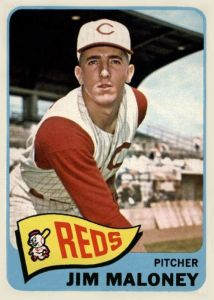
No Hitter:
Jim Maloney (CIN)
vs. Chicago Cubs (1-0)
1966
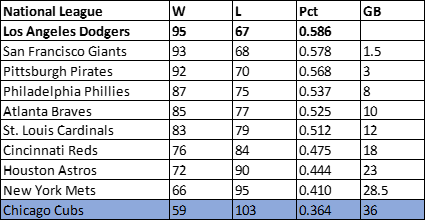
The Cubs would hit rock bottom in 1966 winning 59 games on the year finishing dead-last in the National League, 36 games behind the Los Angeles Dodgers. The Cubbie pitching staff struggled throughout the season, surrendering 809 runs, despite a shakeup during the second week of the season. On April 21st, the Cubs traded away two starting pitchers, Larry Jackson and Bob Buhl, to the Philadelphia Phillies in exchange for Ferguson Jenkins, John Herrnstein and Adolfo Phillips. Jenkins would win six of fourteen decisions in a relief role. Staff ace, Dick Ellsworth went 8-22, leading the league in hits allowed (321) and losses (22). Rookie twirler, Ken Holtzman, would post an 11-16 mark with a 3.79 ERA and 171 strikeouts.
Ron Santo (.312/30/94) would be the only Cub invited to the All-Star game in St. Louis as he earned a starting role by leading the league in walks (95) and on-base percentage (.412) while winning a Gold Glove at third base. Billy Williams (.276/29/91) would top the league in games (162) and plate appearances (727). Ernie Banks (.272/15/75) contributed solid numbers, but not the numbers the Wrigleyville faithful would expect from their perennial all-star.
Cubs’ rookie catcher, Randy Hundley (.236/19/63), made history on August 11th when he hit for the cycle against the visiting Houston Astros. Hundley would finish fourth in the National League Rookie of the Year voting.
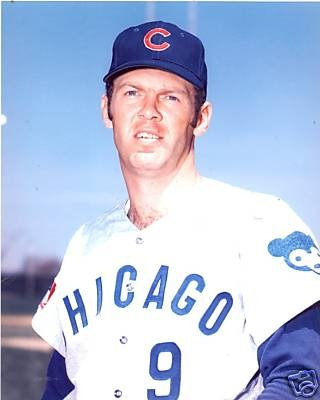
Cycle:
Randy Hundley (CHC)
vs. Houston Astros
1967
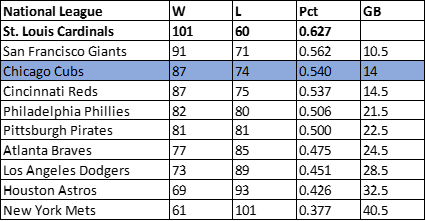
The Cubs made a big jump in 1967, rising from last place to third overall in the National League. The Cubbies won 87 games and finished 14 games behind the St. Louis Cardinals. The North-siders played their best baseball in June going 21-10 for the month. The Cubs received solid contributions offensively from catcher Randy Hundley (.267/14/60) and center fielder Adolfo Phillips (.268/17/70). The Cubs “Big Three” in Billy Williams (.278/28/84), Ernie Banks (.276/23/95) and Ron Santo (.300/31/98) once again paced the Cubbies. Santo would lead the National League in WAR (9.8) and walks (96) and secure a Gold Glove, while Banks would be named as a reserve for the All-Star game in Anaheim.
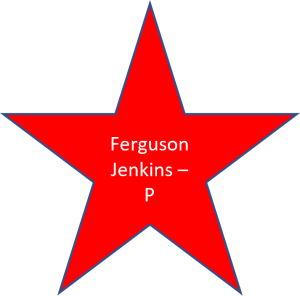
Fergie Jenkins (20/2.80/236) would win 20 games while leading the league in complete games (20) and home runs allowed (30) to earn a spot in the All-Star game. Lefthander, Rich Nye, would win 13 games with 119 strikeouts and a 3.20 ERA. Rookie righthander, Joe Niekro, won 10 of 17 decisions and posted a 3.34 ERA with 77 punchouts. Lefthander, Ken Holtzman, limited to weekend games due to his service in the National Guard, posted a 9-0 record in 12 starts.
1968

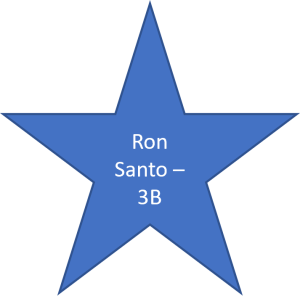
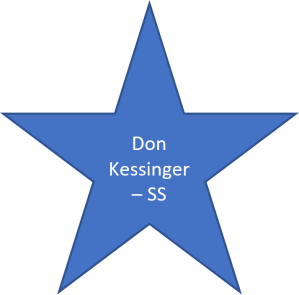
The Cubs would retain their third place in the National League standings despite winning three less games than the prior campaign. A disastrous June record of 10-18 dashed any pennant hopes the Wrigley faithful had. Don Kessinger (.240/1/32) and Ron Santo (.246/26/98) fueled the Cubs offense, and both received starting roles for the All-Star game at the Astrodome. Billy Williams earned a backup role for the game in Houston by posting a .288 batting average, 30 home runs and 98 RBIs. Second baseman, Glenn Beckert led the National League in runs scored (98) paired with a .294 average.
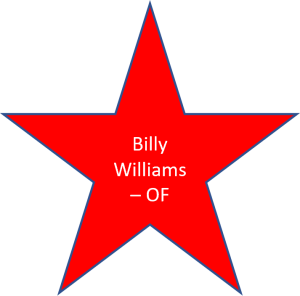
A quartet of hurlers anchored the pitching staff, Fergie Jenkins (20/2.63/260), Bill Hands (16/2.89/148), Ken Holtzman (11/3.35/151) and Joe Niekro (14/4.31/65) each reached double digit wins. Jenkins led the league in games started (40) and both he and Hands led the league in home runs allowed (26). Closer, Phil Regan, won 10 games, saved 25 more and posted a meager 2.20 ERA on his way to winning the National League’s Fireman of the Year award.
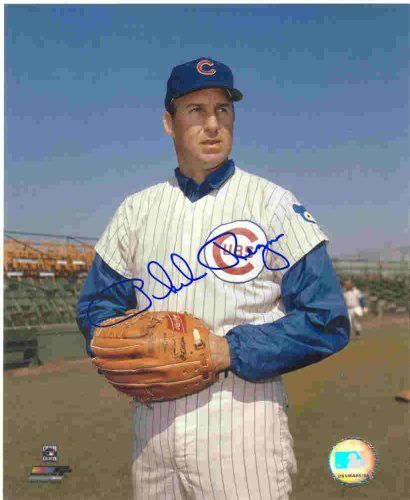
N.L. Fireman of the Year
Phil Regan (CHC)
1969
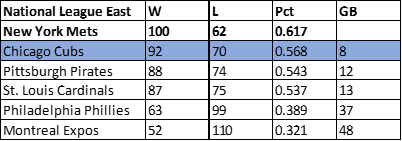
1969 marked the beginning of divisional play in Major League Baseball and the Cubs would join the National League East. The Cubs would hold first place for 156 days during the ’69 season, but they faltered in September with an 8-17 record and were overtaken by the “Miracle Mets”. The Cubs were loaded with offensive firepower which included five All-Stars: Glenn Beckert (.291/1/37), Ernie Banks (.253/23/106), Randy Hundley (.255/18/64), Don Kessinger (.273/4/53) and Ron Santo (.289/29/123).
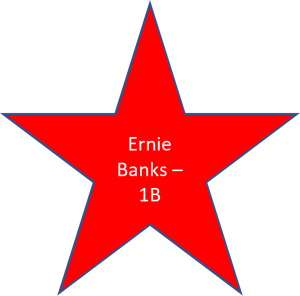
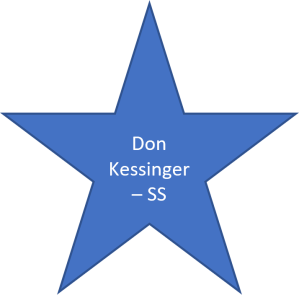

The Cubs also received large contributions from right fielder Jim Hickman (.237/21/54) and Billy Williams (.293/21/95). Williams would play in a league high 163 games while Santo led the leagues in sacrifice hits (14) and ground into the most double plays (21). Kessinger would add a Gold Glove to his 1969 resume.
The Cubs pitching staff was exceptional in 1969, led by future Hall-of-Famer, Fergie Jenkins. Jenkins posted a 21-15 record while leading the league in games started (42) and strikeouts (273).
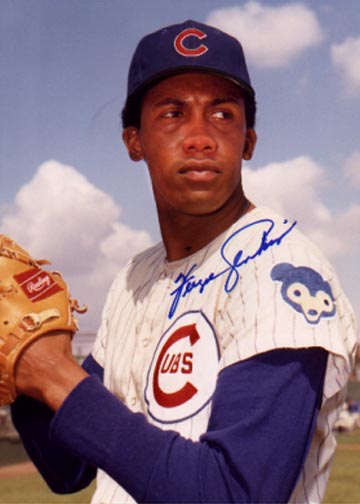
N. L. Strikeout Leader (273)
Ferguson Jenkins (CHC)
Right-handed starter, Bill Hands, notched a 20-14 record with 181 strikeouts and a 2.49 ERA. Dick Selma won 10 of 18 decisions and struck out 161 batters while sporting a 3.63 ERA. Southpaw, Ken Holtzman, won 17 games with 176 strikeouts and a 3.58 ERA. Holtzman’s excellence reached its peak on August 19th when he no-hit the visiting Atlanta Braves in a 3-0 Cubs win. Closer, Phil Regan won 12 games and saved 17 more out of the bullpen.
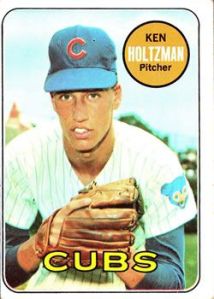
No Hitter:
Ken Holtzman
vs. Atlanta Braves (3-0)
1970
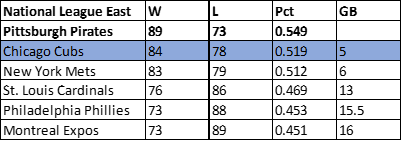
The Cubs finished the 1970 season where they left off in ’69, in second place. The ’70 Cubs finished five games behind the pennant-winning Pittsburgh Pirates. The Cubs experienced some fireworks early in the year. On April 12th, Ernie Banks hit his 500th career home run against the visiting Atlanta Braves. On April 14th, the Cubs went on a 12-game winning streak that would last until April 27th.
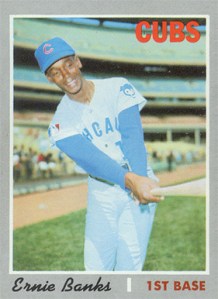
500th Home Run:
Ernie Banks
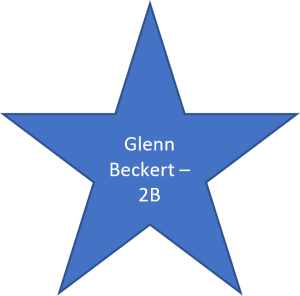
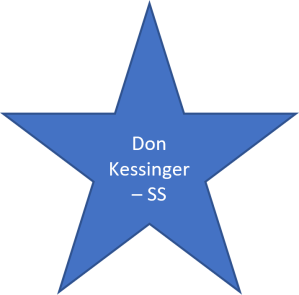
The Cubs would send three representatives to the All-Star game at Riverfront Stadium in Cincinnati. Glenn Beckert (.288/3/36) and Don Kessinger (.266/1/39) would be named starters and Jim Hickman (.315/32/115) would be selected as a reserve.
Left fielder, Billy Williams, would not be selected to the All-Star squad despite posting monster numbers (.322/42/129) and leading the league in games played (161), runs (137), hits (205) and total bases (373). Williams would finish second in the voting for the National League’s Most Valuable Player award. Right fielder, Johnny Callison, contributed a .264 batting average with 19 home runs and 68 RBIs.
The Cubs had an exceptional pitching staff in 1970 headed by future Hall-of-Famer, Ferguson Jenkins. Fergie won 22 games and led the senior circuit in complete games (24), earned runs (118), WHIP (1.038) and walks per nine innings (1.7). Lefthander, Ken Holtzman, won 17 of 28 decisions with a 3.38 ERA and 202 strikeouts. Bill Hands won 18 games with a 3.70 ERA and 170 strikeouts. Milt Pappas won 10 games in 20 starts and recorded a 2.68 ERA.
1971
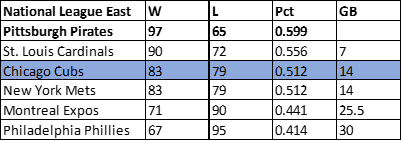
The 1971 Cubs got off to a slow start, winning only 8 of their first 21 games and finishing the year 14 games behind the Pirates in third place. The Cubs played their best brand of ball during June, posting an 18-9 mark for the month. The Cubs sent three position players to the All-Star Game at Tiger Stadium. Don Kessinger (.258/2/38) and Ron Santo (.267/21/88) were selected as reserves and Glenn Beckert (.342/2/42) was named the starter at second base. Billy Williams (.301/28/93) and Joe Pepitone (.307/16/61) added power to a team that scored 637 runs on the year.
Ferguson Jenkins won the National League’s Cy Young Award, leading the league in wins (24), games started (39), complete games (30), innings pitched (325.0), hits allowed (304), home runs allowed (29), batters faced (1299), walks per 9 (1.0) and strikeout to walk ratio (7.11).
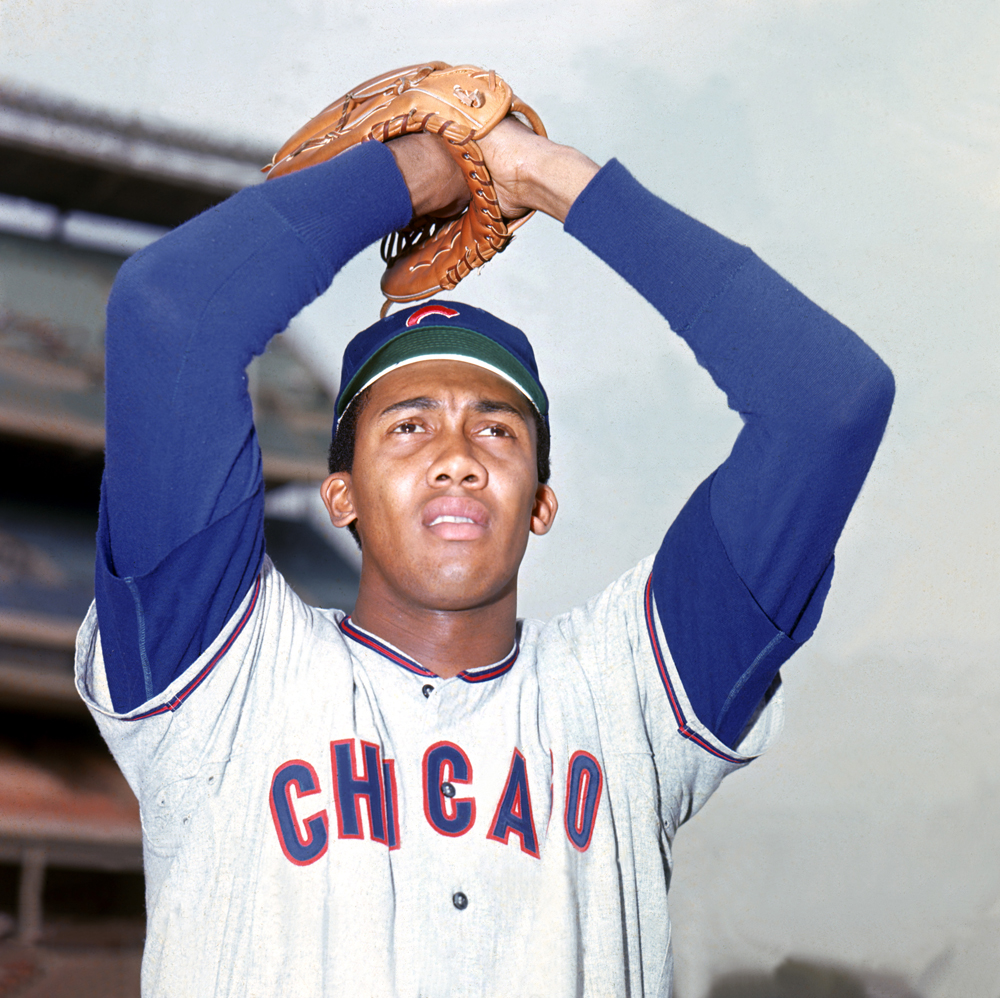
N.L. Cy Young Award
Ferguson Jenkins (CHC)
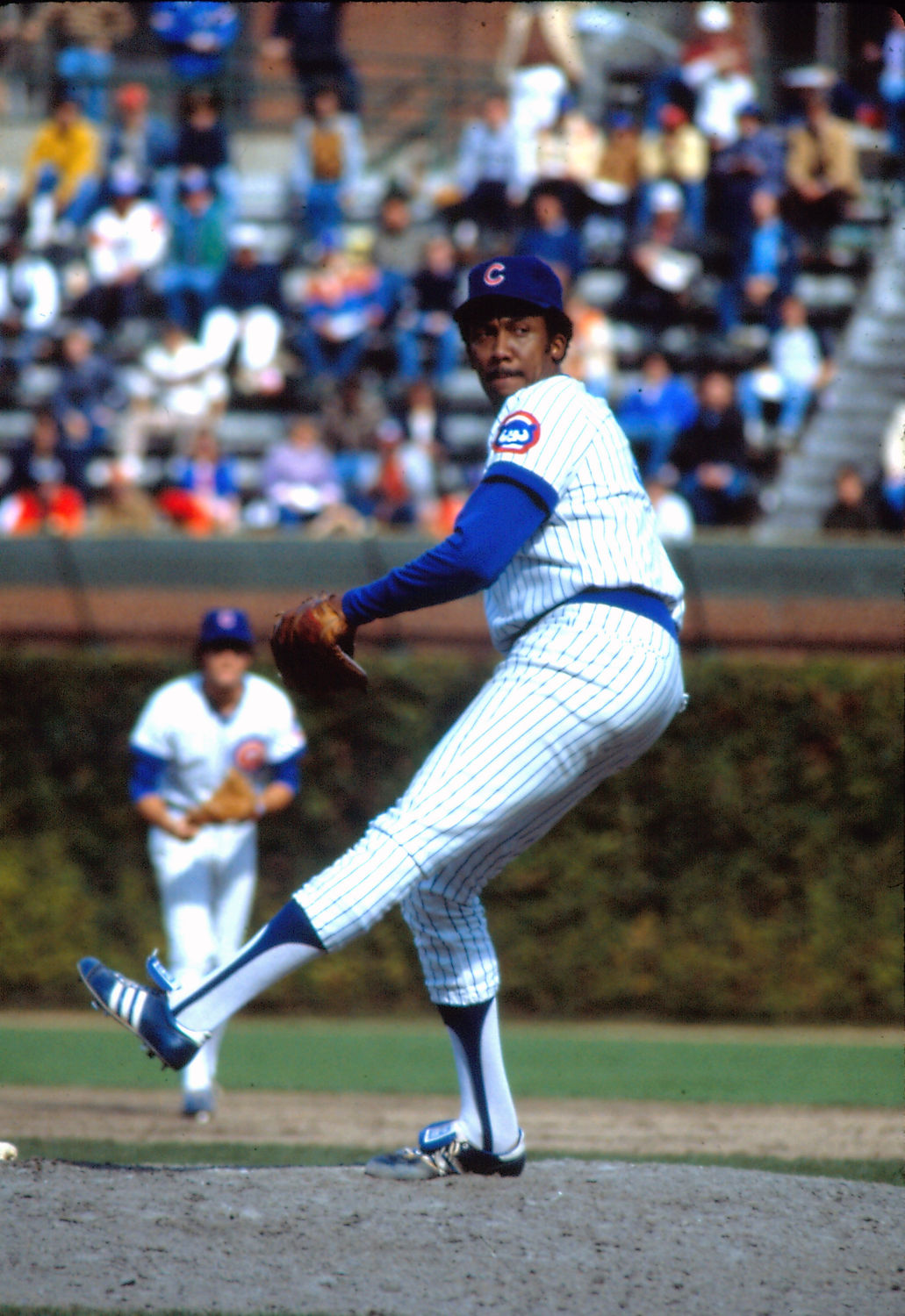
N. L. Wins Leader (24)
Fergie Jenkins (CHC)
Bill Hands contributed 12 wins in 30 decisions with a 3.42 ERA and 128 strikeouts. Milt Pappas won 17 games with 99 strikeouts and a 3.51 ERA. Pappas also threw an Immaculate Inning on September 24th against the visiting Philadelphia Phillies.
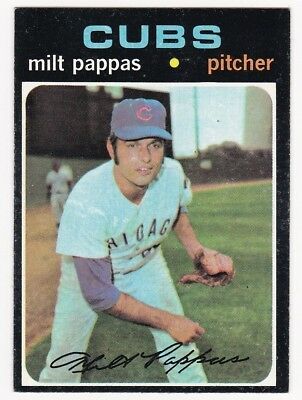
Immaculate Inning (4th)
Milt Pappas (CHC)
vs. Philadelphia Phillies
1972

The Chicago Cubs finished the 1972 campaign in second place in the National League, eleven games off the pace of the Pittsburgh Pirates. The Cubs could not recover from a 4-10 April record despite having a winning record in every other month save July. Left fielder, Billy Williams (.333/37/122), had a career year, leading the National League in hitting (.333), slugging percentage (.606), OPS (1.005), OPS+ (172) and total bases (348). Williams would earn an All-Star spot and finish second in the Most Valuable Player voting.
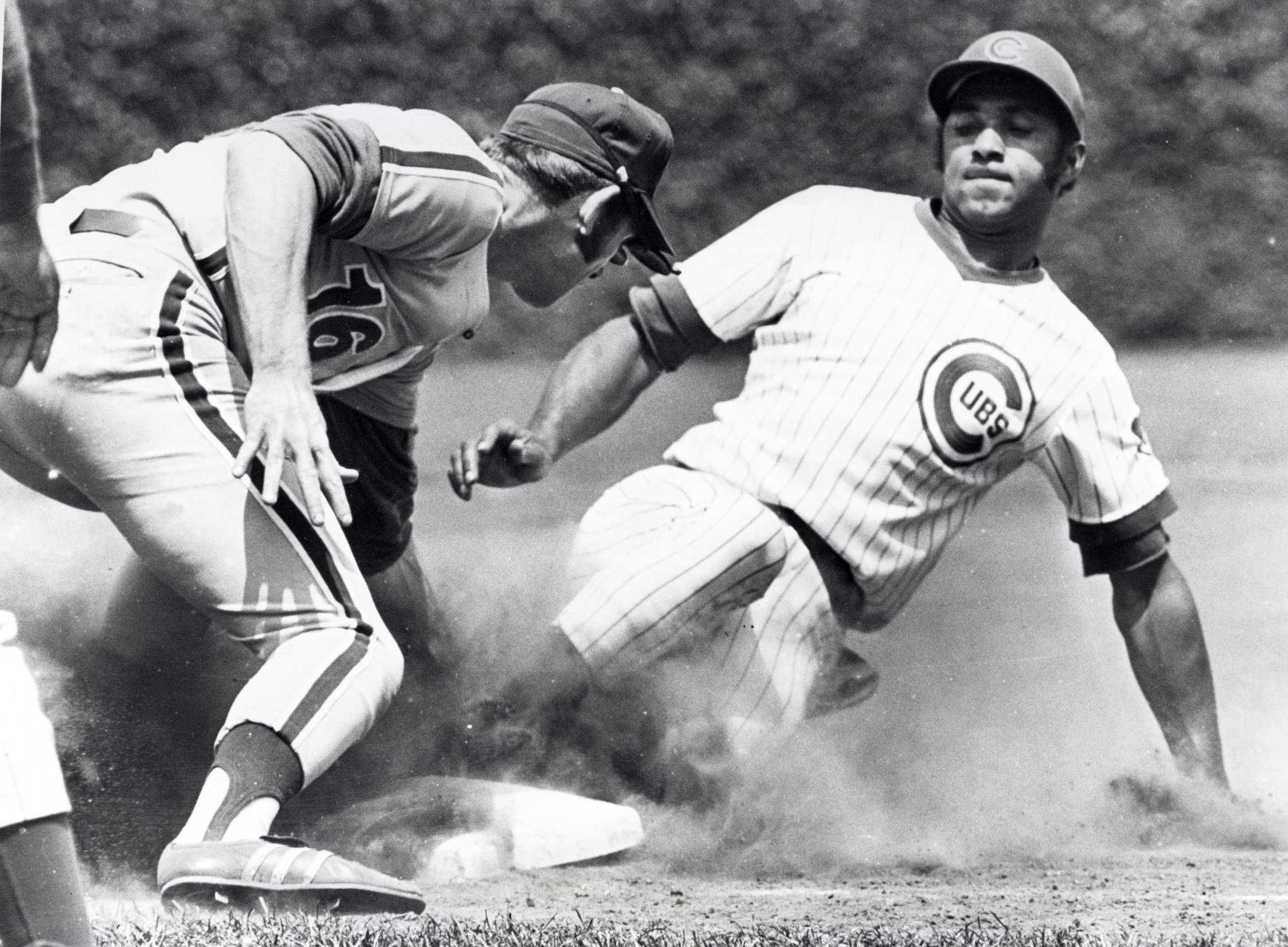
N. L. Batting Champion (.333)
Billy Williams (CHC)
Joining Williams in Atlanta were Ron Santo (.302/17/74), Glenn Beckert (.270/3/43) and Don Kessinger (.274/1/39). Kessinger would be named a starter while Santo and Beckert were reserves. Right fielder, Jose Cardenal, in his first season with the Cubs, hit .291 with 17 long balls and 70 runs driven in.
Fergie Jenkins (20/3.20/184) would lead the pitching staff in wins with 20 while leading the league in earned runs (103) and home runs allowed (32). All five starters would hit the 10-win mark: Burt Hooton (11/2.80/132), Milt Pappas (17/2.77/80), Bill Hands (11/3.00/96) and Rick Reuschel (10/2.93/87). Hooton and Pappas would both make history in ’72 by twirling no-hitters. Hooton blanked the visiting Pirates on April 16th and Pappas stymied the Phillies on September 2nd.
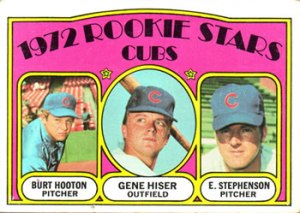
No Hitter:
Burt Hooton
vs. Pittsburgh Pirates (4-0)

No Hitter:
Milt Pappas
vs. Philadelphia Phillies (8-0)
1973
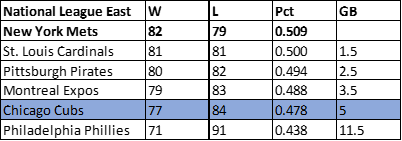
The 1973 season was a tale of two halves for the Cubs. A strong first half left the Cubs at 47-32 and squarely in contention in the National League East at the end of June. The Cubs would finish the second half of the season winning only 30 of 82 games. Due to the mediocre competition in the East, the Cubs remained in the hunt until the final days of the season. The Cubs would send two starters to the All-Star Game in Kansas City, Billy Williams (.288/20/86) and Ron Santo (.267/20/77). Outfielders, Rick Monday (.267/26/56) and Jose Cardenal (.303/11/68) would both have solid season-ending numbers.
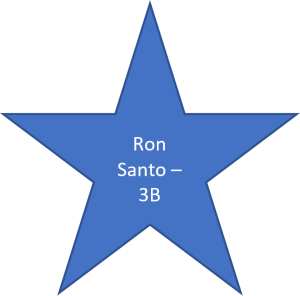
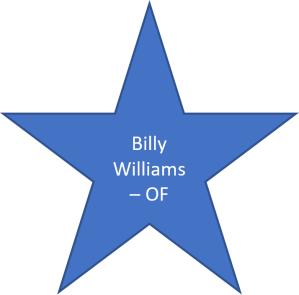
A trio of Cubs starters, Fergie Jenkins (14/3.89/170), Burt Hooton (14/3.68/134) and Rick Reuschel (14/3.00/168) would each win 14 games. Relief Pitchers, Bob Locker (10/2.54/76) and Jack Aker (4/4.10/25) would combine to save 30 games for the Cubs bullpen.
1974

A core group of Cubs were traded in the offseason, including Ferguson Jenkins (Rangers), Bob Locker (Athletics), Glenn Beckert (Padres) and Ron Santo (White Sox). The offseason moves did not pan out for the Cubs as they finished last in the N. L. East, 22 games behind the Pittsburgh Pirates. The Cubs would not post a winning record during any month of the season. Rookie Bill “Mad Dog” Madlock, acquired in the Fergie Jenkins trade, had a stellar rookie campaign. Madlock hit .313 with 9 home runs, 54 RBIs and finished third in the Rookie of the Year voting. Center fielder, Rick Monday, hit .294 with 20 homers and 58 RBIs. Outfield mates, Jerry Morales (.273/15/82) and Jose Cardenal (.293/13/72) performed well for the Cubbies. Don Kessinger (.259/1/42) would be named as a reserve for the All-Star Game in Pittsburgh.
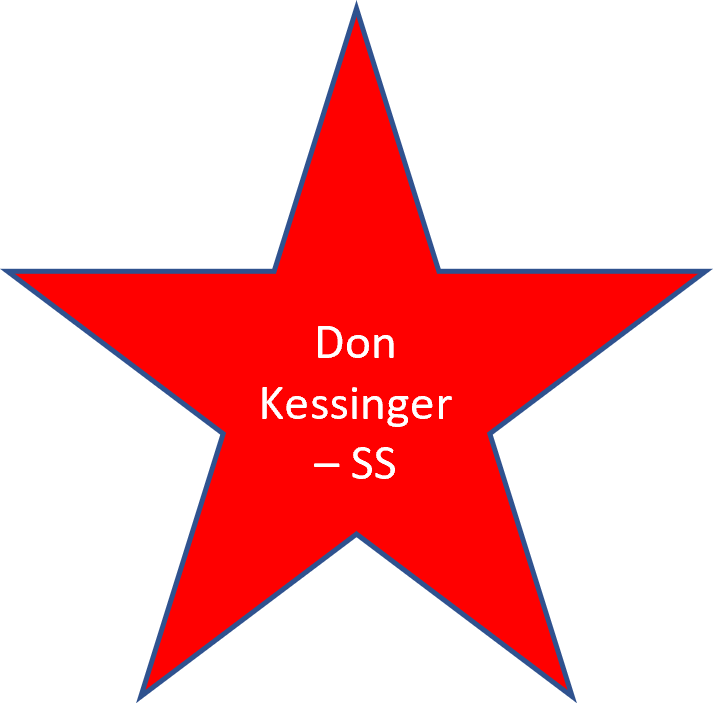
With the loss of Jenkins, the pitching staff struggled, surrendering 826 runs on the year. Bill Bonham, won 11 games for the Cubs while losing a league high 22 games. Rick Reuschel won 13 games while posting a 4.30 ERA with 160 strikeouts. Steve Stone started the third most games for the Cubs and posted an 8-6 record. Closer, Oscar Zamora, won 3 games and saved 10 more out of the pen.
1975
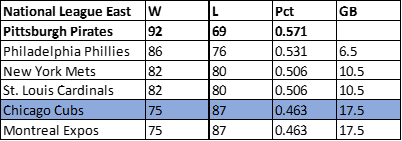
The 1975 Cubs won nine more games than the previous year and finished tied for fifth place in the National League East with the Montreal Expos. Prior to the ’75 campaign, the Cubs traded veteran outfielder and perennial All-Star, Billy Williams, to the Oakland Athletics for Manny Trillo, Darold Knowles and Bob Locker. The Cubs started the season hot, posting a 12-5 record in April, including a seven-game winning streak. The Cubs would not complete another month above the .500 mark.
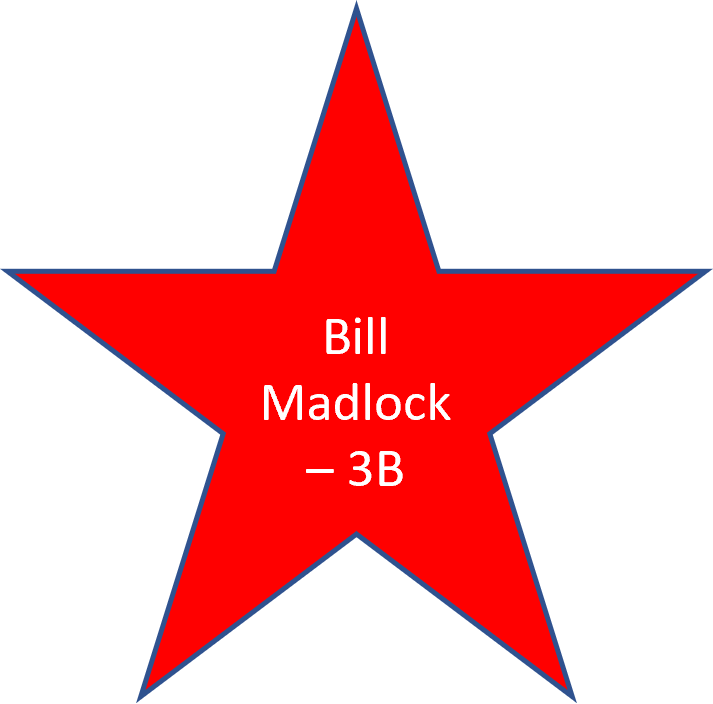
Third baseman, Bill Madlock (.354/7/64) would win the National League batting crown and post an impressive 4.9 WAR. Madlock would be named a reserve for the All-Star game at County Stadium in Milwaukee.
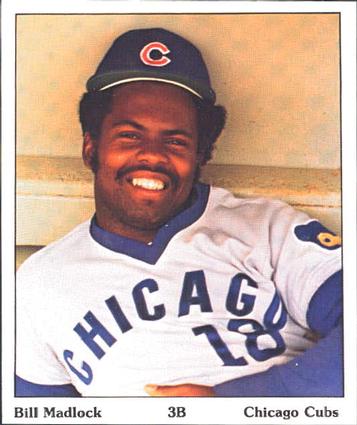
N. L. Batting Champion (.354)
Bill Madlock (CHC)
Newly acquired rookie second baseman, Manny Trillo, would hit .248 with 7 homers, 70 RBIs and finish in third place for Rookie of the Year in the Senior Circuit. The outfield trio of Jose Cardenal (.317/9/68), Rick Monday (.267/17/60) and Jerry Morales (.270/12/91) would all produce solid numbers for the Cubbies.
The Cubs pitching staff featured a quartet of starters who would all reach double-digits in wins. Ray Burris led the team in wins (15) with 108 strikeouts and a 4.12 ERA. Rick Reuschel would win 11 games while losing a league-high 17 decisions. Bill Bonham won 13 of 28 decisions and allowed a league leading 120 earned runs. Steve Stone posted a 12-8 mark, struck out 139 and produced a 3.95 ERA. Newly acquired closer, Darold Knowles won six games and saved 15 more for the North-siders.
1976

As America celebrated its Bicentennial, the Chicago Cubs were mired in fourth place in the National League East, twenty-six games behind the pennant-winning Philadelphia Phillies. The Cubs finished April with a 9-10 record, but the month was filled with historical events. On April 17th, Mike Schmidt of the visiting Phillies, hit four consecutive home runs in the game as the Phillies outlasted the Cubs 18-16.
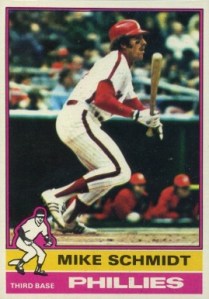
Four Home Runs:
Mike Schmidt
On April 22nd, shortstop Tim Foli of the Montreal Expos, completed a Natural Cycle against the Cubs in front of 11,355 Wrigley faithful.
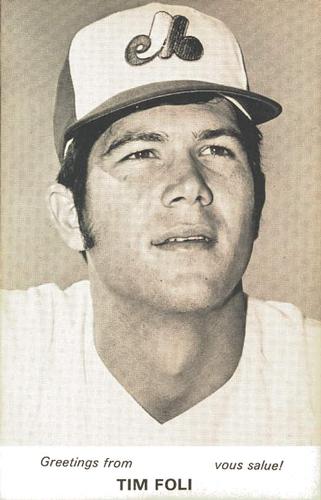
Natural Cycle:
Tim Foli (MON)
vs. Chicago Cubs
On April 25th, Rick Monday stopped two protesters from burning the American flag by swooping in and snatching the flag before they could set it ablaze.
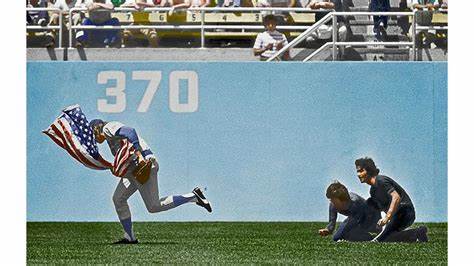
Rick Monday Saves the Day!
The Cubs offense was led by Bill Madlock who won his second consecutive batting title by hitting .339 while being Hit by a Pitch a league high 11 times.
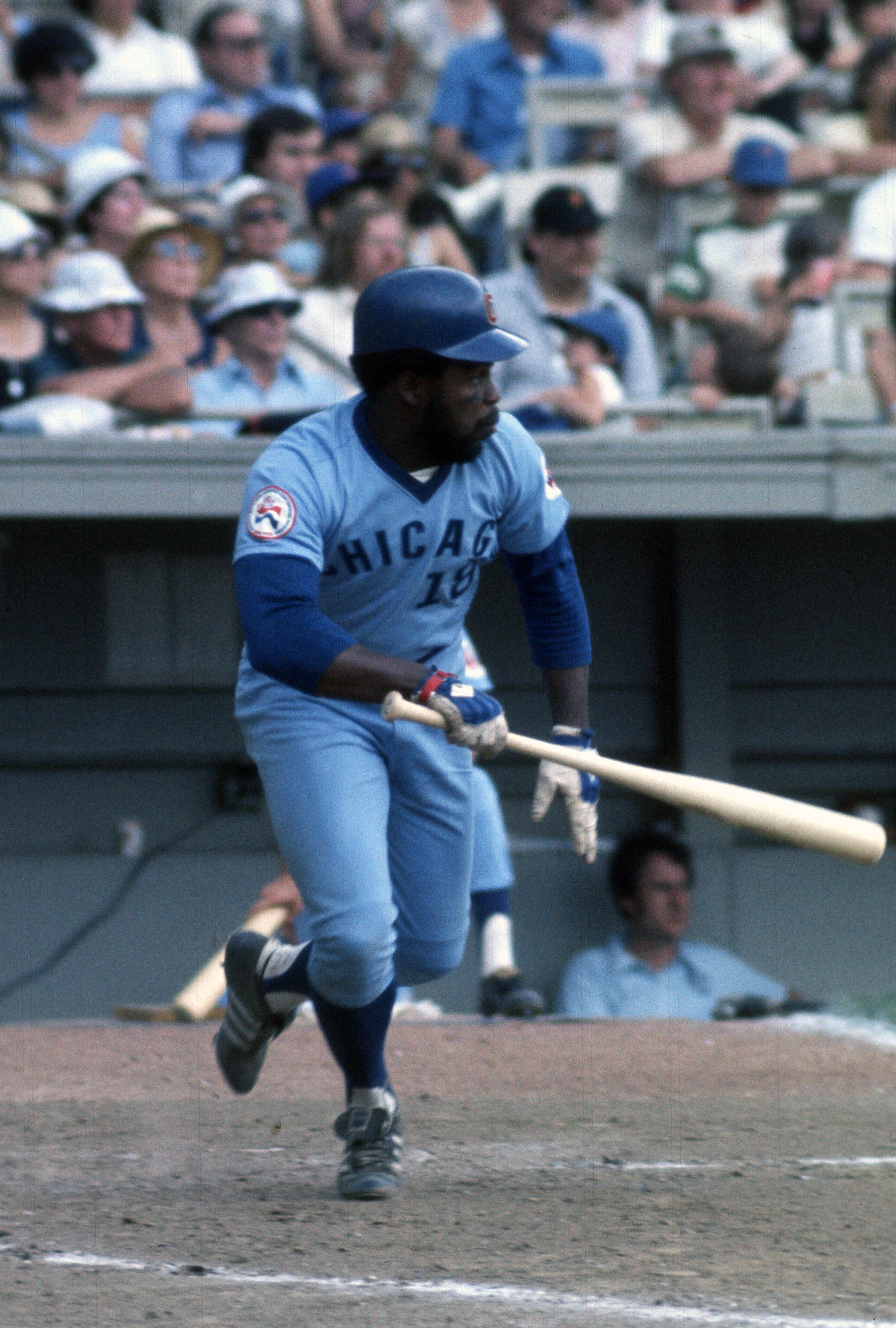
N. L. Batting Champion (.339)
Bill Madlock (CHC)
The lone Cub representative at the All-Star game in Philadelphia was catcher Steve Swisher. Swisher hit .236 with 5 dingers and 42 runs batted in.
The pitching staff was anchored by Rick Reuschel (14/3.46/146) and Ray Burris (15/3.11/112). Remaining starters, Bill Bonham (9/4.27/110), Steve Renko (8/3.86/112) and Steve Stone (3/4.08/33) would combine to win 20 games for the Cubbies. Relievers Bruce Sutter and Darold Knowles would combine to save 19 games for Chicago. On June 25th, Mike Phillips of the Mets, would hit for the cycle against Ray Burris and Mike Garman.
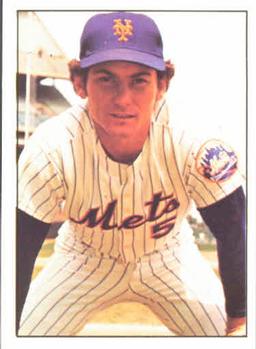
Cycle:
Mike Phillips (NYM)
vs. Chicago Cubs
1977

A flurry of offseason moves dramatically changed the makeup of the 1977 Cubs. The Cubs added Willie Hernandez, Greg Gross, Bill Buckner, Ivan DeJesus and Bobby Murcer. Gone were Rick Monday, Mike Garman, Darold Knowles, Bill Madlock and Champ Summers. First-year manager, Herman Franks, led the Cubs to an 81-81 record and a fourth-place finish in the National League East. The Cubs held first place through the end of June but struggled in July and fell out of contention with a 20-40 record in August, September and October.
Bobby Murcer stoked the Cubs offense, hitting .265 with 27 home runs and 89 RBIs. Jerry Morales (.290/11/69) received an invite to the All-Star game at Yankee Stadium along with second baseman Manny Trillo (.280/7/57). Newly acquired first baseman, Bill Buckner hit .284 with 11 homers and 60 RBIs.

Staff ace, Rick Reuschel, won 20 games with a 2.79 ERA and 166 K’s and earn a spot on the All-Star squad. Ray Burris (14/4.72/105), Bill Bonham (10/4.36/134) and Mike Krukow (8/4.40/106) rounded out the starting staff. Closer, Bruce Sutter won 7 games with 31 saves and a miniscule 1.34 ERA to earn an invite to New York. Sutter would also throw an Immaculate Inning on September 8th against the visiting Montreal Expos.
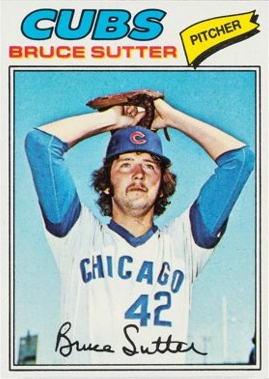
Immaculate Inning (9th)
Bruce Sutter (CHC)
vs. Montreal Expos
1978
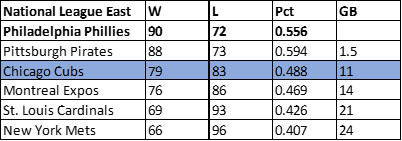
The Chicago Cubs would finish the 1978 campaign in third place, eleven games behind the N. L. East winning Phillies. The Cubs would hover around the .500 mark for most of the season, last touching first place on June 23rd. Cubs ace, Rick Reuschel had a middling year, winning 14 of 29 decisions with 115 strikeouts and a respectable 3.41 ERA. Fellow starters, Dennis Lamp (7/3.30/73), Ray Burris (7/4.75/94), Dave Roberts (6/5.25/54) and Mike Krukow (9/3.90/81) would combine to win a meager 29 games combined. Closer, Bruce Sutter, won 8 games in relief and posted 27 saves on the year. Sutter would receive an All-Star nod for his efforts.
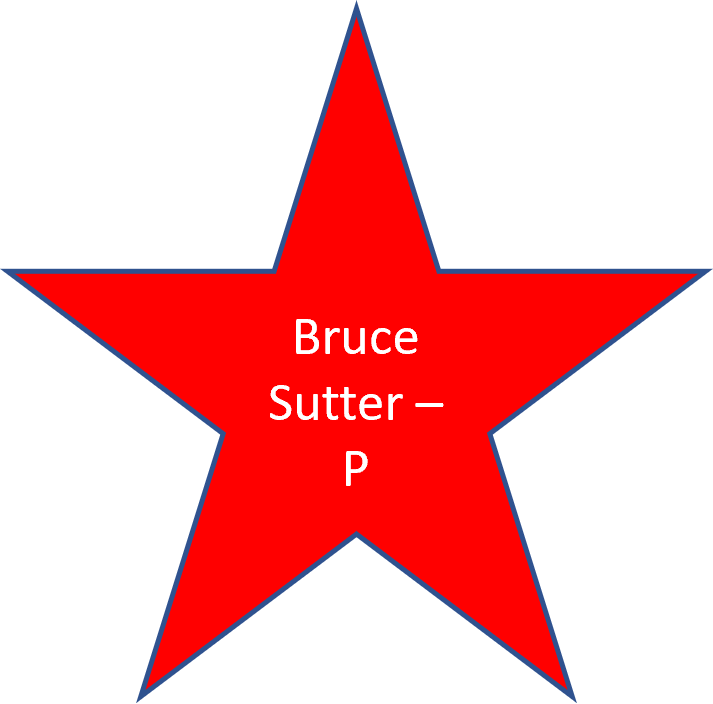
Dave “King Kong” Kingman fueled the Cubs offensively with a .266 average, 28 home runs and 79 runs batted in. Bobby Murcer contributed a .281 average with nine homers and 64 RBIs. First Baseman, Bill Buckner, hit .323 on th year to lead all Cubbies while adding five home runs and 74 RBIs. Shortstop, Ivan DeJesus (.278/3/35), led the National League in runs scored with 104.
1979
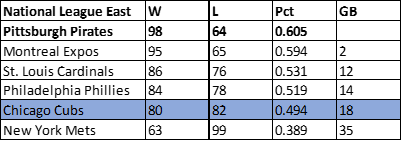
The Cubs of 1979 slid to fifth place in the National League East, despite winning one more game than the ’78 team. The Cubs would finish 18 games behind the eventual World Champion Pittsburgh Pirates. 1979 marked the first time in team history that the player’s last names would appear on the team uniforms but only applied to their road unis. The Cubs hovered around the .500 mark for most of the season, fueled by a 16-8 record in June and an 18-13 mark in August. The pitching staff combined for a solid 3.90 ERA and a trio of Cubs starters reached double-digits in wins. Rick Reuschel (18/3.62/125), Lynn McGlothen (13/4.12/147) and Dennis Lamp (11/3.50/86) all achieved the mark, while Mike Krukow (9/4.21/81) and Ken Holtzman (6/4.59/44) added 15 more wins. Setup man, Dick Tidrow, won 11 games in relief with a paltry 2.72 ERA. Closer, Bruce Sutter, led the National League in saves (37) and won both the Fireman of the Year award and the National League Cy Young award. Sutter would receive a spot on the All-Star team and earn the win for the National League in Seattle.

N.L. Cy Young Award
Bruce Sutter (CHC)

N.L. Fireman of the Year
Bruce Sutter (CHC)
Dave Kingman would also receive an invitation to the Kingdome, but did not make the trip. Kingman led the league in home runs (48), strikeouts (131), slugging percentage (.613) and OPS (.956).
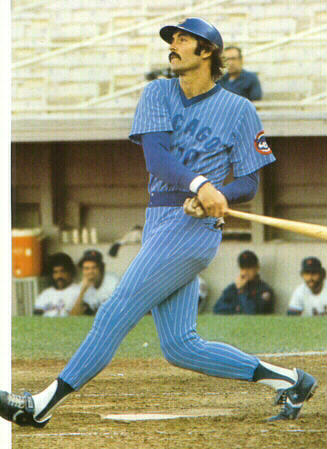
N. L. Home Run Leader (48)
Dave Kingman (CHC)
Bill Buckner (.284/14/66), Barry Foote (.254/16/5) and Jerry Martin (.272/19/73) all contributed to the Cubs offensive output in 1979. Right fielder, Scot Thompson, posted a .289 average in 128 games and placed third in the Rookie of the Year voting. On May 17th, Dave Kingman would homer three times, Steve Ontiveros, Bill Buckner and Jerry Martin would each homer once as the Cubs dropped an all-time classic to the Phillies 23-22.

45 Runs
Phillies vs. Cubs (23-22)
1980
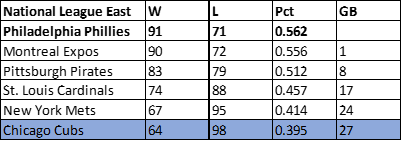
After a 9-6 start in April, the Cubs plummeted to the bottom of the National League East, finishing 27 games behind the World Champion Philadelphia Phillies. The Cubs offense was fueled by National League batting champion Bill Buckner (.324/10/68).
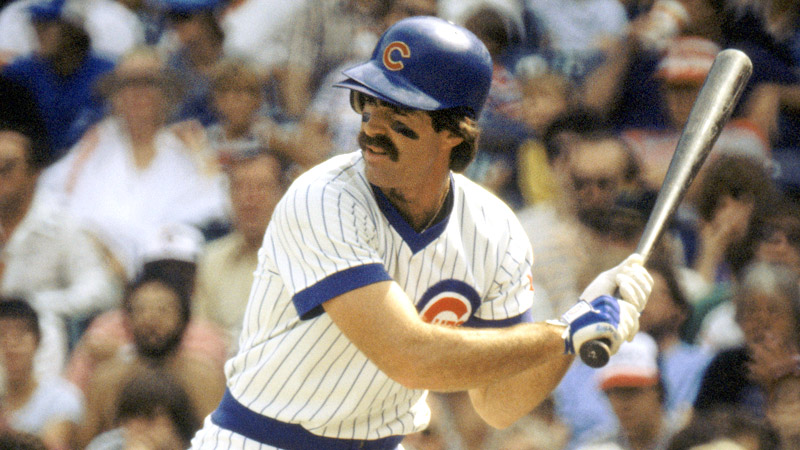
N. L. Batting Champion (.324)
Bill Buckner (CHC)
Shortstop, Ivan Dejesus (.259/3/33), hit for the cycle on April 22nd against the visiting St. Louis Cardinals.
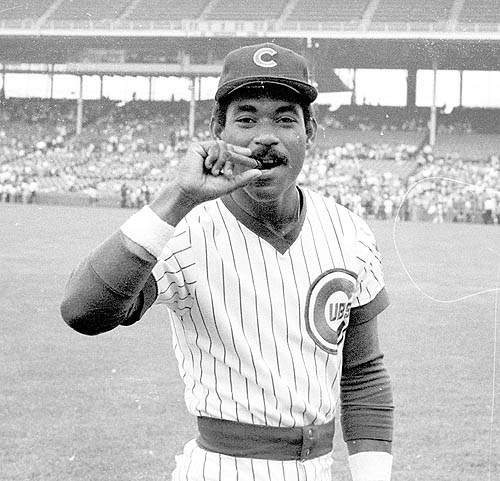
Cycle:
Ivan Dejesus (CHC)
vs. St. Louis Cardinals
Dave Kingman (.278/18/57) and Jerry Martin (.227/23/73) provided the power for a team that would only score 614 runs on the season. Kingman would earn an All-Star selection for the game at Dodger Stadium.
Cubs closer, Bruce Sutter, would join Kingman in Los Angeles for the All-Star festivities. Sutter led the National League in saves (28) while posting a 2.64 ERA. Setup man, Dick Tidrow, led the National League in games with 84. All four starters would post 10+ wins, Rick Reuschel (11/3.40/140), Mike Krukow (10/4.39/130), Dennis Lamp (10/5.20/83) and Lynn McGlothen (12/4.79/119).
1981
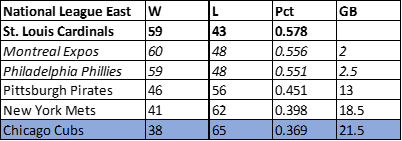
The Cubs never challenged in the strike-shortened 1981 season, posting a 2-13 mark in April and an 8-20 record in May. By the time the work stoppage occurred in Mid-June, the Cubs were out of contention for the first half of the season. When play resumed, the Cubs won 23 and lost 28 to eliminate any chance of winning the second half crown and gaining a postseason berth. Outfielder, Leon “Bull” Durham and first baseman, Bill Buckner, led the team in home runs with 10. Buckner hit .311 for the season and led the National League in doubles with 35 earning him the lone spot in the All-Star game in Cleveland.
No Cub pitcher managed to win 10 games in the shortened season. Mike Krukow produced 9 wins against 9 losses and led the National League in games started (25). Remaining starters, Rick Reuschel (4/3.47/53), Doug Bird (4/3.58/34) and Mike Griffin (2/4.50/20) managed just 10 wins combined. Closer, Dick Tidrow managed to save nine games despite a lofty 5.06 ERA. By the end of the season, ownership of the Cubs was transferred from the Wrigley Family to the Tribune Company, marking the end of an era.
1982
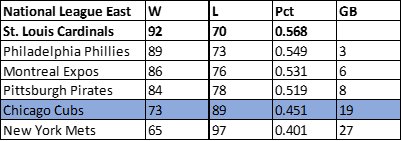
The 1982 edition of the Chicago Cubs finished in fifth place in the National League East, 19 games behind the St. Louis Cardinals. Fergie Jenkins led the pitching staff with 14 wins against 15 losses and 134 strikeouts. Doug Bird posted a 9-14 record while leading the National League in earned runs allowed (109), home runs allowed (26) and walks per 9 innings (1.4). Dickie Noles, who was part of an offseason trade for Mike Krukow, won 10 of 23 decisions and posted a 4.42 ERA. Closer, Lee Smith, posted a 2.69 ERA with 17 saves on the year.
On January 27th, new Cubs General Manager Dallas Green, fleeced his former team by sending shortstop Ivan DeJesus to the Phillies for an aging Larry Bowa and a minor league second baseman by the name of Ryne Sandberg. Ryno would finish sixth in the Rookie of the year voting with a stat line of .271/7/54. Sandberg would go on to a Hall of Fame career and become a Chicago icon. The Cubs offense was fueled by Leon Durham who posted a .312 batting average with 22 home runs and 90 RBIs. Durham would be the Cubs’ lone representative at the All-Star game in Montreal. Bill Buckner led the National League in At-Bats (657), while hitting .306 with 15 dingers and 105 runs driven in. Catcher, Jody Davis played in 130 games and slashed .261/12/52.
Harry Caray was hired by WGN-TV prior to the 1982 season and brought his famous “Seventh Inning Stretch” to Wrigleyville. Harry would lead the crowd in the singing of “Take Me Out to the Ballgame” before the home seventh.
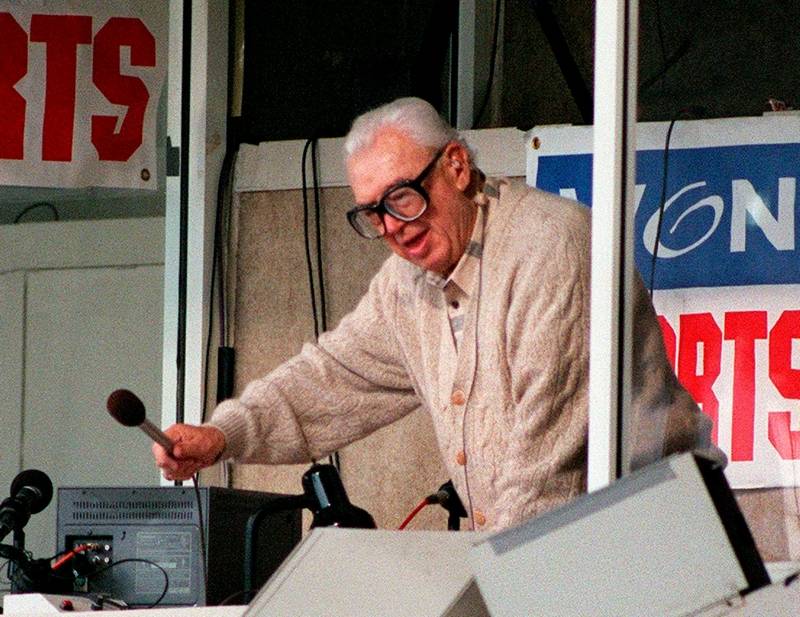
Seventh Inning Stretch
“Take Me Out to the Ballgame”
For the 1982 campaign, the Cubs added flags for each of the retired numbers, a tradition that continues to this day.


Cubs Retired Numbers Flags
1983
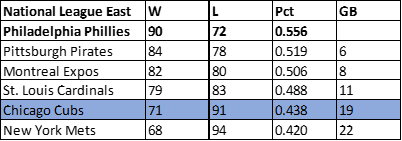
The Cubs maintained their fifth place standing in the National League East despite winning two fewer games than the ’82 campaign. The Cubs offense was led by catcher Jody Davis (.271/24/84) who received MVP votes for his breakout season. First baseman, Bill Buckner slashed .280/16/66 while leading the Senior Circuit in doubles (38). Ryne Sandberg batted .261 with 8 long balls and 48 runs batted in. Third sacker, Ron Cey, contributed 24 home runs, 90 RBIs and a .275 average. Centerfielder, Mel Hall, posted .283/17/56 numbers and finished third in the Rookie of the Year voting. Leon Durham earned his second straight All-Star invitation by hitting .258 with 12 homers and 55 RBIs.

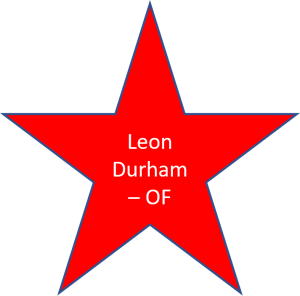
Righthander, Chuck Rainey led the pitching staff in wins with 14. Lefty, Steve Trout, notched ten wins with 80 punchouts and a 4.65 ERA. Offseason acquisition, Dick Ruthven, posted a 12-9 record with 73 strikeouts and a 4.10 ERA. Setup man, Bill Campbell, led the National League in games, appearing in 82 contests. Closer, Lee Smith, joined the All-Star festivities in Chicago by finishing a league high 56 games along with a league high 29 saves. Smith would be voted Co-Fireman of the Year along with Al Holland of the Phillies.

N.L. Co-Fireman of the Year
Lee Smith (CHC)
1984
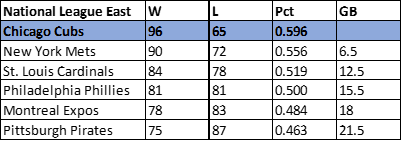
The 1984 season would be the North-Siders most successful campaign since the Summer of ’69. The Cubs spent 109 days in first place in the National League East, culminating with a division title, 6 1/2 games ahead of the New York Mets.
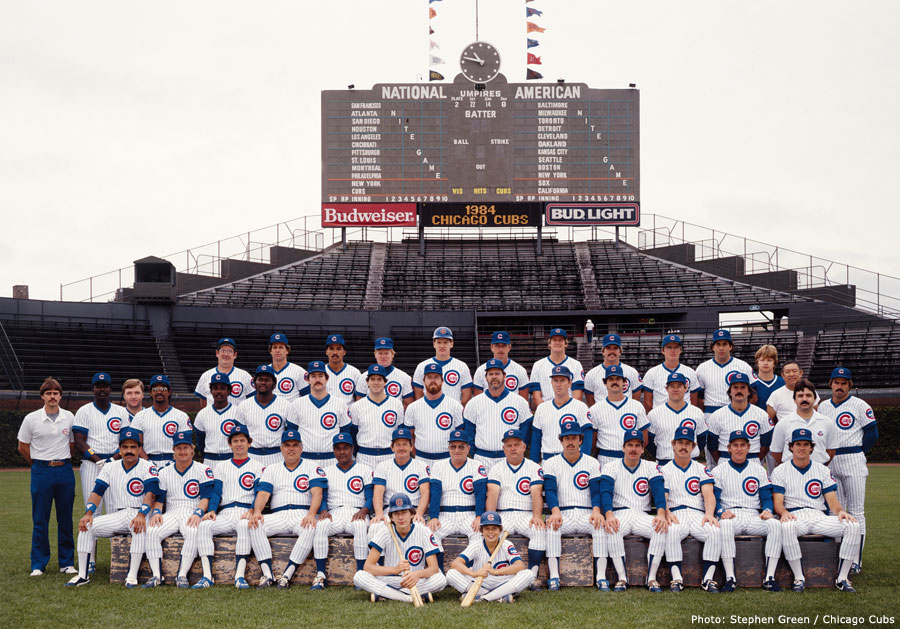
N. L. East Division Champions
Chicago Cubs
Second baseman, Ryne Sandberg was named Most Valuable Player in the National League. Ryno led the senior circuit in WAR (8.5), runs (114), and triples (19) while slashing .314/19/84. Sandberg was selected to start the All-Star Game at Candlestick Park in San Francisco.
N. L. Most Valuable Player
Ryne Sandberg (CHC)
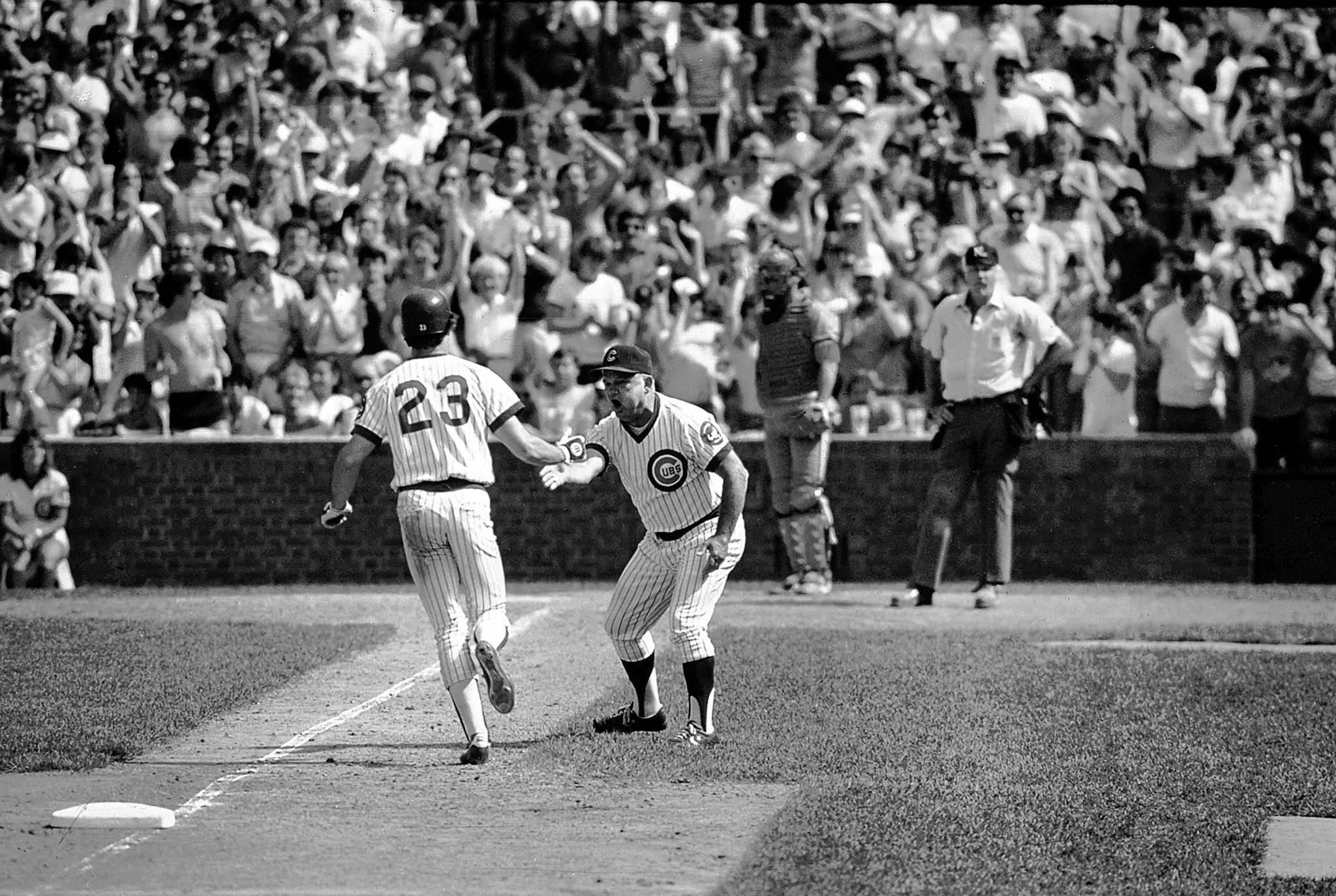
N. L. Co-Triples Leader (19)
Ryne Sandberg (CHC)
Joining Sandberg in San Francisco was catcher Jody Davis. Davis hit .256 with 19 homers and 94 runs driven in.

Leon Durham (.279/23/96), Ron Cey (.240/25/97) and Gary Matthews (.291/14/82) would all add to the Cubs offensive firepower. Matthews would lead the league in walks (103) and on-base percentage (.410).
On June 23rd, Willie McGee of the Cardinals would hit for the cycle in a 12-11 Cubs win.
Cycle:
Willie McGee (STL)
vs. Chicago Cubs
Rick Sutcliffe led the Cubs’ hurlers, posting a 16-1 record with 155 strikeouts and a 2.69 ERA. Sutcliffe would lead the league in winning percentage (.941) and win the National League’s Cy Young Award while finishing fourth in the MVP voting.
N.L. Cy Young Award
Rick Sutcliffe (CHC)
Lefty, Steve Trout (13/3.41/81) and righty, Dennis Eckersley (10/3.03/81) would both top ten victories for the Cubbies. Scott Sanderson would notch 8 wins along with a 3.14 ERA. Closer, Lee Smith would save 33 games and setup man, Tim Stoddard would win 10 games out of the pen. The Cubs season would end in a five-game loss to the San Diego Padres, in a tightly contested National League Championship series. Manager, Jim Frey, would be voted the National League’s Manager of the Year for righting the ship in Chicago.
N. L. Manager of the Year
Jim Frey (CHC)
1985
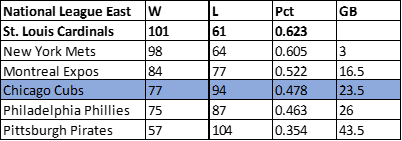
The Cubs regressed in the second year of Manager Jim Frey’s tenure. The Cubs fell to fourth place in the National League East, finishing 23 1/2 games behind the division winning Cardinals. Ryne Sandberg led the Cubs offense hitting .305 with 26 home runs and 83 RBIs. Sandberg was named the only Cub to the All-Star Game in Minneapolis.
Leon Durham continued to provide solid numbers hitting .282 with 21 long balls and 75 runs driven in. Jody Davis (.232/17/58), Ron Cey (.232/22/63) and Gary Matthews (.235/13/40) all posted strong numbers, but fell off from their 1984 totals. Right fielder, Keith Moreland, hit .307 with 14 homers and 106 RBIs and garnered some MVP votes.
Starter, Dennis Eckersley, was the only Cub hurler to earn 10 wins. Eck posted a 11-7 record with 117 strikeouts and a 3.08 ERA. Fellow starters, Ray Fontenot, Steve Trout, Rick Sutcliffe, Scott Sanderson and Dick Ruthven would combine to win only 32 games. Lee Smith was again stellar out of the pen, finishing a league high 57 games and saving 33 while posting a 3.04 ERA. The highlight of the season for the Wrigley faithful came on September 24th when Andre Dawson of the Montreal Expos hit two home runs against the Cubs in the fifth inning of a 17-15 Expos slugfest win.
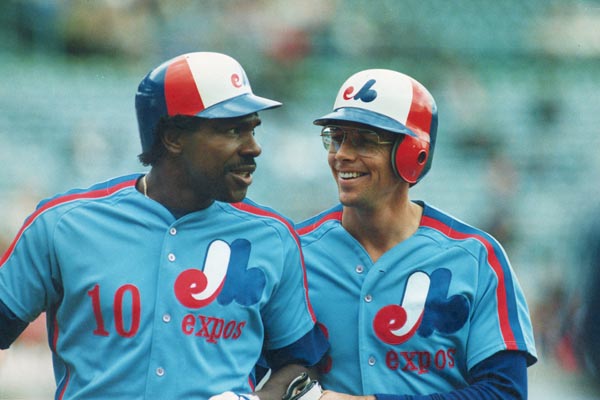
Andre Dawson (MON)
Two Home Runs
5th Inning
vs. Chicago Cubs
1986
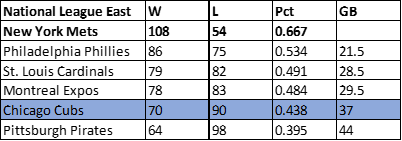
The Cubbies fell further in the standings in 1986, finishing in fifth place and costing Manager Jim Frey his job 56 games into the season. John Vuckovich served as interim Manager for two games and split the two decisions. Gene Michael would helm the Cubs the remainder of the season to mixed results.
Jody Davis (.250/21/74) and Ryne Sandberg (.284/14/76) would both be named All-Stars for the Midsummer Classic at the Astrodome.
Leon Durham (.262/20/65), Gary Matthews (.259/21/46) and Shawon Dunston (.250/17/68) would provide additional power to the Cubs starting lineup.
Starting pitcher, Scott Sanderson, led the staff in wins with nine. The remaining starters, Dennis Eckersley, Rick Sutcliffe, Steve Trout, Ed Lynch and Jamie Moyer won only 30 games combined while contributing to a team ERA of 4.51. Lee Smith won nine games out of the bullpen with a 3.09 ERA and 31 saves.
1986 marked the release of the film “Ferris Bueller’s Day Off”. Wrigley Field was the site for a scene in the film that would become an 80’s classic.
Baseball Scenes Filmed
at Wrigley Field
1987

The 1987 edition of the Chicago Cubs dropped to the cellar in the National League East despite the best efforts of free agent signing Andre Dawson. Dawson did not draw much interest in the offseason and the Cubs signed him for a mere $500,000 one-year contract. Dawson repaid the Cubs by turning in an MVP performance (literally!). Dawson led the National League in home runs (49), RBIs (137) and total bases (353). Andre won a Gold Glove in right field, earned a Silver Slugger award and was named a starter for the All-Star game in Oakland. Dawson set the tone early in the season when he hit for the cycle on April 29th against the visiting San Francisco Giants.
N. L. Most Valuable Player
Andre Dawson (CHC)

N. L. Home Run Leader (49)
Andre Dawson (CHC)
N. L. RBI Leader (137)
Andre Dawson (CHC)
Cycle:
Andre Dawson (CHC)
vs. San Francisco Giants
Ryne Sandberg also earned a trip to the Oakland Coliseum by hitting .294 with 16 home runs and 59 RBIs. Ryno would also win a Gold Glove at second base and earn a Silver Slugger award. Jody Davis (.248/19/51), Leon Durham (.273/27/63) and Keith Moreland (.266/27/88) would all post offensive numbers familiar to Wrigleyville.

Starter, Rick Sutcliffe joined his teammates in Oakland along with closer, Lee Smith. Sutcliffe sported an 18-10 record with 174 strikeouts and a 3.68 ERA. Sutcliffe’s 18 victories were tops in the National League. Smith saved 36 games and had an ERA of 3.12.
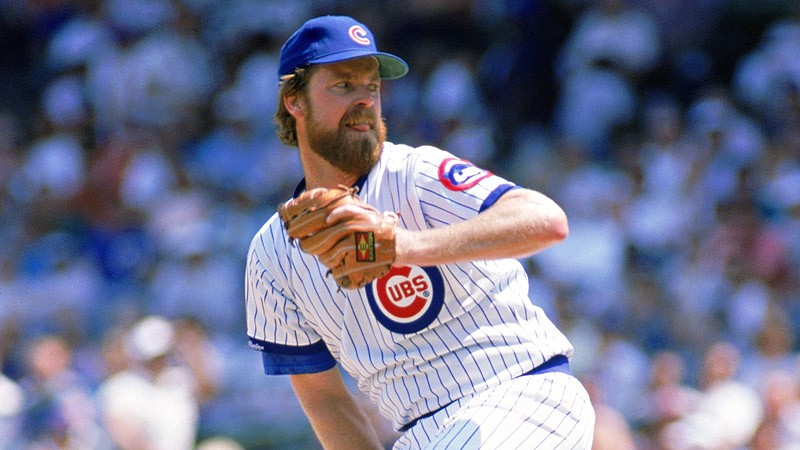
N. L. Wins Leader (18)
Rick Sutcliffe (CHC)
Perhaps the most impressive pitching performance of the year was turned in on September 7th by Jeff Robinson of the visiting Pittsburgh Pirates. Robinson struck out the side in the 8th inning on nine pitches to record an Immaculate Inning.
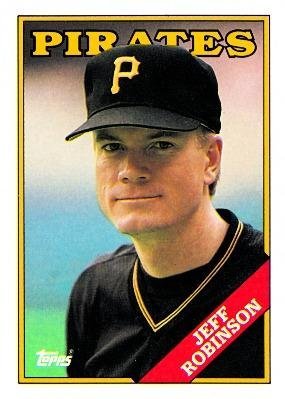
Immaculate Inning (8th)
Jeff Robinson (PIT)
vs. Chicago Cubs
1988
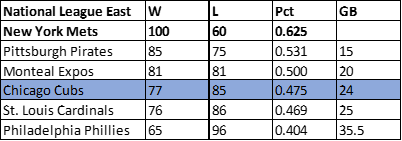
The 1988 Cubs won one more game than the ’87 squad but jumped into fourth place in the National League East. The season started in grand fashion when President Ronald Reagan threw out the first pitch at Wrigley field on April 15th.

The Cubs sent five offensive players to the All-Star game in Cincinnati: Andre Dawson (.303/24/79) and Ryne Sandberg (.264/19/69) were named starters for the game at Riverfront Stadium with both earning a Gold Glove and Sandberg adding a Silver Slugger award. Rafael Palmeiro (.307/8/53), Shawon Dunston (.249/9/56) and Vance Law (.293/11/78) were named as All-Star reserves.


Greg Maddux would lead the pitching staff with 18 wins, 140 strikeouts and a 3.18 ERA earning an All-Star nod. Rick Sutcliffe would pick up 13 wins to go with his 144 K’s. Offseason trade acquisition, Rich “Goose” Gossage would make history on August 6th when he saved his 300th career game against the visiting Phillies.
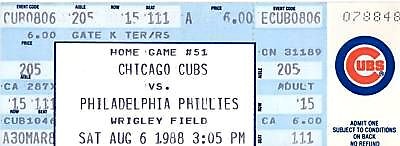
Two days later, history was almost made again. Newly installed lights would allow the Cubs to play the first night game in the history of Wrigley Field. Rain delayed the game in the fourth inning and the game was postponed.
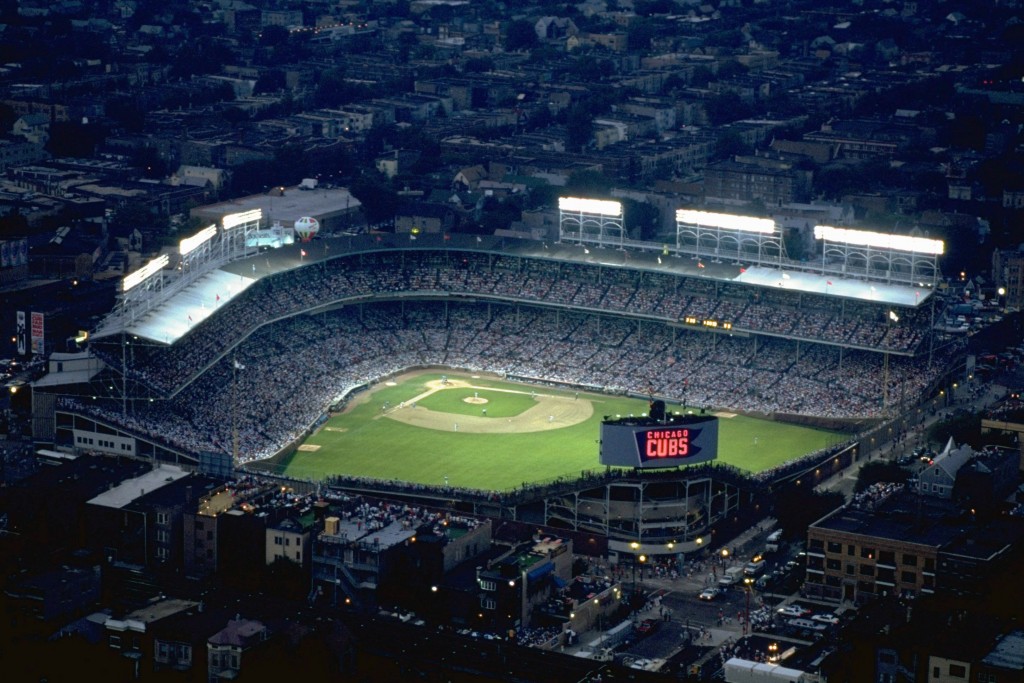
First Night Game
Phillies vs. Cubs (PPD)
The next evening, the Cubs played their first “official” night game and defeated the Mets 6-4 in front of a crowd of 36,399.
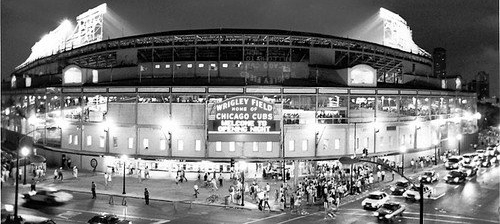
First Official Night Game
Mets vs. Cubs
1989
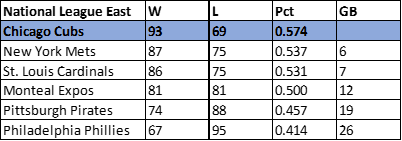
The 1989 Chicago Cubs won the National League East for the second time on the strength of a red-hot July where they posted an 18-9 mark. The Cubs would battle the Mets and Cardinals to the end of the season but finished with a six-game cushion.
N. L. East Division Champions
Chicago Cubs
The jump from fourth place to first earned second-year skipper, Don Zimmer, Manager of the Year honors.
N. L. Manager of the Year
Don Zimmer (CHC)
Greg Maddux led the pitching staff with 19 wins, 135 strikeouts and a 2.95 ERA. Mike Bielecki posted a dazzling 18-7 record with 147 K’s and a 3.14 ERA. Rick Sutcliffe won 16 of 27 decisions and fanned 153 with a 3.65 ERA earning an All-Star invitation. Closer, Mitch WIlliams, acquired in an offseason trade with the Rangers, saved 36 games while appearing in a league high 76 games. Williams would join Sutcliffe in Anaheim for the All-Star festivities.

Ryne Sandberg (.290/30/76) would be named an All-Star starter while leading the Senior Circuit in runs scored (104). Andre Dawson (.252/21/77) was an All-Star reserve in Anaheim. A tandem of young outfielders made their mark in their first seasons with the Cubs. Jerome Walton (.293/5/46) and Dwight Smith (.324/9/52) finished 1-2 in the Rookie of the Year voting.
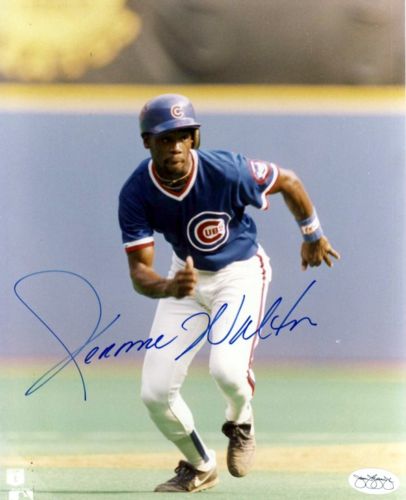
N.L. Rookie of the Year
Jerome Walton (CHC)
The Cubs would face the San Francisco Giants in the National League Championship series. The division champions split the first two games at Wrigley Field before the Giants took three straight games at Candlestick Park to advance to the Fall Classic.
1990

The Chicago Cubs were unable to defend their National League East crown in 1990, falling to fourth place in the division. The Cubs started slowly and finished the first half of the season under .500. Ryne Sandberg (.306/40/100) once again led the Cubs offensively. Ryno led the National League in runs scored (116), total bases (344) and home runs (40). Sandberg became the first second baseman to lead the Senior Circuit in homers since Rogers Hornsby in 1925.
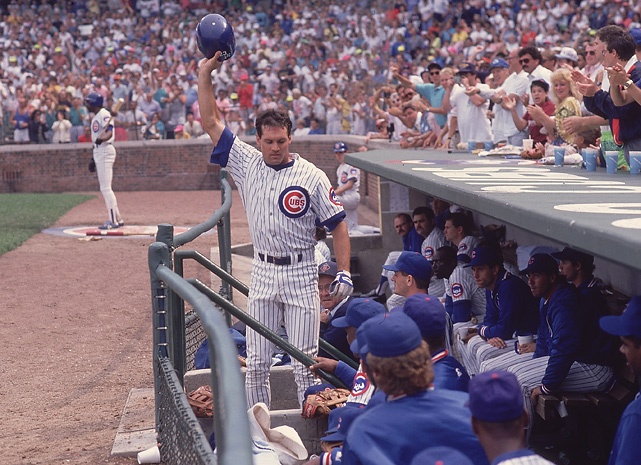
N. L. Home Run Leader (40)
Ryne Sandberg (CHC)
Sandberg was named as a starter for the 61st All-Star game hosted by the Cubs at Wrigley Field. Joining Sandberg were Andre Dawson (.310/27/100) as a starter and Shawon Dunston (.262/17/66) as a reserve.


The American League won the All-Star contest by a score of 2-0. Julio Franco of the Texas Rangers was named MVP based on his run scoring double in the seventh inning. Mr. Cub, Ernie Banks threw out the ceremonial first pitch.
American League 2
National League 0
Ryne Sandberg took home the hardware for the Home Run Derby. He added the trophy to his Gold Glove and Silver Slugger awards.
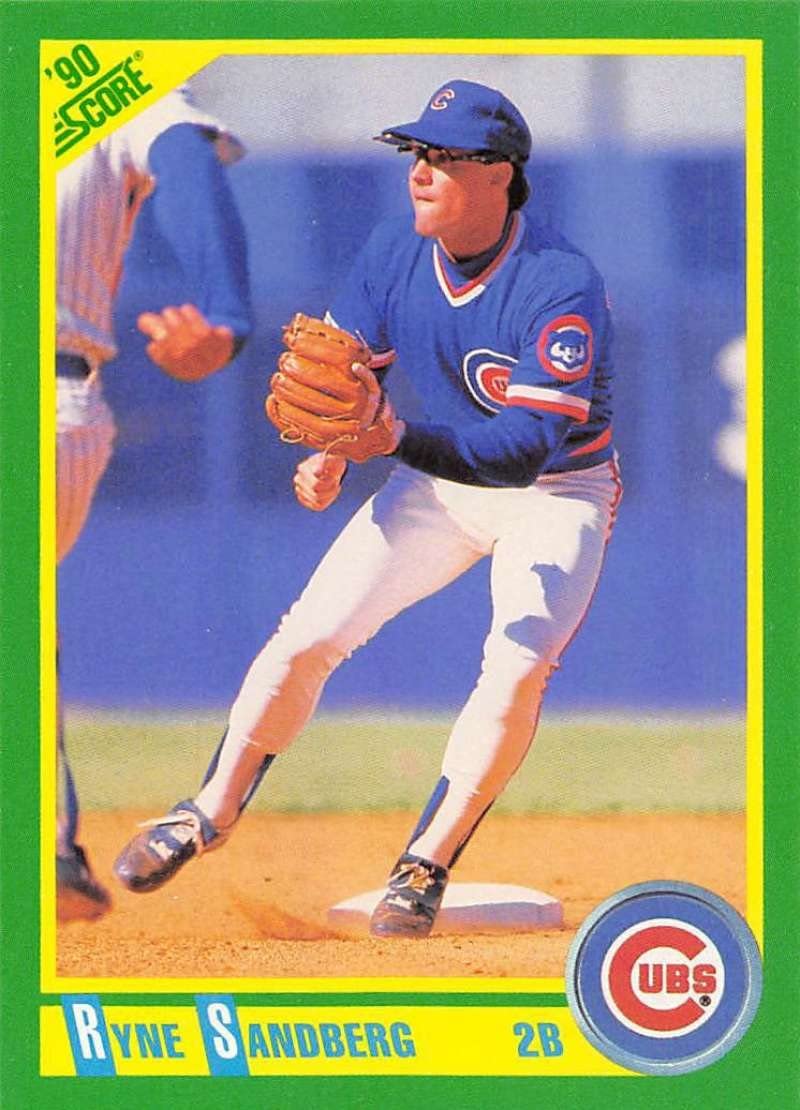
Home Run Derby Champion
Ryne Sandberg (CHC)
The Cubs pitching staff struggled most of the year. Staff ace, Greg Maddux, finished the season with a 15-15 mark including 144 strikeouts and a 3.46 ERA. Maddux led the league in games started (35) and hits allowed (242). Fellow starter, Mike Harkey, posted a 12-6 record with 94 K’s and a 3.26 ERA. Closer, Mitch Williams, saved 16 games but lost eight on the year. Setup man, Paul Assenmacher, went 7-2 with a 2.80 ERA and 10 saves.
1991
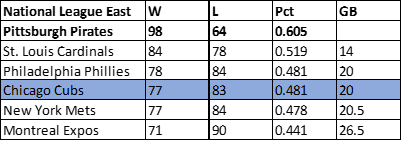
The Cubbies maintained their fourth place standing in the N. L. East in 1991, once again winning 77 games. The Cubs sent a trio of players to the All-Star game in Toronto, Ryne Sandberg (.291/26/100), Andre Dawson (.272/31/104) and free agent signing George Bell (.285/25/86). Sandberg again collected hardware for Gold Glove and Silver Slugger honors. First baseman, Mark Grace led the league in at-bats (619) while hitting .273 with 8 dingers and 58 RBIs.
Staff ace, Greg Maddux posted a 15-11 record while leading the league in games started (37), innings pitched (263) and batters faced (1070). Maddux would also earn a Gold Gove for his fielding prowess. Mike Bielecki posted a 13-11 record with 72 strikeouts and a 4.50 ERA before a late season trade to the Braves. The Cubs signed closer Dave Smith in the offseason and subsequently traded Mitch WIlliams to the Phillies. Smith posted a 0-6 record, a 6.00 ERA and saved 17 games.
1992
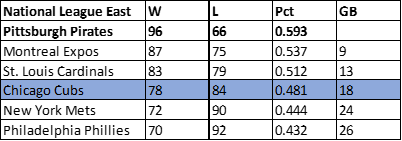
The 1992 Cubs won one more game than the prior season but stayed in fourth place in the National League East. The Cubs would finish 18 games behind the division winning Pirates. Just prior to the season, the Cubs completed a trade with their crosstown rivals. The Cubs sent all-star George Bell to the White Sox for Sammy Sosa and Ken Patterson. The Cubs started slowly posting a 20-28 record over the first two months of the season. Despite a productive June and August, the Cubs stumbled down the stretch going 11-21.
Future Hall of Famer, Greg Maddux carried the Cubs pitching staff posting a 20-11 record for the year. Maddux would lead the league in WAR (9.1), wins (20 – tie Glavine), games started (35), innings pitched (268), hit batters (15), batters faced (1061), ERA+ (166), FIP (2.58) and home runs per 9 innings (0.2) on his way to winning the National League’s Cy Young Award. Maddux would win the Gold Glove Award for pitchers and secure a spot at the All-Star Game in San Diego.
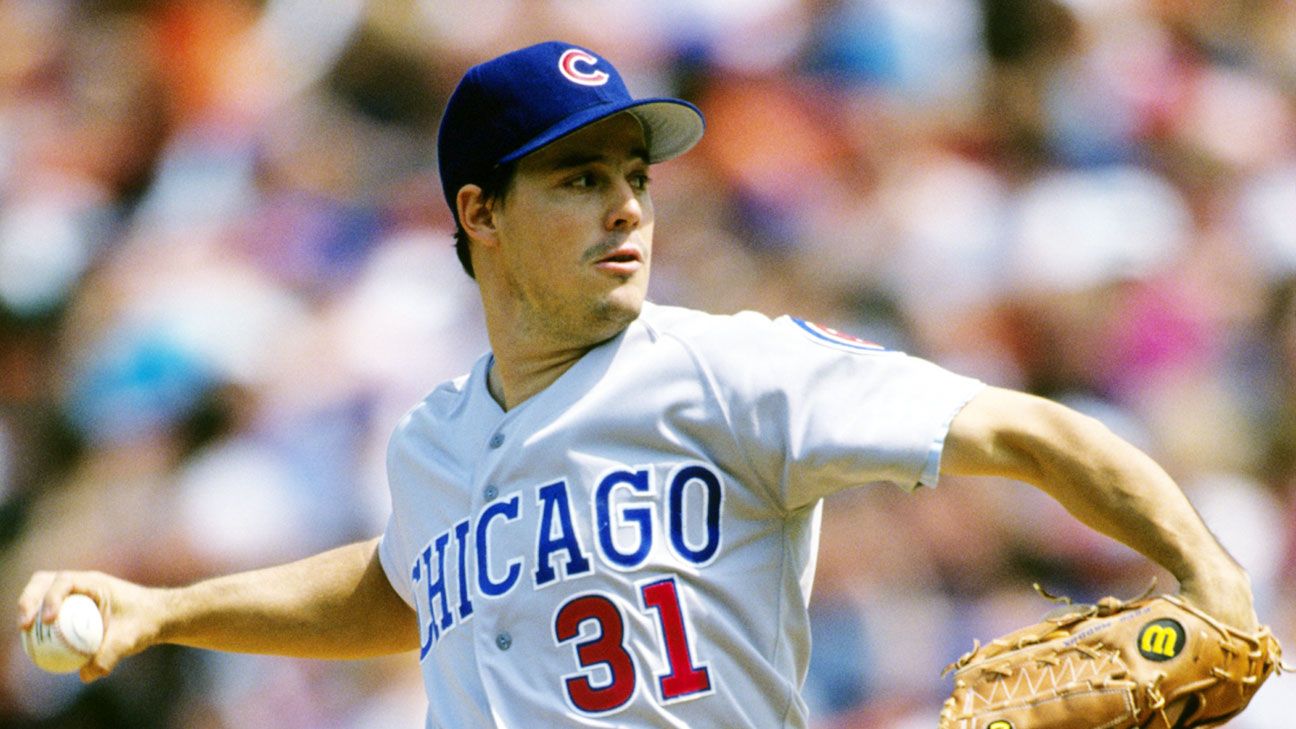
N.L. Cy Young Award
Greg Maddux (CHC)
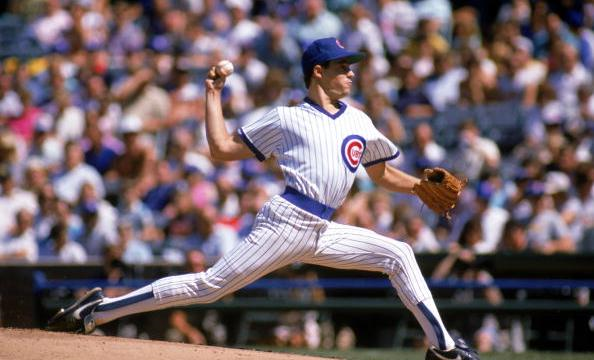
N. L. Co-Wins Leader (20)
Greg Maddux (CHC)
Fellow starter, Mike Morgan, recorded a 16-8 record with 123 K’s and a 2.55 ERA. Frank Castillo (10/3.46/135), Danny Jackson (4/4.22/51) and Shawn Boskie (5/5.01/39) would round out the starting rotation. Bob Scanlan handled the closing duties, posting 17 saves with a 2.89 ERA.
Ryne Sandberg would join Maddux in San Diego as an All-Star starter. Ryno hit .304 with 26 dingers and 87 RBIs to secure the Silver Slugger Award. Mark Grace (.307/9/79) would win the Gold Glove for his play at first base. Right fielder, Andre “The Hawk” Dawson, hit .277 with 22 homers and 90 runs driven in.
1992 saw the release of the film “The Babe” starring John Goodman as the titular character. The baseball scenes in the movie were filmed at Wrigley Field.
Baseball Scenes Filmed
at Wrigley Field
1993
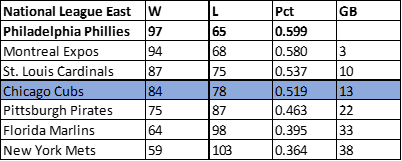
The Cubs increased their win total by six games in 1993 but still finished fourth in the now seven team National League East. The Cubbies hovered around the .500 mark until August when they posted a 12-18 record. The Cubs had a tremendous September winning 18 of 27 games but it was not enough to make up ground on the front running Phillies.
Catcher, Rick Wilkins, had a breakout season for the North-siders posting a .303 average with 30 home runs and 73 RBIs. Second-year Cub, Sammy Sosa, announced his arrival by hitting .261 with 33 long balls and 93 runs batted in. Ryne Sandberg (.309/9/45) and Mark Grace (.325/14/98) were both named as All-Star reserves for the midsummer classic in Baltimore.
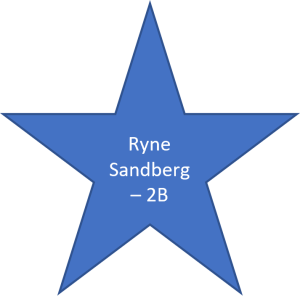
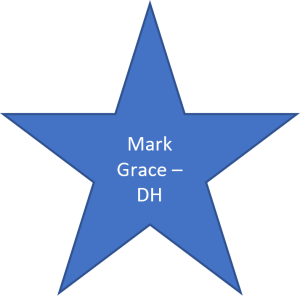
Grace would also hit for the cycle on May 9th against the Padres in a 5-4 Cubs loss before 30,062 Wrigley spectators.

Cycle:
Mark Grace (CHC)
vs. San Diego Padres
On August 2nd, the Pirates and Cubs would mix it up on the field after Mark Grace was brushed back by a Blas Minor pitch. When play resumed, Steve Buechele and Sammy Sosa homered propelling the Cubs to a 12-10 victory.
https://www.youtube.com/watch?v=yBiwyRm1iDo
Pittsburgh Pirates vs. Chicago Cubs
The Cubs had a quartet of starting pitchers who hit the ten-win mark. Mike Morgan (10/4.03/111), Greg Hibbard (15/3.96/82), Jose Guzman (12/4.34/163) and Mike Harkey (10/5.26/67) each achieved the milestone. Setup man, Jose Bautista, won 10 games out of the pen, sporting 2.82 ERA with 63 whiffs. The star of the staff was closer Randy Myers. Myers saved a league high 53 games to earn the Fireman of the Year Award and received votes for both the Cy Young and Most Valuable Player awards.
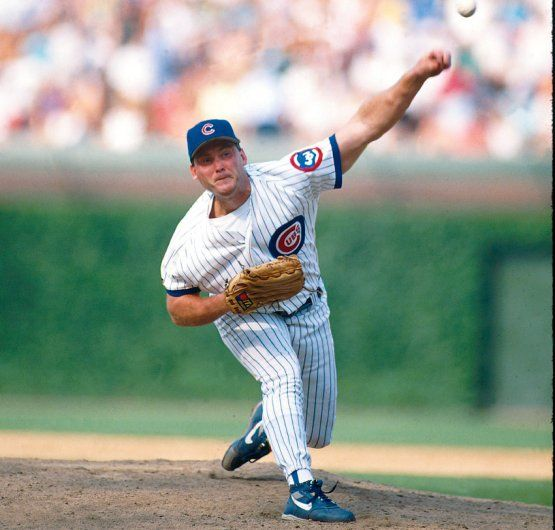
N.L. Fireman of the Year
Randy Myers (CHC)
The movie “Rookie of the Year” was released in 1993. Wrigley Field was the focal point of the film about a kid who breaks his arm and develops a 100-mph fastball.

Some Baseball Scenes
Filmed at Wrigley Field
1994
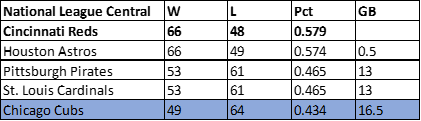
Between divisional realignment and the strike-shortened season, 1994 was not kind to the Chicago Cubs. The Cubs stumbled out of the gate to a 6-15 mark in the month of April. On Opening Day, Karl “Tuffy” Rhodes hit three home runs in a 12-8 loss to the New York Mets. The Cubs would drop their first 12 home games to start the year. By the time the season was cancelled in August, the Cubs were 16.5 games behind the Cincinnati Reds in the newly formed National League Central.
Sammy Sosa led the Cubs offensively with a .300 average, 25 home runs and 70 RBIs. Shawon Dunston (.278/11/35) and Steve Buechele (.242/14/52) contributed to a Cubs team that would struggle at the plate throughout the season.
Steve Trachsel would lead the rotation with 9 wins against 7 losses with a 3.21 ERA and 108 strikeouts. Willie Banks would win 8 games and fan 91 batters. Closer, Randy Myers, would be the only Cub named to the All-Star game in Pittsburgh and finished the year with 21 saves.
1995
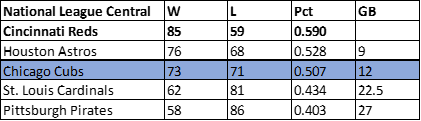
The Chicago Cubs fared better than their predecessor during the strike shortened 1995 season finishing two games over .500 and in third place in the National League Central. The Cubbies started strong winning 20 of their first 31 games, but a disastrous June (9-20) created distance between the Cubs and the Red Legs of Cincinnati.
The Cubs pitchers posted a team ERA of 4.13 and combined for 12 shutouts on the season. Jaime Navarro (14/3.28/128), Frank Castillo (11/3.21/135), Kevin Foster (12/4.51/146) and Jim Bullinger (12/4.14/93) combined to win 49 games out of the starting rotation. Randy Myers saved a league high 38 games while being named to the All-Star game in Arlington and garnering the Fireman of the Year award.

N.L. Fireman of the Year
Randy Myers (CHC)
Sammy Sosa (.268/36/119) played in a league high 144 games, won the Silver Slugger Award and joined Myers at The Ballpark in Arlington. Mark Grace (.326/16/92) accompanied his teammates to Texas, leading the league in doubles (51) and earning a Gold Glove for his play at first base. Brian McRae (.288/12/48), who was obtained in a trade with Kansas City on April 5th, led the National League in at-bats (580).
1996
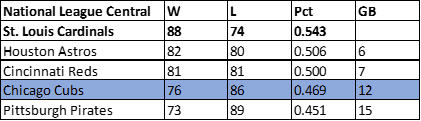
The Chicago Cubs finished their first full season of baseball ten games under .500 and 12 games behind the St. Louis Cardinals in 1996. The Cubs played well most of the year with the exceptions of May (9-17) and September (9-19). The Cub pitching staff combined for a team ERA of 4.36. Jaime Navarro (15/3.92/158) led the team in wins with 15 while surrendering the most hits (244) in the league and facing the most batters in the senior circuit (1007). Frank Castillo lost a league high 16 games against only 7 wins but struck out 139 batters. Steve Trachsel won 13 of 22 decisions and posted a respectable 3.03 ERA with 132 punchouts earning a reserve role for the All-Star game in Philadelphia.
Sammy Sosa (.273/40/100) fueled a Cubs offense that would tally 772 runs on the season. Sosa’s high-water mark came on May 6th against the Houston Astros when he hit two home runs in the 7th inning of a 13-1 Cubs victory.
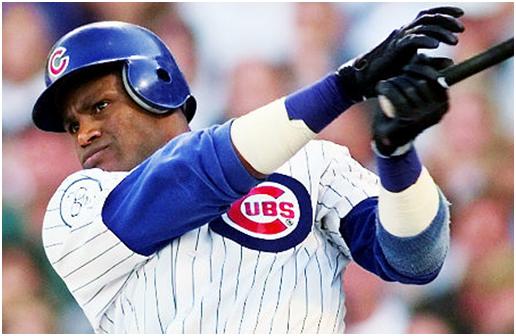
Sammy Sosa (CHC)
Two Home Runs
7th Inning
vs. Houston Astros
Scott Servais (.265/11/63), Mark Grace (.331/9/75), Ryne Sandberg (.244/25/92), Leo Gomez (.238/17/56), Luis Gonzalez (.271/15/79) and Brian McRae (.276/17/66) all contributed to Sosa’s power surge.
1997
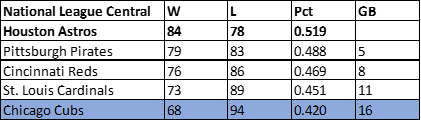
The Cubs would lose their first 14 games of the 1997 campaign and never recovered. The North-siders would win 68 games and finish 16 behind the front running Houston Astros. Sammy Sosa once again paced the offense hitting .251 with 36 home runs and 119 RBIs despite a league high 174 strikeouts. The aging core of Ryne Sandberg (.264/12/64) and Mark Grace (.319/13/78) would contribute to the Cubbies cause. Grace would be the only Cub representative at the All-Star game in Cleveland.
Kevin Foster (10/4.61/118), Kevin Tapani (9/3.39/55) and rookie Geremi Gonzalez (11/4.25/93) all posted winning records in the starting rotation. Closer Terry Adams would save 18 games on the year and setup man Mel Rojas would save 13.
1998

On February 18th, the Cubs organization lost an American treasure with the passing of long-time broadcaster, Harry Caray. The Cubs would wear patches with the likeness of Harry throughout the season.
On April 10th, the Cubs unveiled a statue in honor of Harry Caray outside of Wrigley Field at the corner of Sheffield and Addison.

Harry Caray Statue
The Cubs would finish the season with a 90-73 record. They finished the regular season tied with the San Francisco Giants but won a one game playoff to earn the National League’s Wild Card berth. The Cubs would face the Atlanta Braves in the divisional series and were swept three games to none.

N. L. Wild Card
Chicago Cubs
Sammy Sosa (.308/66/158) won the National League’s Most Valuable Player Award, Silver Slugger Award ans was named to the All-Star game at Coors Field in Colorado. Sosa led the National League in runs (134), RBIs (158), strikeouts (171) and total bases (416).

N. L. Most Valuable Player
Sammy Sosa (CHC)
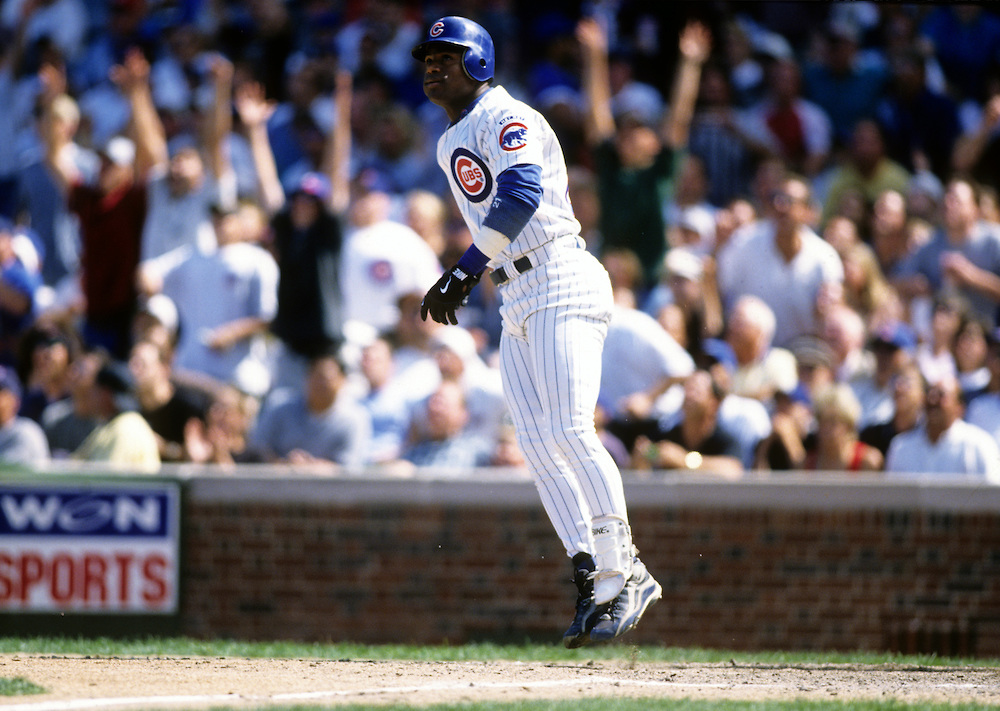
N. L. RBI Leader (158)
Sammy Sosa (CHC)
Both Sosa and Mark McGwire broke the single season home run record of 61, set by Roger Maris. Throughout the year they would each lead the league several times before McGwire won the title with 70 and Sosa finished with 68. Third baseman, Jose Hernandez (.254/23/75) and left fielder Henry Rodriguez (.251/31/85) each had superb years in Sosa’s looming shadow.
The Cubs rotation sported a trio of excellent pitcher in 1998. Kevin Tapani finished with a 19-9 record, a 4.85 ERA and 136 strikeouts. Steve Trachsel won 15 games with a 4.46 ERA and 149 strikeouts. Rookie of the Year, Kerry Wood, won 13 of 19 decisions with a 3.40 ERA and 240 strikeouts. Wood announced his arrival on May 6th when he struck out 20 Houston Astros en route to a 2-0 Cubs win.
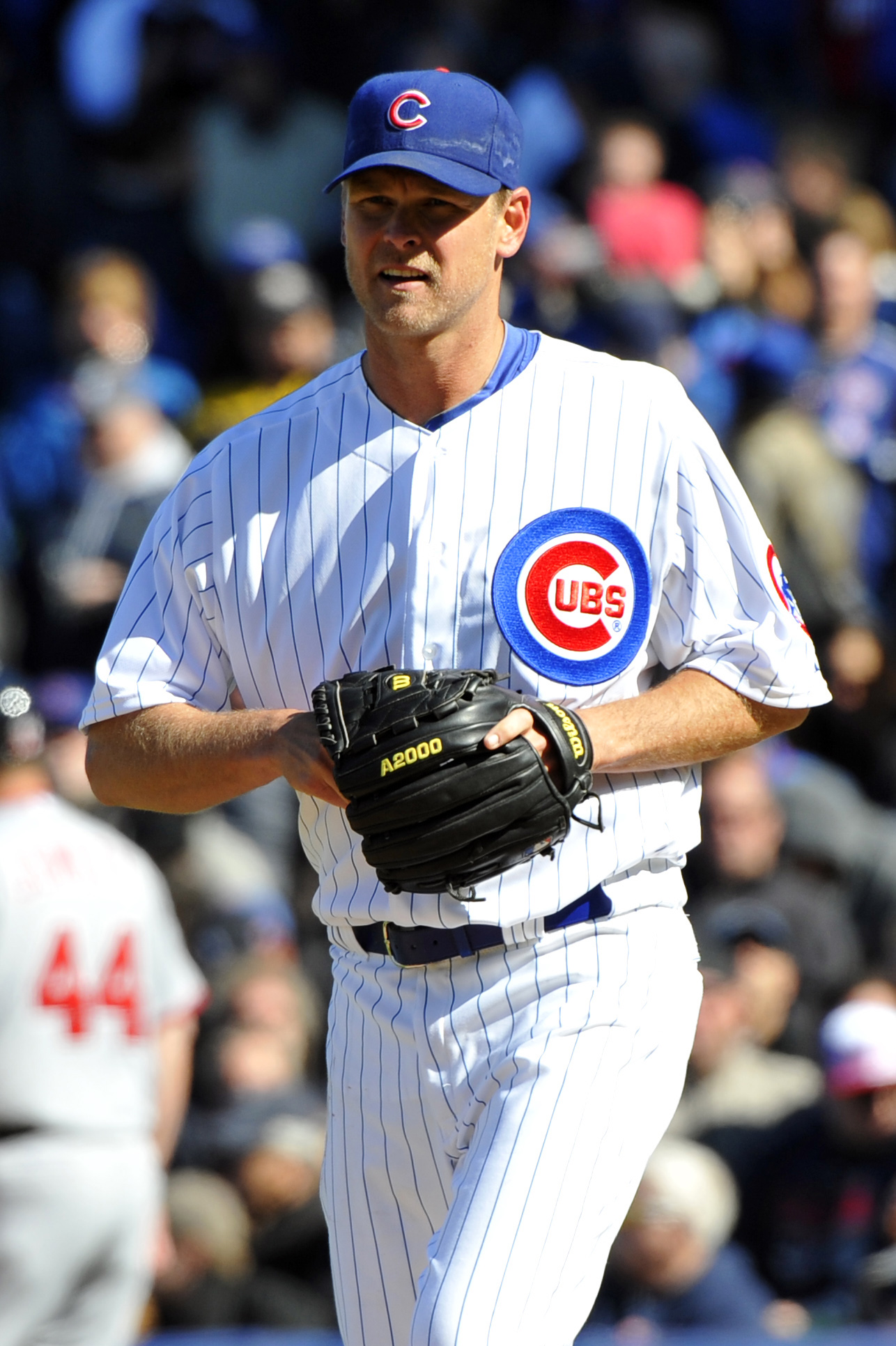
N.L. Rookie of the Year
Kerry Wood (CHC)
1999

One year after making the playoffs, the Cubs would plummet to the bottom of the National League Central. The Cubs would finish 67-95 and 30 games behind the division champion Houston Astros. Sammy Sosa continued his otherworldly play by hitting .288 with 63 home runs and 141 runs driven in. Sosa led the league in games played (162), strikeouts (171) and total bases (397). Sosa would earn a Silver Slugger award and be named to the All-Star game in Boston.
Supporting Sosa offensively were Mark Grace (.309/16/91), Henry Rodriguez (.304/26/87) and Jose Hernandez (.272/15/43).
The pitching staff had an abysmal season allowing 920 runs and combining for a 5.27 team ERA. Steve Trachsel won 8 games while losing a league high 18 with a 5.56 ERA. Jon Lieber won a team high 10 games and lost 11 despite 186 strikeouts. Closer, Terry Adams, won six games out of the bullpen and saved 13 more.
2000
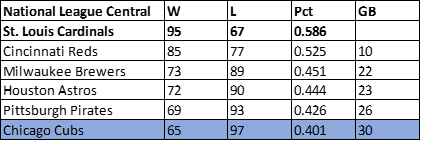
The Cubs remained in last place in the National League Central in 2000, despite opening the season with a 5-3 win over the New York Mets at the Tokyo Dome in Japan. The Cubs won 65 games and finished 30 games behind the St. Louis Cardinals.
Sammy Sosa continued his tear against major league pitching, hitting .320 with 50 home runs and 138 RBIs. Sosa led the league in home runs for the only time in his career while earning a Silver Slugger award and earning a starting spot on the All-Star squad.
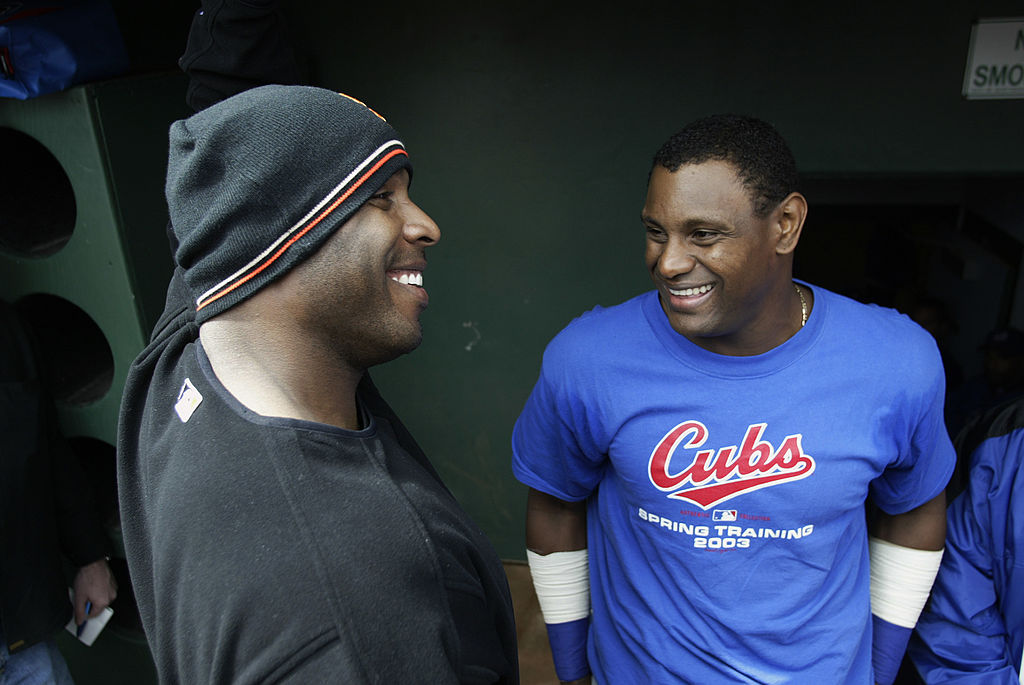
N. L. Home Run Leader (50)
Sammy Sosa (CHC)

Joe Girardi (.278/6/40) would join Sosa in Atlanta by earning a reserve role for the midsummer classic. Damon Buford (.251/15/48), Henry Rodriguez (.251/18/51) and Ricky Gutierrez (.276/11/56) all provided supporting roles for the Cubs offense.
The Cubs pitching staff struggled again 2000 allowing 904 runs with a combined ERA of 5.26. Jon Lieber achieved the most success in the starting rotation. Lieber posted a 12-11 record and led the league in innings pitched (251.0) and batters faced (1047). Rotation mates Kevin Tapani (8/5.01/150), Kerry Wood (8/4.80/132), Scott Downs (4/5.17/63), Ruben Quevedo (3/7.47/65) and Ismael Valdez (2/5.37/45) won only 25 games combined. Closer, Rick Aguilera saved 29 games out of the pen with 38 strikeouts and a 4.91 ERA.
2001
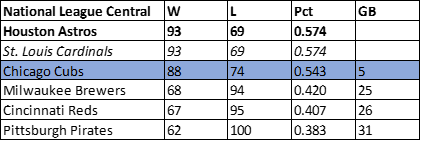
The Chicago Cubs had a bounce back year in 2001 finishing in third place in the National League Central, just five games off the division lead and a wild card spot. The Cubbies came out of the gate hot sporting a 15-9 record in April. They continued yo play solid ball until August where they finished out the season with a 26-31 mark. Sammy Sosa (.328/64/160) finished second in the National League’s Most Valuable Player voting. Sosa led the league in runs (146), RBIs (160), total bases (425) and intentional walks (37).
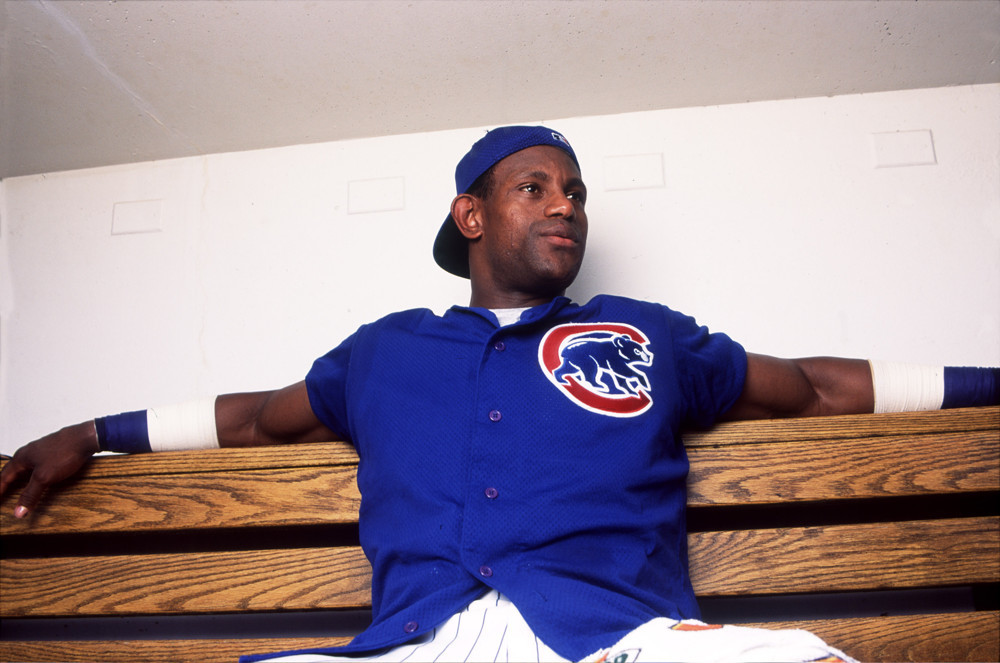
N. L. RBI Leader (160)
Sammy Sosa (CHC)
Sosa would earn a Silver Slugger award and be named as a starter for the All-Star game in Seattle. Matt Stairs (.250/17/61) would start the year at first base but was replaced after the Cubs acquired Fred “The Crime Dog” McGriff (.282/12/41) from the Tampa Bay Devil Rays. Left fielder, Rondell White, provided solid numbers hitting .307 with 17 home runs and 50 RBIs.
The Cubs pitching staff was much improved over the prior few seasons. They allowed 701 runs and had a combined ERA of 4.03. Jon Lieber posted a 20-6 record with 148 strikeouts and a 3.80 ERA. Lieber would join Sosa as an All-Star selection at Safeco Field. Kerry Wood won 12 of 18 decisions and struck out 217 batters while recording a 3.36 ERA. Jason Bere finished the year 11-11 but struck out 175 batters along the way. Closer, Tom “Flash” Gordon, saved 27 games in relief.
2002
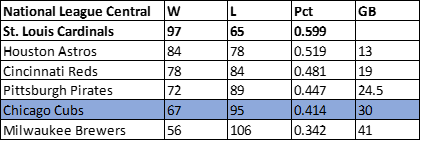
The Cubs fortunes reversed for the 2002 season. They dropped to fifth place in the National League Central, finishing 30 games behind the St. Louis Cardinals. A poor start in April (8-16) put the Cubs in a hole that they could not dig out of. Sammy Sosa continued to torture opposing pitchers hitting .288 with 49 home runs (most in the N. L.), 108 RBIs and a league leading 122 runs. Sosa would again win a Silver Slugger award and be selected as a starter for the All-Star game at Miller Park.
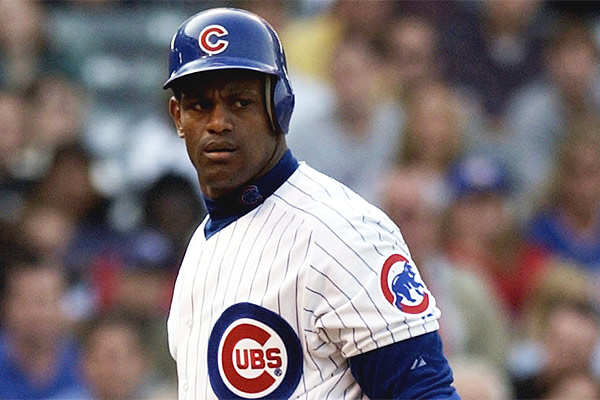
N. L. Home Run Leader (49)
Sammy Sosa (CHC)
Fred McGriff (.273/30/103) and Mark Bellhorn (.258/27/56) would add power to the Cubs offensive arsenal. Alex Gonzalez (.248/18/61), Moises Alou (.275/15/61) and Corey Patterson (.253/14/54) all had solid numbers at the plate.
The Cubs pitching staff regressed slightly from the 2001 squad allowing 759 runs and a 4.31 team ERA. Starters, Kerry Wood (12/3.66/217) and Matt Clement (12/3.60/215) had matching 12-11 records for the year. Jon Lieber, Mark Prior and Jason Bere combined for a 13-24 record. Antonio Alfonseca saved 19 games out of the bullpen. A young Carlos Zambrano posted 4-8 record in 16 starts.
2003
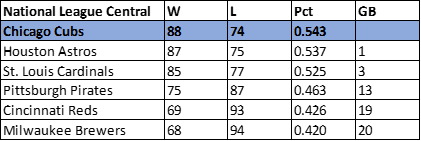
The Cubs vaulted to a division crown under first year Manager Dusty Baker surpassing the Houston Astros by one game. The Cubs hovered around the .500 mark for most of the season but finished strong with a 19-8 record in September.
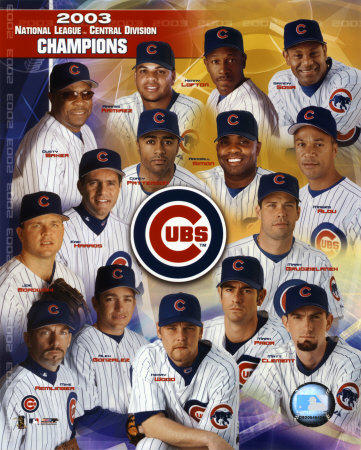
N. L. Central Division Champions
Chicago Cubs
The Cubs success in 2003 was largely attributed to the pitching staff. The starting rotation of Carlos Zambrano (13/3.11/168), Mark Prior (18/2.43/245), Kerry Wood (14/3.20/266), Matt Clement (14/4.11/171) and Shawn Estes (8/5.73/103) combined to win 67 games. Zambrano led the N. L. in home runs per 9 innings (0.4) while Prior led the league in WAR (7.4) and fielding independent pitching (2.47). Kerry Wood topped the N. L. in strikeouts (266), hit batters (21), hits per 9 innings (6.5) and strikeouts per 9 innings (11.3). Both Prior and Wood were selected as reserves for the All-Star game on Chicago’s South side. Closer, Joe Borowski, saved 33 games for the Cubbies ans sported 2.63 ERA.
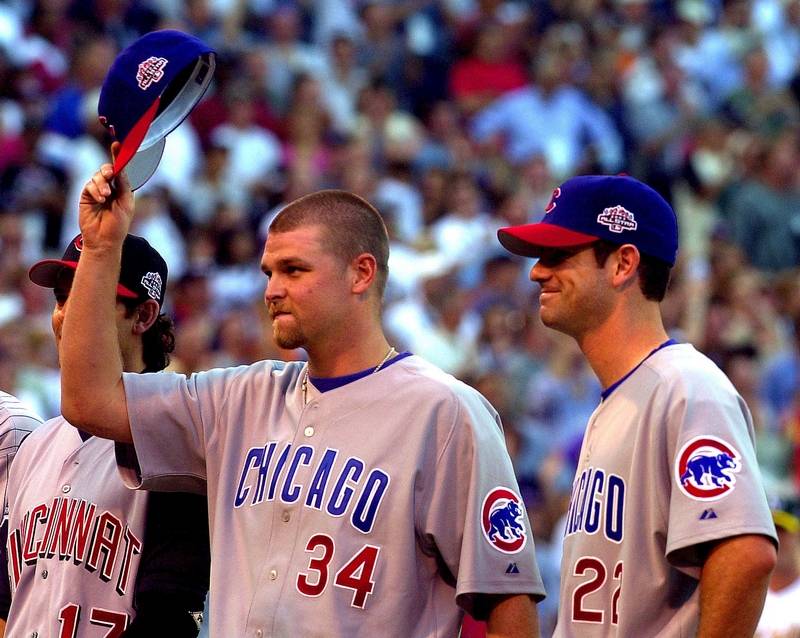
N. L. Strikeout Leader (266)
Kerry Wood (CHC)
Sammy Sosa again provided the spark for the Cubs offense. Sosa batted .279 with 40 home runs, 103 RBIs and 99 runs scored. Moises Alou (.280/22/91), Alex Gonzalez (.228/20/59), Corey Patterson (.298/13/55) and deadline acquisition Aramis Ramirez (.259/15/39) contributed to the Cubs 724 runs scored.
The Cubs played the Atlanta Braves in the National League Division Series and advanced by taking 3 of 5 games against the Bravos. The Cubs went on to play the Florida Marlins in the National League Championship Series. The Marlins would prevail in seven games, but the series is best known for a fan interference call late in game six that many feel swung the tide for the Marlins.
2004
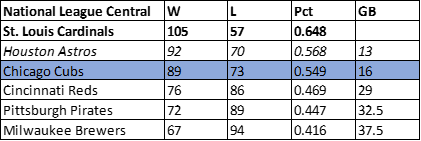
Coming off their first postseason series win since 1908; the Cubs missed the playoffs in 2004 but still had a solid season. The Cubs won 89 games in 2004 but finished a distant third, 16 games behind the 105-win Cardinals. Offensive firepower was not lacking with this version of the Cubbies. The Cubs had seven starters hit 15 or more home runs. Sammy Sosa, in what would be his last year with the Cubs, hit .253 with 35 home runs and 80 runs driven in. Sosa would be named a starter for the All-Star game in Houston. Moises Alou was named a reserve for the midsummer classic by slashing .293/39/106. Michael Barrett (.287/16/65), offseason acquisition Derrek Lee (.278/32/98), Todd Walker (.274/15/50), Aramis Ramirez (.318/36/103) and Corey Patterson (.266/24/72) all provided power from the plate.


Greg Maddux and Carlos Zambrano led the team in wins with 16. Maddux struck out 151 batters and posted a 4.02 ERA while earning a Gold Glove in the field. Zambrano struck out 188 batters with a paltry 2.75 ERA while leading the league in hit batters (20). Zambrano would finish fifth in the CY Young voting and joined hist teammates at the All-Star festivities in Houston. Closer, LaTroy Hawkins, won five games out of the pen with 25 saves and a 2.63 ERA. On September 11th, Hawkins would twirl and immaculate inning in the ninth inning against the Marlins in a 5-2 Cubs victory.

Immaculate Inning (9th)
LaTroy Hawkins (CHC)
vs. Florida Marlins
2005

The Cubs fell under the .500 mark in 2005 and dropped to fourth place in the National League Central. The Cubs flirted with a winning record until a disastrous August (10-18) took them out of contention. The Cubs ended the year at 79-83, twenty-one games behind the St. Louis Cardinals. With the offseason trade of Sammy Sosa to the Texas Rangers, the Cubs would rely on other player to fill the power void. First baseman, Derrek Lee (.335/46/107) , won the National League batting title hitting .335 on the season. Lee also led the National League in hits (199), doubles (50), slugging percentage (.662), OPS (1.080), OPS+ (174) and total bases (393). Lee was selected as the National League starter at first base for the All-Star game in Detroit. Lee would also collect Gold Glove and Silver Slugger hardware while finishing third in the MVP voting.
N. L. Batting Champion (.335)
Derrek Lee (CHC)
Joining Lee as a starter in Detroit was third baseman Aramis Ramirez. Ramirez hit .302 with 31 home runs and 92 RBIs. Catcher, Michael Barrett, earned a Silver Slugger award by hitting .276 with 16 home runs and 61 runs plated. Free agent signee, Jeromy Burnitz, awarded the Cubs by hitting .258 with 24 homers and 87 RBIs.
The Cubs pitching staff performed to middling results in 2005. Carlos Zambrano finished the season with a 14-6 record. Zambrano struck out 202 batters with a 3.26 ERA. Mark Prior posted an 11-7 record with 188 K’s and a 3.67 ERA while leading the league strikeouts per 9 innings (10.2). Staff ace, Greg Maddux, posted a 13-15 record with a 4.24 ERA and 136 punchouts. Maddux led the league in games started (35) and walks per 9 innings (1.4) while earning another Gold Glove in the field. Maddux would reach a career milestone on July 26th when he recorded his 3,000th strikeout against the San Francisco Giants.
3,000th Strikeout:
Greg Maddux
2006
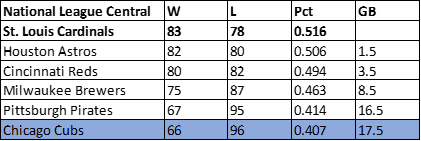
The Cubs sank to the bottom of the division standings in 2006. The North-siders managed to win only 66 games and finished 17 games back in a mediocre National League Central. A 13-10 start in April was soon erased by a 16-40 mark in May and June. The Cubs pitchers struggled as a unit combining for a team ERA of 4.74 and allowing 834 runs for the year. The lone bright spot was starter Carlos Zambrano whose 16 wins was tied for most in the National League. Zambrano struck out 210 batters with an ERA of 3.41. Despite leading the league in walks (115), Zambrano was selected as an All-Star reserve for the game in Pittsburgh.
N. L. Co-Wins Leader (16)
Carlos Zambrano (CHC)
The rest of the rotation, Greg Maddux (9/4.69/81), Sean Marshall (6/5.59/77), Rich Hill (6/4.17/90) and Carlos Marmol (5/6.08/59) would combine for only 26 wins. Closer, Ryan Dempster, saved 24 games and led the league in games finished (64) despite his 1-9 record.
Much of the Cubs offense was provided by a quartet of players. Aramis Ramirez hit .291 with 38 home runs and 119 RBIs earning Ramirez MVP votes. Michael Barrett produced a .307 average with 16 long balls and 53 runs driven in. Free agent signing right fielder Jacque Jones, hit .285 with 27 home runs and 87 RBIs. Juan Pierre, who was acquired from the Marlins in a trade over the Winter, hit .330 with 58 stolen bases while leading the league in games played (162), at-bats (699), hits (204) and caught stealing (20).
2006 marked the release of the film “The Break Up” starring Vince Vaughn and Jennifer Aniston. The two main characters meet while attending a Cubs game at Wrigley Field.
The Break Up
Baseball Scenes Filmed
at Wrigley Field
2007
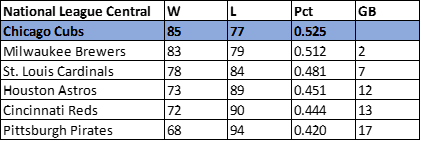
Lou Piniella took over the managerial reins of the Chicago Cubs in 2007 after the Cubs management decided not to offer incumbent Manager Dusty Baker a contract extension. Piniella rewarded the organization with a division title in his first season at the helm. The ’07 Cubs won 85 games after starting the season with a 22-29 record and distanced the second place Brewers by two games.
N. L. Central Division Champions
Chicago Cubs
The Cubs made a historic investment on the offseason by signing free agent Alfonso Soriano to an 8-year $136 Million contract. Soriano would pay immediate dividends as he hot .299 with 33 home runs and 70 RBIs. Soriano was selected as a reserve for the All-Star squad in San Francisco and garnered some MVP votes. Joining Soriano on the bench at A.T.&T. Park was first baseman Derrek Lee. Lee hit .317 with 22 homers and 82 RBIs. Lee picked up a Gold Glove award for his infield play.

Aramis Ramirez (.310/26/101) and offseason free agent acquisition Mark DeRosa (.293/10/72) complimented their all-star teammates at the dish.
The Cubs pitching staff was superb as a unit in 2007. The starting rotation of Carlos Zambrano (18/3.95/177), Ted Lilly (15/3.83/174), Rich Hill (11/3.92/183), Jason Marquis (12/4.60/109) and Sean Marshall (7/3.92/67) anchored a staff that allowed only 690 runs and a combined ERA of 4.04. Closer, Ryan Dempster saved 28 games and setup man Carlos Marmol posted a 5-1 record with a 1.43 ERA.
Tom Glavine made history on August 5th when he notched his 300th career win in an 8-3 victory over the Cubs.

300th Win:
Tom Glavine
2008
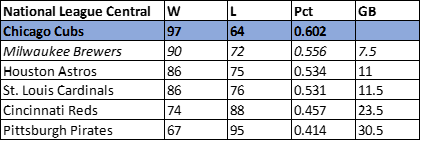
The 2008 Cubs won consecutive division titles for the first time in club history by winning 97 games and distancing the Milwaukee Brewers by 7 1/2 games. The Cubs won 17 of their first 27 games to start the season hot and added a 20-8 August to set the pace in the National League Central.
N. L. Central Division Champions
Chicago Cubs
The Cubs started the season in grand fashion by immortalizing Cubs legend Ernie “Mr. Cub” Banks with a statue outside of Wrigley Field.

Ernie Banks Statue
Starters Carlos Zambrano (14/3.91/184) & Ryan Dempster (17/2.96/187) along with setup man Carlos Marmol (2/2.68/114) and closer Kerry Wood (5/3.26/84) would all be named to the All-Star team for the game at Yankee Stadium. Lefty starter, Ted Lilly, posted a 17-9 record with a 4.09 ERA, 184 strikeouts and led the league games started (34). Zambrano would pick up a Silver Slugger award for being the best hitting pitcher in the National League.

Alfonso Soriano (.280/29/75), rookie Kosuke Fukudome (.257/10/58) and rookie catcher Geovany Soto (.285/23/86) were each named starters for the National League All-Star team. Aramis Ramirez (.289/27/111) was named as an All-Star reserve at third base. Soto would be voted the N.L.’s top rookie with Fukudome coming in sixth on the ballots.
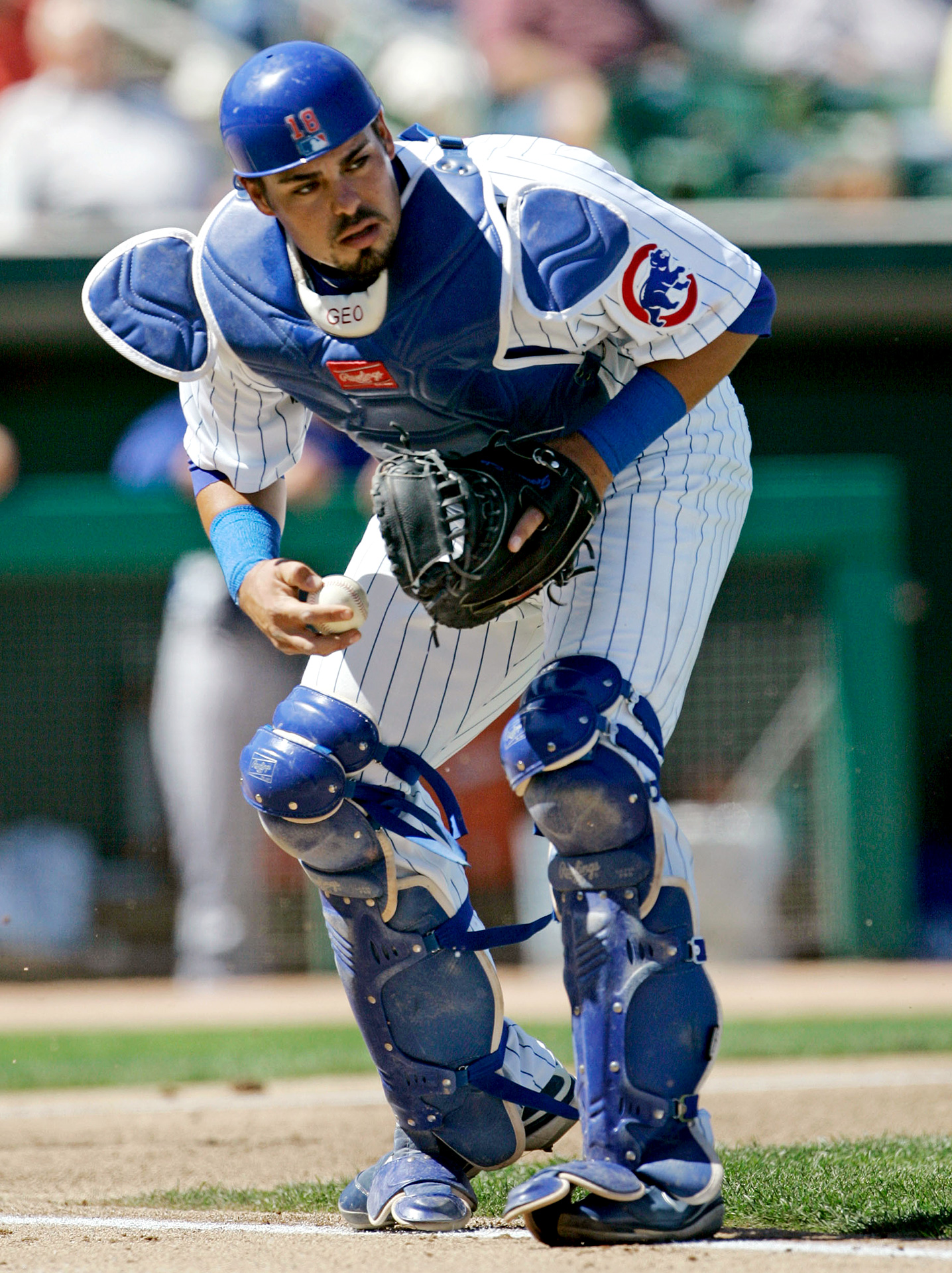
N.L. Rookie of the Year
Geovany Soto (CHC)
Center fielder Jim Edmonds, hit two home runs in the 4th inning on June 21st against the crosstown rival White Sox in an 11-7 Cubs win.
Jim Edmonds (CHC)
Two Home Runs
4th Inning
vs. Chicago White Sox
Lou Piniella earned Manager of the Year honors by guiding the Cubs to their second straight division crown.
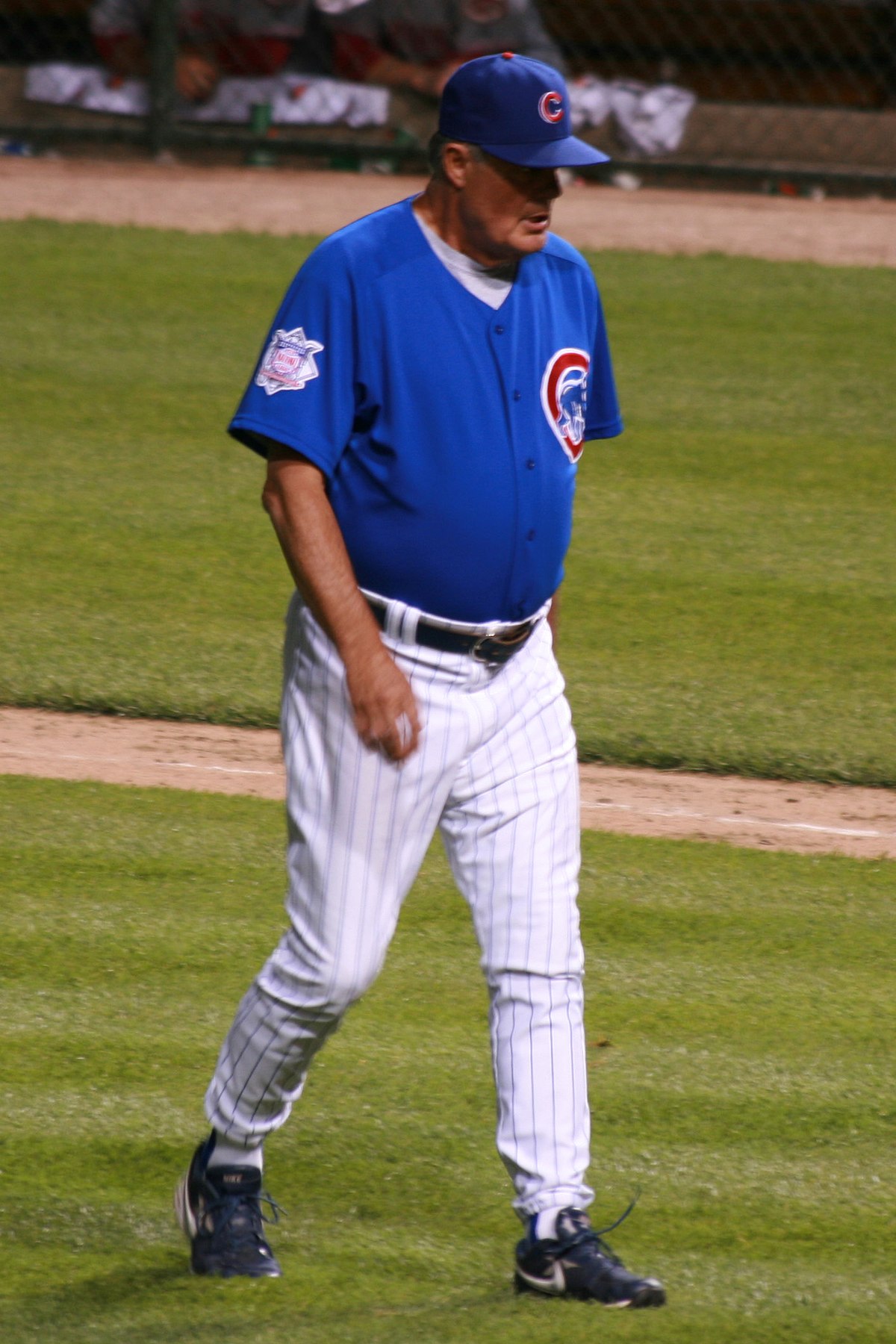
N. L. Manager of the Year
Lou Piniella (CHC)
The Cubs would face the Los Angeles Dodgers in the National League Division Series. The Dodgers would sweep the series 3-0 ending the Cubs season. The Cubs managed to score only 6 runs in the three-game sweep.
2009
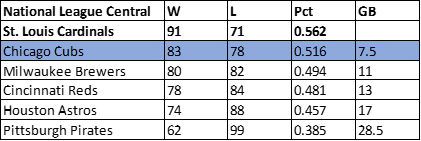
The Chicago Cubs failed to win their third consecutive National League Central title in 2009 finishing 7 1/2 games behind the St. Louis Cardinals. The Cubs hovered around the .500 mark until July when they won 18 of 27 games to vault themselves into the pennant race. The Cubs collapsed in August when they posted an 11-17 record. Despite a 17-12 record in September, the Cubs could not make up enough ground on the Cardinal in the division.
Injuries played a big role in the offense’s ability to produce consistently. Aramis Ramirez (.317/15/65) was limited to 82 games on the year. 2008 Rookie of the Year, Geovany Soto (.218/11/47) struggled in his sophomore season and played only 102 games behind the dish. Derrek Lee hit .306 with 35 long balls and 111 RBIs as he dealt with injuries during the course of the year. Alfonso Soriano played in only 117 games and hit .241 with 20 homers and 55 RBIs.
The starting rotation of Ryan Dempster (11/3.65/172), Ted Lilly (12/3.10/151), Carlos Zambrano (9/3.77/152), Randy Wells (12/3.05/104) and Rich Harden (9/4.09/171) combined to win 53 games for the North-siders. Kevin Gregg (4/5.72/71) and Carlos Marmol (3/4.32/68) combined to save 38 games out of the Cubs bullpen. Zambrano would win another Silver Slugger award and Wells finished 6th on the Rookie of the Year voting. Ted Lilly would be the Cubs lone representative at the All-Star game in St. Louis.
2010
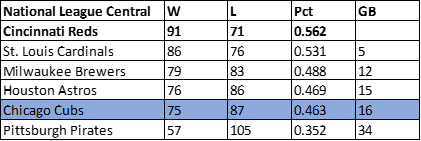
The Cubs fell to fifth place in the National League Central in 2010 finishing 16 games behind the front-running Cincinnati Reds. The Cubs never contended during the regular season and won 75 games largely on the strength of a 17-9 September. The Cubs core of Geovany Soto (.280/17/53), Aramis Ramirez (.241/25/83), Alfonso Soriano (.258/24/79) and Kosuke Fukudome (.263/13/44) fueled the Cubs offense. Derrek Lee (.251/16/56) provided solid number before his August trade to the Atlanta Braves. Free agent signee Marlon Byrd, .293 with 12 home runs and 66 RBIs earning the Cubs only All-Star roster spot for the game in Anaheim.
The Cubs pitching staff featured three starting pitchers who finished the year with winning records. Ryan Dempster went 15-12 with a 3.85 ERA and 208 strikeouts. Carlos Zambrano posted an 11-6 record with 117 punchouts and an ERA of 3.33. Carlos Silva won 10 of 16 decisions while whiffing 80 batters and recording a 4.22 ERA. Carlos Marmol saved 38 games out of the pen while finishing a league high 70 games. On September 7th, the Cubs unveiled a statue outside Wrigley honoring Hall of Famer Billy Williams.
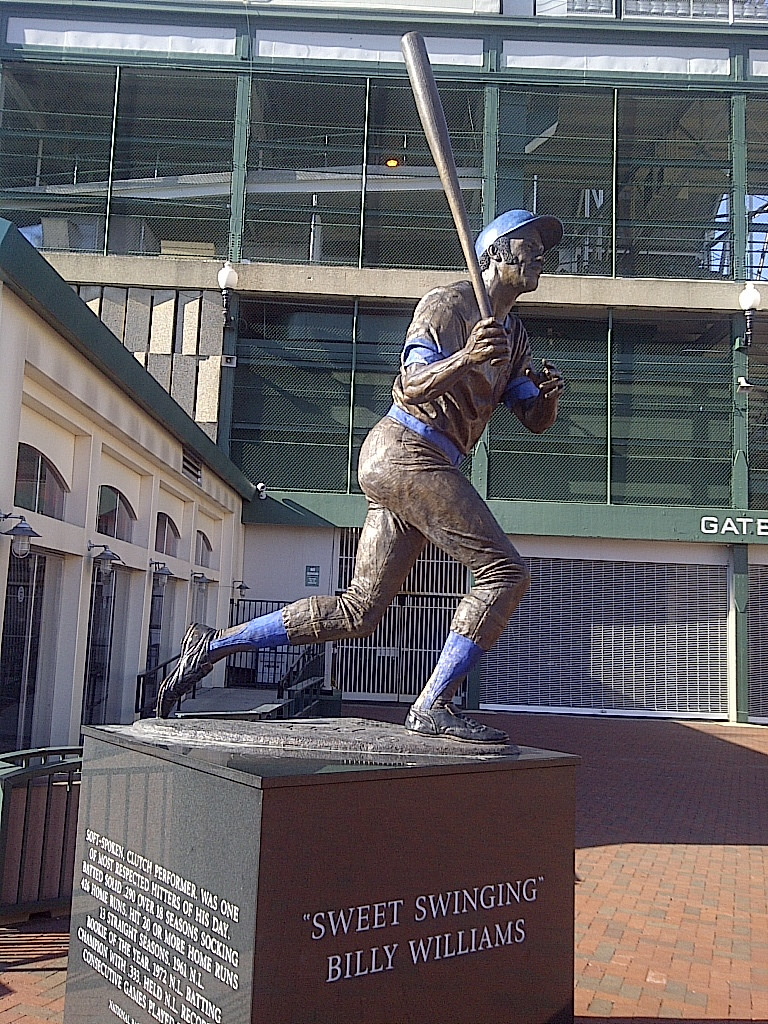
Billy Williams Statue
Attendees of the friendly confines were witnesses to history on September 23rd when Juan Uribe of the San Francisco Giants hit two home runs in the 4th inning of a 13-0 Cubs loss.
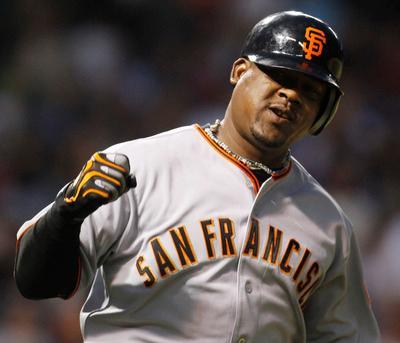
Juan Uribe (SFG)
Two Home Runs
2nd Inning
vs. Chicago Cubs
2011
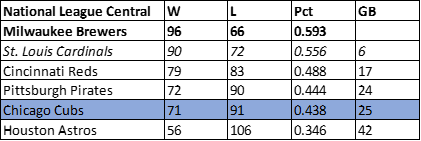
The Cubs maintained their fifth place standing in 2011 and finished the year 25 games behind the division champion Milwaukee Brewers. Mike Quade became the full-time Manager after posting a 24-13 record at the end of 2010 as the interim replacing Lou Piniella. The Cubs never challenged for the division lead as they posted losing records in April, May, June and July. A quartet of bear cubs provided the Cubs offense with power. Geovany Soto (.228/17/54), Carlos Pena (.225/28/80), Alfonso Soriano (.244/26/88) and Silver Slugger winner Aramis Ramirez (.306/26/93) all featured the long ball for the Cubs. Starlin Castro (.307/10/66) led the National League in at-bats (674) and hits (207) to earn a reserve spot in Phoenix for the All-Star game.
The Cubs pitching was middle of the road as much as their season was. Matt Garza (10/3.32/197) and Ryan Dempster (10/4.80/191) both led the team in wins with 10 while Dempster led the league in games started (34). The rest of the starting rotation, Carlos Zambrano (9/4.82/101), Randy Wells (7/4.99/82), Rodrigo Lopez (6/4.42/54) and Casey Coleman (3/6.40/75) managed to win only 25 games combined. Closer Carlos Marmol notched 34 saves in relief.
In December 2010, Cubs legendary third baseman Ron Santo passed away. To honor Santo, the Cubs wore an honorary patch for the 2011 season. On August 10th, the Cubs unveiled a statue outside Wrigley Field to honor Santo.
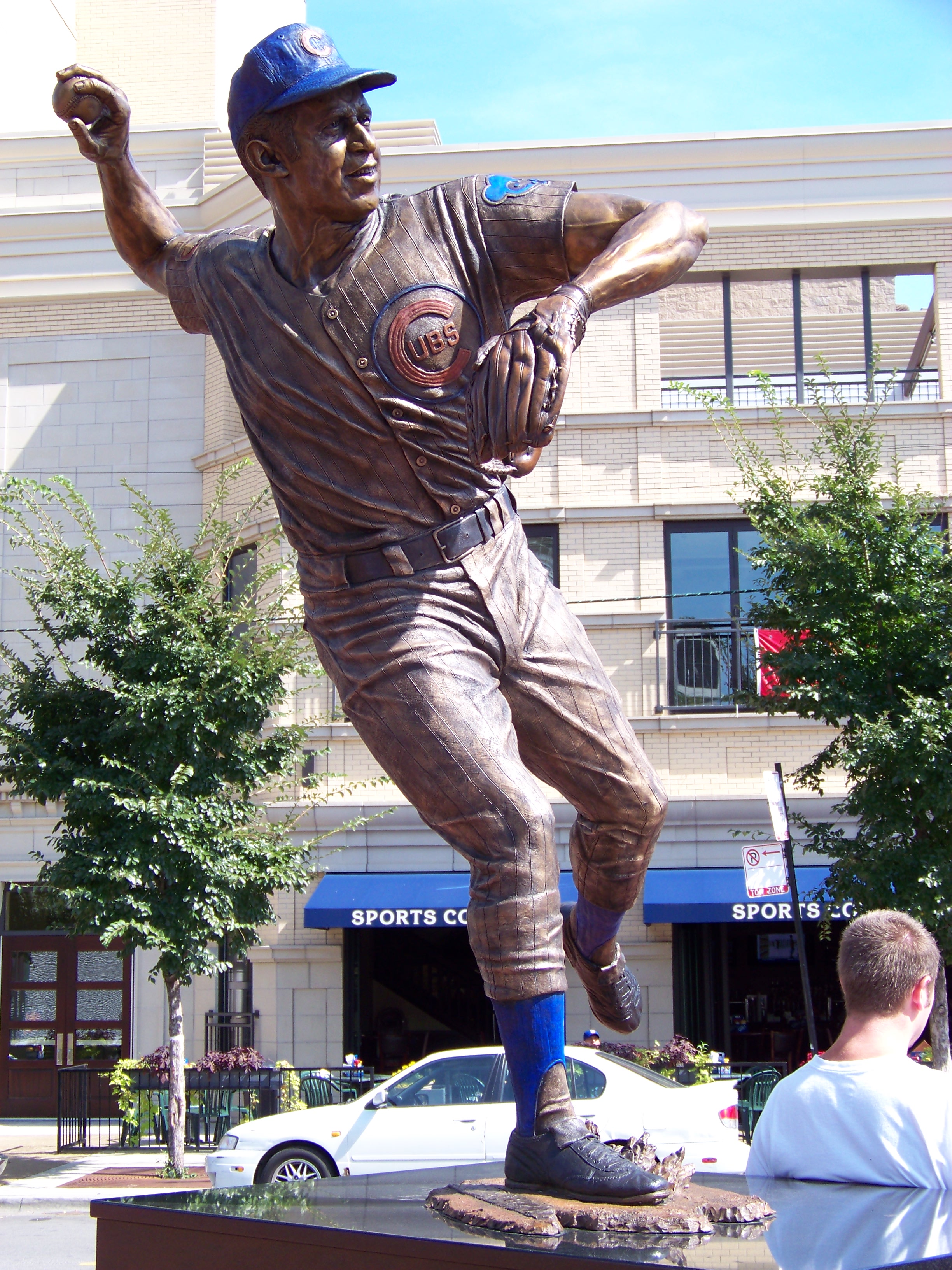
Ron Santo Statue
2012

The Cubs remained in fifth place in 2012 but lost 101 games and finished 36 games behind the Cincinnati Reds. The Cubs rebuild was officially under way with new Manager Dale Sveum and General Manager Jed Hoyer. The Cubs were dreadful for most of the season only posting a winning record (15-10) in the month of July. Alfonso Soriano led the Cubs offense hitting .262 with 32 home runs and 108 RBIs. Anthony Rizzo, acquired from the Padres in the offseason, hit .285 with 15 homers and 48 RBIs. The Cubs had two players selected for the All-Star game in Kansas City. Starlin Castro (.283/14/78) led the National League in games (162), at-bats (646) and caught stealing (13). Super utility man Bryan LaHair (.259/16/40) joined Castro at Kauffmann Stadium.
The only Cubs starter to record a winning record was Paul Maholm (9/3.74/81) at 9-6. Jeff Samardzija (9/3.81/180), Travis Wood (6/4.27/119), Chris Volstad (3/6.31/61), Ryan Dempster (5/2.25/83) and Matt Garza (5/3.91/96) rounded out the rotation combining for 28 wins. Carlos Marmol’s save total dipped to 20 due to limited opportunities. The Cubs said goodbye to fan favorite Kerry Wood when he retired in May.
2013
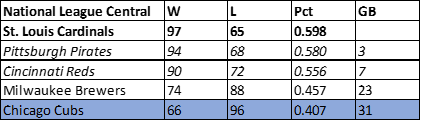
2013 was year two of the Cubs rebuild and they managed five more wins than the previous campaign. The Cubbies finished in last place in the now five team National League Central. Realignment saw the bottom-dwelling Houston Astros move to the American League West. The Cubs never contended under second year Manager Dale Sveum posting a winning record (14-13) only in July. The Cubs pitching staff did an admirable job on the season allowing 689 runs with a team ERA of 4.00. Jeff Samardzija (8/4.34/214) started 33 games for the Cubs but lost 13 of 21 decisions. Edwin Jackson (8/4.98/135) led the National League in losses (18). Matt Garza posted a 6-1 record in only 11 starts with a 3.17 ERA. Travis Wood (9/3.11/144) would be the Cubs only representative at the All-Star game at Citi Field.
The Cubs offense struggled to produce runs throughout the season tallying just 602 and a team .238 batting average. Anthony Rizzo and Nate Schierholtz stood out from the crowded Cubs anemic offense. Rizzo hit .233 with 23 home runs and 80 RBIs. Right fielder Nate Schierholtz, hit .251 with 21 long balls and 68 runs driven in. Starlin Castro hit .245 with 10 homers and 44 RBIs while leading the league in at-bats (666). Alfonso Soriano hit .254 with 17 home runs and 51 RBIs. Soriano was sent to the New York Yankees at the trade deadline depleting an already struggling offense.
2014
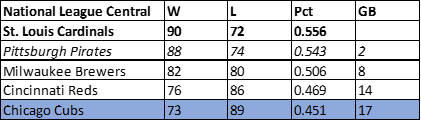
Year three of the Cubs rebuild showed incremental improvement ove the prior season. Dale Sveum was replaced as Manager by Rick Renteria during the offseason. Renteria would guide the Cubs to 73 wins, a seven-game improvement, but not enough to climb out of the National League Central cellar. The Cubs would finish the year 17 games behind the division winning Cardinals. A 9-17 start to the year doomed the Cubs chances of competing in the Central division.
First baseman Anthony Rizzo was the offensive standout for the ’14 Cubs. Rizzo hit .286 for the year and clobbered 32 home runs with 78 RBIs. Starlin Castro provided Castro-like numbers, batting .292 with 14 home runs and 65 RBIs. Both Rizzo and Castro would be All-Star reserves in Minneapolis. Catcher, Wellington Castillo (.237/13/46) and third baseman Luis Valbuena (.249/16/51) would contribute to the Cubs cause.

Despite a bad luck performance in 2014, Jeff Samardzija (2/2.83/103) joined his teammates at Target Field for the 2014 All-Star game. Fellow starter Jake Arrieta posted a 10-5 record on the year with 2.53 ERA and 167 strikeouts. Arrieta finished 9th in the National League Cy Young voting. Jason Hammel went 8-5 with a 2.98 ERA and 104 punchouts. Rookie Kyle Hendricks won 7 of 9 decisions in 13 starts while recording a 2.46 ERA. Hendricks finished 7th in the Rookie of the Year voting. Closer Hector Rondon saved 29 games with a sparkling 2.46 ERA out of the pen. 2014 was the debut of the Cubs new mascot, Clark the Cub.
2015
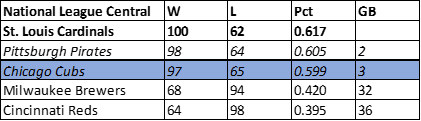
In year four of the Cubs rebuild, they turned the corner and hit the accelerator winning 97 games and claiming a wild card spot in the National League. The Cubs started the year strong under new Manager Joe Maddon posting a 12-8 record in April. The Cubs played May, June and July at four games above .500 and then turned it on down the stretch going 57-30 the rest of the way. The Cubs finished three games behind the division winning Cardinals and one game behind the Pittsburgh Pirates who would claim the other Wild Card entry.
N. L. Wild Card
Chicago Cubs
Anthony Rizzo (.278/31/101) led the charge for the Cubbies in 2015. Rizzo led the National League in games played (160), plate appearances (701) and hit by pitch (30). Rizzo was named an All-Star reserve and finished fourth overall in the MVP voting.

Rookie Kris Bryant (.275/26/99) joined Rizzo in Cincinnati for the All-Star festivities and led the National League in strikeouts (199). Bryant would finish 11th on the MVP voting and took home the hardware as Rookie of the Year.
N.L. Rookie of the Year
Kris Bryant (CHC)
On September 6th, Bryant sealed his Rookie of the Year status when he hit a 495′ home run off the video scoreboard at Wrigley Field.

Kris Bryant
495′ Home Run
Hits Video Screen
In addition to Rizzo and Bryant, the Cubs had eight other players register double digit home runs including Miguel Montero, Addison Russell, Starlin Castro, Chris Coghlan, Dexter Fowler, Jorge Soler and Kyle Schwarber.
Jake Arrieta cemented his “Ace” status in 2015 with a 22-6 record, 1.77 ERA and 236 strikeouts. Arrieta led the National League in wins (22), games started (33), complete games (4), shutouts (3), hits per 9 innings (5.9) and home runs per 9 innings (0.4). Arrieta would claim the National League’s Cy Young Award and finish sixth in the Most Valuable Player voting.
N.L. Cy Young Award
Jake Arrieta (CHC)
N. L. Wins Leader (22)
Jake Arrieta (CHC)
Jon Lester (11/3.34/207), Kyle Hendricks (8/3.95/167), Jason Hammel (10/3.74/172) and Dan Haren (4/4.01/44) would round out the rotation and combine for 33 wins. Closer Hector Rondon saved 30 games and won six more with a miniscule 1.67 ERA. Manager Joe Maddon would win the Manager of the Year Award in his first season in Chicago.
N. L. Manager of the Year
Joe Maddon (CHC)
Amidst the Cubs success on the field in 2015, a couple of visiting players made history. On June 14th, Billy Hamilton of the Cincinnati Reds stole five bases during a 2-1 Cubs win.

Five Stolen Bases
Billy Hamilton (CIN)
vs. Chicago Cubs
On July 25th, Cole Hamels of the Phillies threw a no-hitter against the Cubs in a 5-0 Phillies victory.

No Hitter:
Cole Hamels (PHI)
vs. Chicago Cubs (5-0)
On October 7th, the Cubs travelled to Pittsburgh to face the Pirates in the Wild Card game. The Cubs defeated the Pirates behind Jake Arietta’s five hit shutout performance and advanced to the division series.
In the NLDS, the Cubs would lose the first game of the series in St. Louis and then take three straight games to advance to the National League Championship. In Game four against the Cardinals, Kyle Schwarber hit a home run that landed on top of the video scoreboard.
 Kyle Schwarber
Homers on Top of The Scoreboard
vs. St. Louis Cardinals (6-4)
NLDS – Game 4
The Cubs were overmatched in the National League Championship Series, dropping four straight games to the New York Mets who would advance to the World Series. Oddly, the Cubs had won all seven regular season meetings between the two teams.
2016
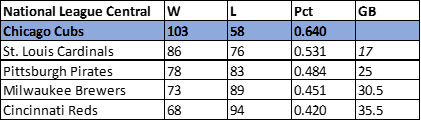
In the fifth year of the Cubs rebuild, they ascended to the top of the baseball world by winning the World Series and ending the Curse of the Billy Goat. The Cubs jumped out to a blistering 17-5 start and held first place for 180 days during the regular season. The North-siders won 103 games and won the National League Central by 17 1/2 games over the St. Louis Cardinals.
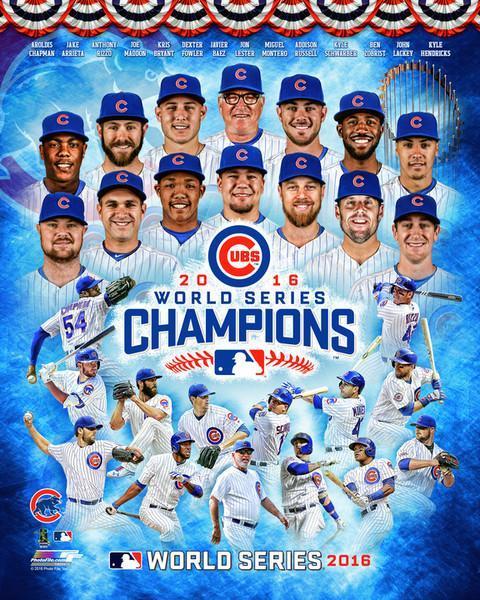
N. L. Champions
Chicago Cubs
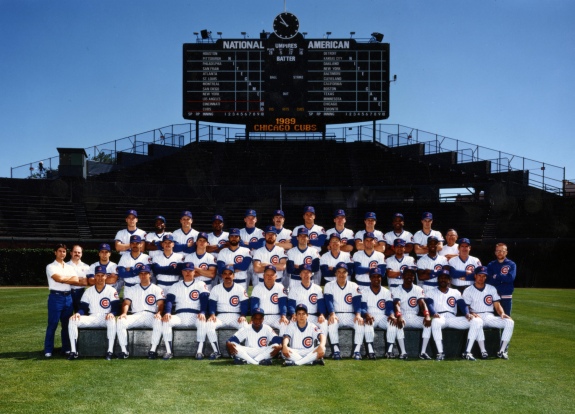
N. L. Central Division Champions
Chicago Cubs
The Cubs offense was driven by the MVP year of third baseman Kris Bryant (.292/39/102). Bryant led the National League in WAR (7.3) and runs scored (121). Bryant would take home the hardware for the National League’s Most Valuable Player and was selected as a starter at the All-Star game in San Diego.
N. L. Most Valuable Player
Kris Bryant (CHC)
Joining Bryant as starters in San Diego were teammates, Dexter Fowler (.276/13/48), Addison Russell (.238/21/95), Ben Zobrist (.272/18/76) and Anthony Rizzo (.292/32/109). Rizzo would place fourth in the MVP voting while winning a Gold Glove as well as a Silver Slugger award. Centerfielder, Jason Heyward would also receive a Gold Glove for his play in the outfield.

Jon Lester had a dominant year on the hill for the Cubs. Lester posted a 19-5 mark with a league best .792 winning percentage. Lester had an ERA of 2.44 with 197 punchouts and finished second in the Cy Young Award voting in the National League. Lester and fellow starter Jake Arrieta would be named as reserves for the All-Star Game at Petco Park. Arrieta would post an 18-8 record with a 3.10 ERA and 190 strikeouts. Arrieta led the National League in hits per 9 innings (6.3) and wild pitches (18). Kyle Hendricks rounded out the trio of starting pitching dominance by leading the league in ERA at 2.13 on the year. Hendricks went 16-8 and struck out 170 with a league best 196 ERA+.
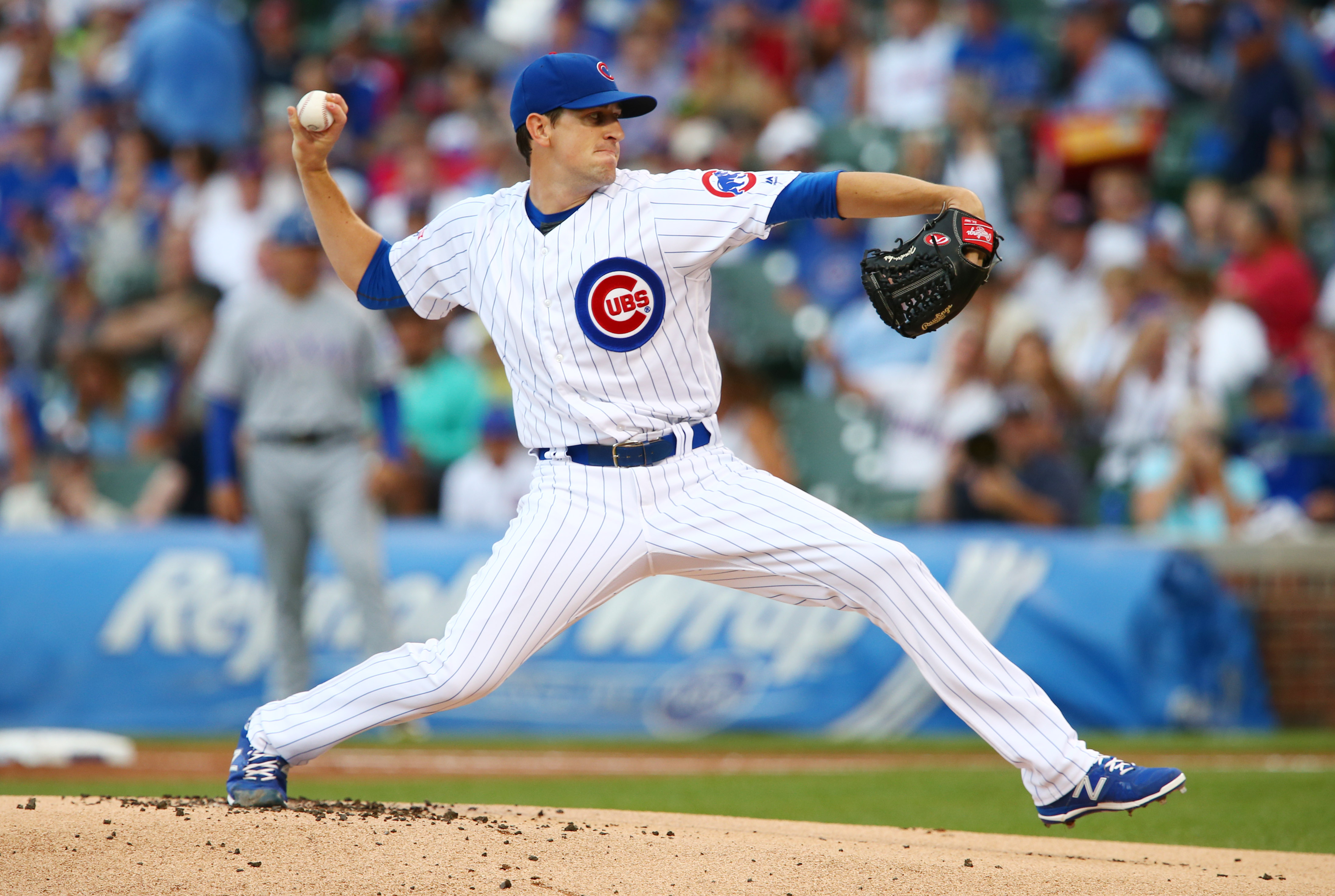
N. L. ERA Leader (2.13)
Kyle Hendricks (CHC)
The Cubs would match up against the Wild Card winning San Francisco Giants in the National League Division Series. The Cubs won the first two games at Wrigley Field and dropped game three at A.T.&T. Park in San Francisco before clinching the series in a game four win.
The Cubs opponent for the National League Championship Series was the 91-win Los Angeles Dodgers. The teams split the first two games at Wrigley Field before moving West to Los Angeles. The Dodgers took game three by 6-0 score largely due to ex-Cub Rich Hill’s performance on the mound. The Cubs prevailed in games four and five to take a 3-2 lead in games heading back to the friendly confines of Wrigley Field. In game six, Kyle Hendricks and Aroldis Chapman combined for a 2-hit shutout of the Dodgers to clinch the National League Championship for the Cubbies. The Cubs would advance to the World Series for the first time since 1945.
The Fall Classic pitted the Cubs and the American League Champion Cleveland Indians. The Tribe and the Cubs would split the first two games at Progressive Field in Cleveland. The Cubs would lose games three and four at home to go into a 3-1 series deficit. The Cubs salvaged game five in Wrigley to force the series back to Cleveland. The Cubbies would win both games in Cleveland to complete the comeback and become the first team to rally from down three games to one since the 1985 Kansas City Royals. The Cubs ended the longest World Series drought by winning their first title since 1908.
2017
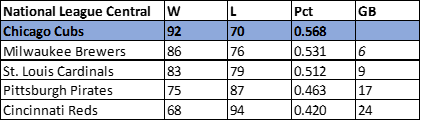
The Cubs followed up their World Series title in 2016 by winning the National League Central for a second consecutive season. The Cubs won 92 games and finished six games ahead of the second place Milwaukee Brewers. The Cubs finished June with a .500 mark but a torrid 16-8 record in July pushed the Cubs into contention. A 36-22 marl the rest of the way would propel the Cubs to the division crown.
N. L. Central Division Champions
Chicago Cubs
The Cubs pitching staff performed well led by starters Jon Lester (13/4.33/180), John Lackey (12/4.59/149), Jake Arrieta (14/3.53/163), Kyle Hendricks (7/3.03/123), Jose Quintana (7/3.74/98) and Eddie Butler (4/3.95/30). Lackey surrendered the most home runs (36) in the National League while Arrieta led the league in wild pitches (14). Closer Wade Davis saved 32 games with 79 strikeouts and a miniscule 2.30 ERA and earned a spot on the National League All-Star team.
The Cubs offense did not lack for power as 9 players hit double digit home runs. Wilson Contreras (.276/21/74), Anthony Rizzo (.273/32/109), Ben Zobrist (.232/12/50), Addison Russell (.239/12/43), Kris Bryant (.295/29/73), Kyle Schwarber (.211/30/59), Jason Heyward (.259/11/59), Javier Baez (.273/23/75) and Ian Happ (.253/24/68) all contributed to the Cubs power surge. Bryant and Rizzo received MVP votes while Happ garnered interest in the Rookie of the Year voting. Heyward would win another Gold Glove for his defensive prowess.
2018
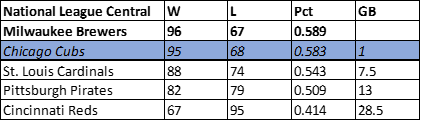
The Cubs were denied their third straight Central Division title by the Milwaukee Brewers. The teams ended the season with identical 95-67 records and played a one game playoff to determine the Central Champs. The Pirates prevailed 3-1 in the playoff game and the Cubs would be resigned to a Wild Card entry into the playoffs.
N. L. Wild Card
Chicago Cubs
Kyle Hendricks (14/3.44/161) and Jose Quintana (13/4.03/158) had solid seasons out of the starting rotation. Cole Hamels, acquired at the trade deadline from the Phillies, won 4 games in 12 starts. Yu Darvish made his first appearance in March, but struggled to a 1-3 record in eight starts. The Cubs pitching staff was led by ace Jon Lester (18/3.32/149). Lester tied for the league lead in wins (18) with Max Scherzer of the Nationals and Miles Mikolas of the Cardinals. Lester was selected for the All-Star game in Washington D.C. and would finish 9th in the Cy Young voting.
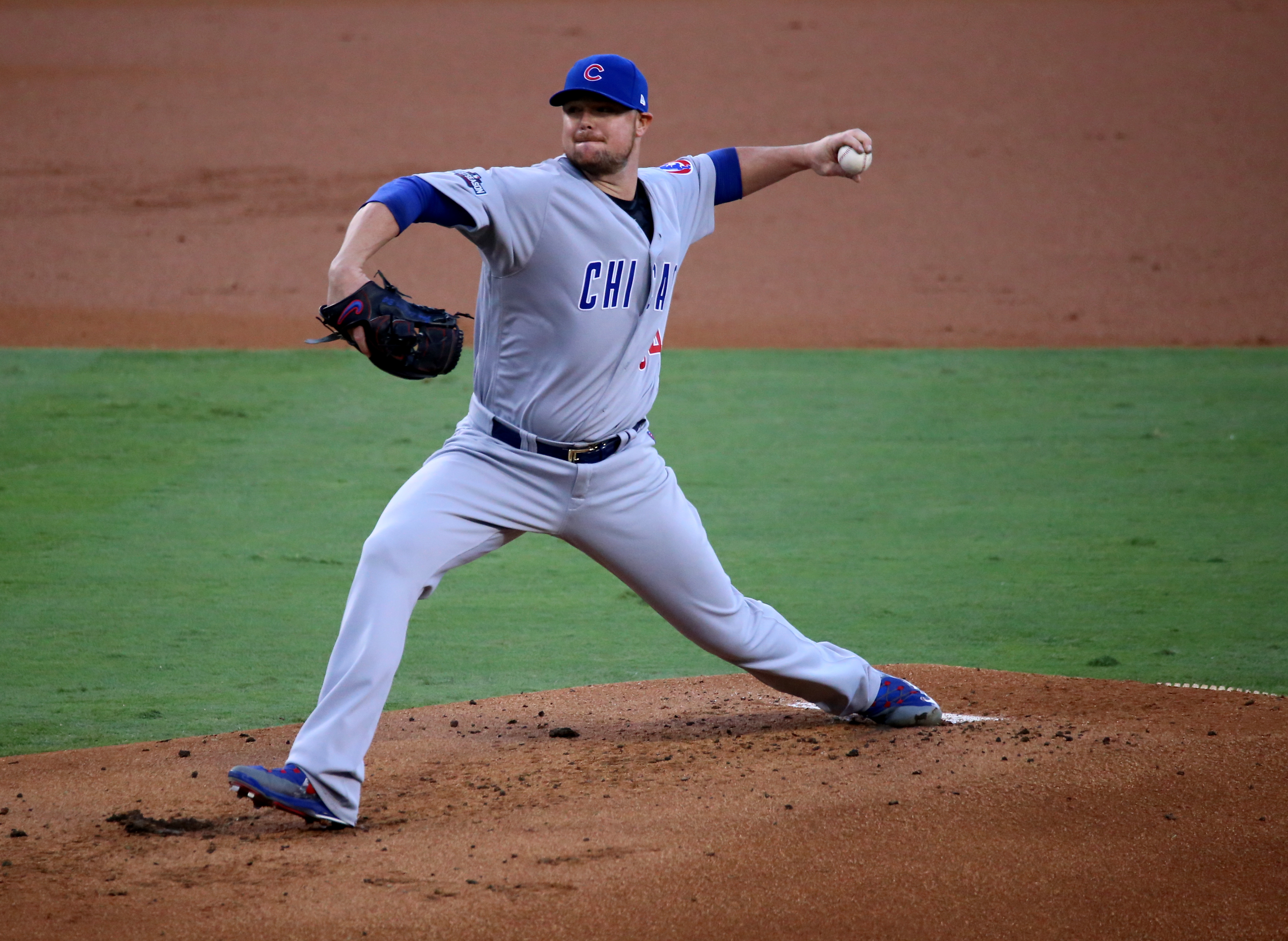
N. L. Wins Co-Leader (18)
Jon Lester (CHC)
The Cubs offense was driven by the usual cast of characters. Willson Contreras (.249/10/54) earned an All-Star start along with Javier Baez (.290/34/111). Baez would join Contreras in the festivities at Nationals Park while leading the Senior Circuit in RBIs (111).
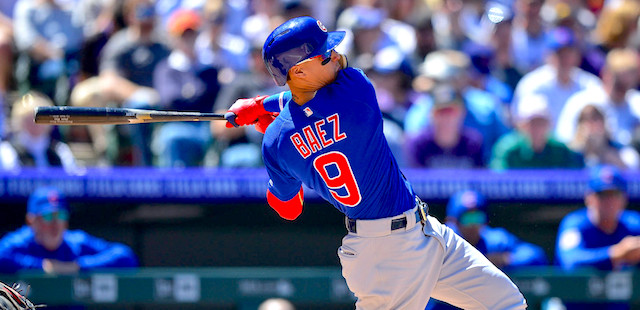
N. L. RBI Leader (111)
Javier Baez (CHC)
Anthony Rizzo (.283/25/101), Kyle Schwarber (.238/26/61), Kris Bryant (.272/13/52) and Ian Happ (.233/15/44) all contributed to the Cubs offense.
The Cubs hosted the Colorado Rockies in the Wild Card Game but dropped out of the playoffs after losing 2-1 in 13 innings. Tony Wolters plated Trevor Story with an RBI single in the 13th to seal the win for the Rockies.
2019
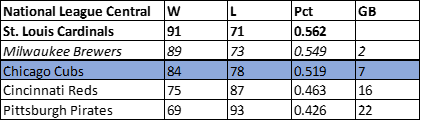
The 2019 Cubs stayed in contention for most of the season spending 77 days in first place. The Cubs faltered in late August and through September to finish 84-78 and miss the playoffs for the first time since 2014. A trio of bear cubs were selected for the All-Star game in Cleveland. Javier Baez (.281/29/85) and Willson Contreras (.272/24/64) were named as starters at shortstop and catcher. Kris Bryant (.282/31/77) was named as a reserve at third base.
Kyle Schwarber (.250/38/92) and Jason Heyward (.251/21/62) provided additional power while Anthony Rizzo (.293/27/94) secured a Gold Glove for his play at first base.
The Cubs starting five of Yu Darvish (6/3.98/229), Kyle Hendricks (11/3.46/150), Jon Lester (13/4.46/165), Jose Quintana (13/4.68/152) and Cole Hamels (7/3.81/143) started 150 games and won only 50. Closer Craig Kimbrel, who the Cubs signed in June as a free agent, saved 13 games in 23 appearances.
2020
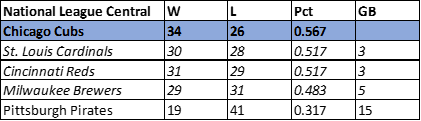
The Chicago Cubs reclaimed the Central Division crown in 2020 during the COVID-19 shortened season. The Cubs finished the season with a 34-26 mark under new Manager David Ross when Joe Maddon was not re-signed after the 2019 campaign.
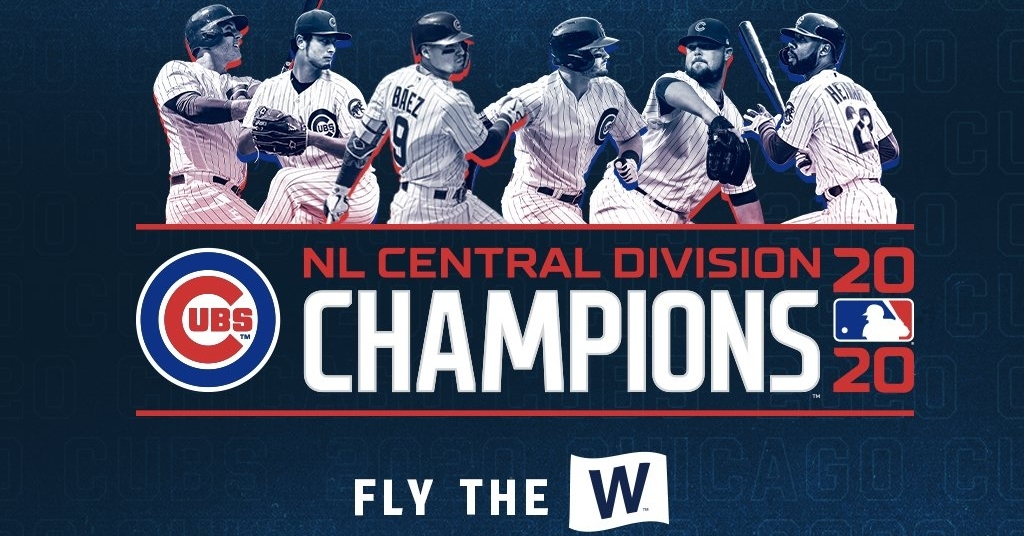
N. L. Central Division Champions
Chicago Cubs
Kyle Hendricks (6/2.88/64) and Yu Darvish (8/2.01/93) anchored the Cubs rotation. Hendricks led the National League in walks per 9 innings (0.9) and strikeout/walk ratio (8.00) and Darvish led the league in wins (8) and fielding independent pitching (2.23). Darvish finished second in the Cy Young voting and Hendricks finished ninth.
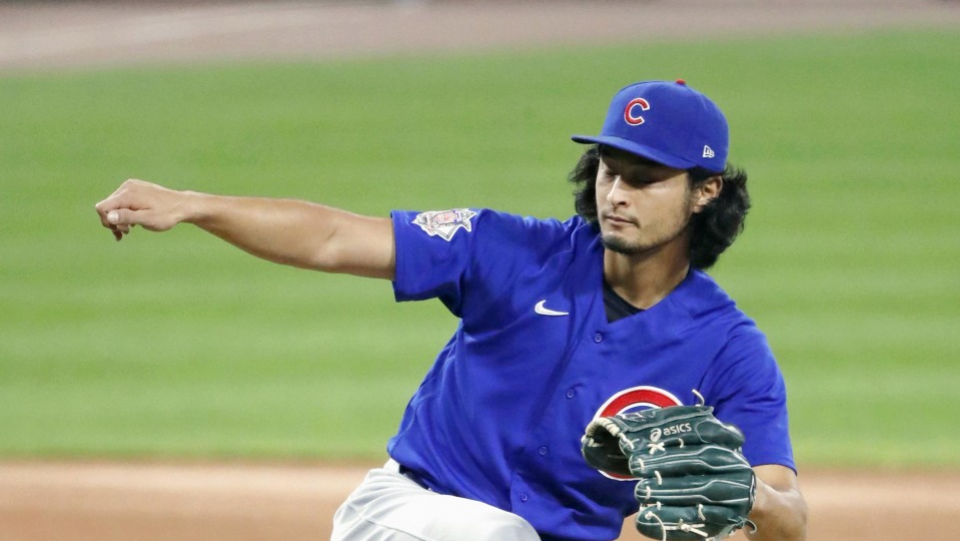
N. L. Wins Leader (8)
Yu Darvish (CHC)
Anthony Rizzo (.222/11/24), Javier Baez (.203/8/24), Kyle Schwarber (.188/11/24) and Ian Happ (.258/12/28) led a Cubs offense that average 4.4 runs per game. Happ would receive MVP votes while Rizzo and Baez would earn Gold Glove Awards.
The Cubs hosted the Miami Marlins in the Wild Card round. The Marlins took the first two games at Wrigley field 5-1 and 2-0 to sweep the Cubs from the playoffs.
2021
The Cubs got off to an 11-15 start in 2021 under second year Manager David Ross. A torrid May saw the Cubs win 19 of 27 but they finished out the year playing under .500 in every month. The aging core from the Cubs 2016 title season was beginning to show their wear. Willson Contreras (.237/21/57), Anthony Rizzo (.248/14/40), Javier Baez (.248/22/65) and Kris Bryant (.267/18/51) all performed under their career norms. Bryant would be named as an All-Star reserve for the game in Denver. Rookies Patrick Wisdom (.231/28/61) and Frank Schwindel (.342/13/40) would finish fourth and sixth on the National League Rookie of the Year voting respectively. Baez, Bryant and Rizzo were all shipped out of town at the trade deadline, gutting the title winning team.
The Cubs staff struggled to a team 4.88 ERA on the season. Kyle Hendricks (14/4.77/131) and Trevor WIlliams (4/5.06/61) were the only starters to post winning records. Hendricks would lead the league in hits allowed (200) while fellow rotation mate Zach Davies (6/5.78/114) would lead the league in walks (75). Closer Caraig Kimbrel would notch 23 saves with a 0.49 ERA to earn a spot on the N.L. All-Star team.
2022
The Cubbies started the season poorly posting a 41-60 record through the end of July. a .500 August and an 18-13 close to the season found the Cubs with 74 wins and a third-place finish in the National League Central. 2022 would also mark the first season since 2014 that the Cubs ended the year with a losing record. Willson Contreras (.243/22/55) and Patrick Wisdom (.207/25/66) would provide the clubs offensive clout with Contreras selected as a starter for the All-Star game at Dodger Stadium. Outfielders Christopher Morel (.235/16/47) and Seiya Suzuki (.262/14/46) and shortstop Nico Hoerner (.281/10/55) would swipe a combined 40 bases for the Cubbies. Ian Happ (.271/17/72) would join Contreras in Los Angeles as an All-Star reserve.

Righthander Keegan Thompson (10/3.76/108) would post a 10-5 record and was the only starter to win more decisions than lose. Rotation mates Marcus Stroman (6/3.50/119), Justin Steele (4/3.18/126), Drew Smyly (7/3.47/91), Adrian Sampson (4/3.11/73) and Kyle Hendricks (4/4.80/66) would combine to start 88 games but won only 25. David Robertson saved 14 games in 36 appearances with a 2.23 ERA.
2023
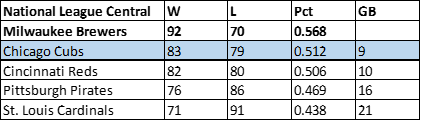
The Cubs rose above the .500 mark in Manager Davis Ross’ fourth year at the helm. The Cubs finished 83-79 but finished one game out of a Wild Card entry. Offseason free agent acquisition Cody Bellinger (.307/26/97) paid immediate dividends for the North-siders and picked up a Gold Glove for his play in center field. Ian Happ (.248/21/84), Seiya Suzuki (.285/20/74) and Christopher Morel (.247/26/70) all provided a long ball threat in the Cubs lineup. Happ would also receive a gold glove for his play in left field. The Cubs other big free agent signing, Dansby Swanson (.244/22/80), received MVP votes, a gold glove award and was selected as a reserve for the All-Star game in Seattle.


The Cubs pitching staff was led by two All-Star invitees. Justin Steele (16/3.06/176) and Marcus Stroman (10/3.95/119) both earned a trip to Safeco Field in the Pacific Northwest. Jameson Taillon (8/4.84/140), Drew Smyly (11/5.00/141) and Kyle Hendricks (6/3.74/93) rounded out the Cubs starting five. Closer Adbert Alzolay appeared in 58 games notching 22 saves with a 2.67 ERA.
2024
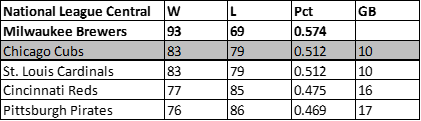
The Cubs finished the 2024 season with an 83-79 record under new Manager Craig Counsell. Counsell jumped from the Brewers to the Cubs after the Cubs relieved David Ross after four years at the helm. The Cubs had a promising start to the season by winning 18 of 30 games. The Cubs floundered through May, June and July before posting an 18-8 mark in August pulled them back into the pennant race. The Cubs managed only .500 ball for the month of September and finished 10 games behind the Milwaukee Brewers.
Jameson Taillon (12/3.27/125) and Shota Imanaga (15/2.91/174) anchored the Cubs starting rotation. Former Phillie and Astros castoff, Hector Neris, saved 17 games in 46 appearances. Imanaga was selected as the lone Cubs representative for the All-Star game in Arlington. Imanaga finished fourth in the Rookie of the Year voting and fifth in the Cy Young tabulations.
On September 4th, Imanaga along with Nate Pearson and Porter Hodge combined to no-hit the Pirates in a 12-0 Cubs victory in front of 30,369 spectators at Wrigley Field.
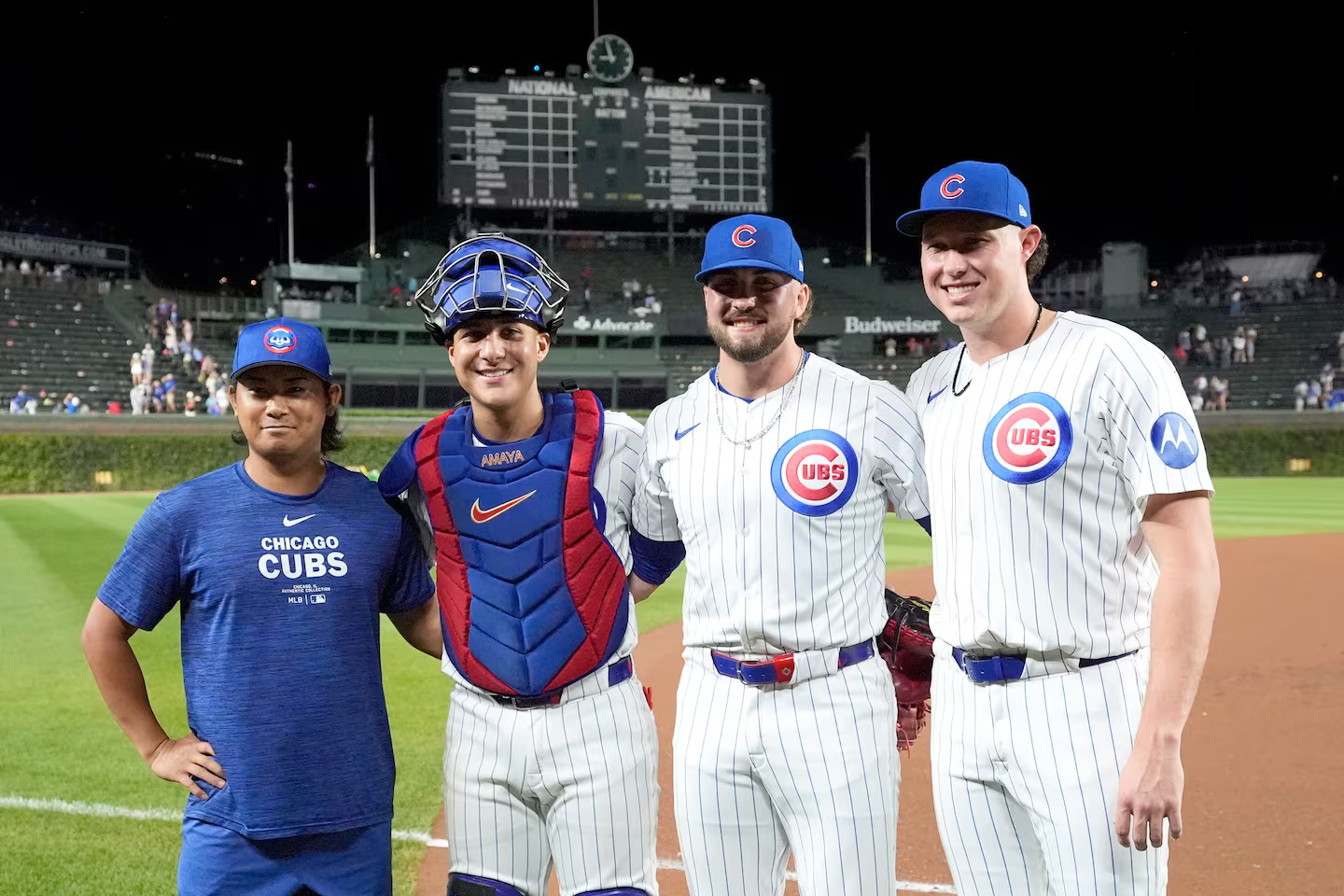
Combined No-Hitter
Shota Imanaga (7)
Nate Pearson (1)
Porter Hodge (1)
vs.
Pittsburgh Pirates (12-0)
The Cubs had seven players hit the double-digit mark in home runs in 2024. First baseman Michael Busch (.248/21/65), shortstop Dansby Swanson (.242/16/66), third baseman Christopher Morel (.199/18/51), left fielder Ian Happ (.243/25/86), center fielder Pete Crow-Armstrong (.237/10/47), right fielder Seiya Suzuki (.283/21/73) and designated hitter Cody Bellinger (.266/18/78) all exceeded the ten home run threshold. Happ would earn a gold glove award for his outfield play.
2025
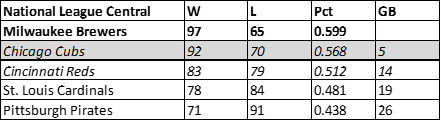
N. L. Wild Card
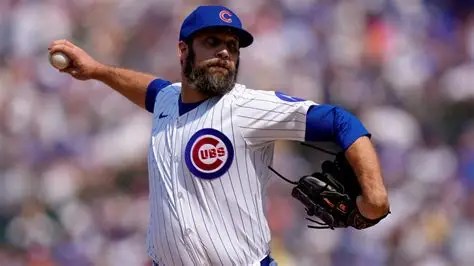
Immaculate Inning (7th)
Andrew Kittredge (CHC)
vs. Cincinnati Reds
 Curve in the Dirt.com
23-22 game individual innings add up to 22 for Phillies
That’s a picture of the scoreboard at Wrigley Field, I can’t change that
LikeLike